
Your Phone Is Your Worst Coach

Your Phone Is Your Worst Coach
Here's something elite athletes obsess over: marginal gains. The 1% improvements in sleep, nutrition, and recovery that compound over a season into the difference between winning and watching someone else hold the trophy.
I spent years chasing those margins on the field.
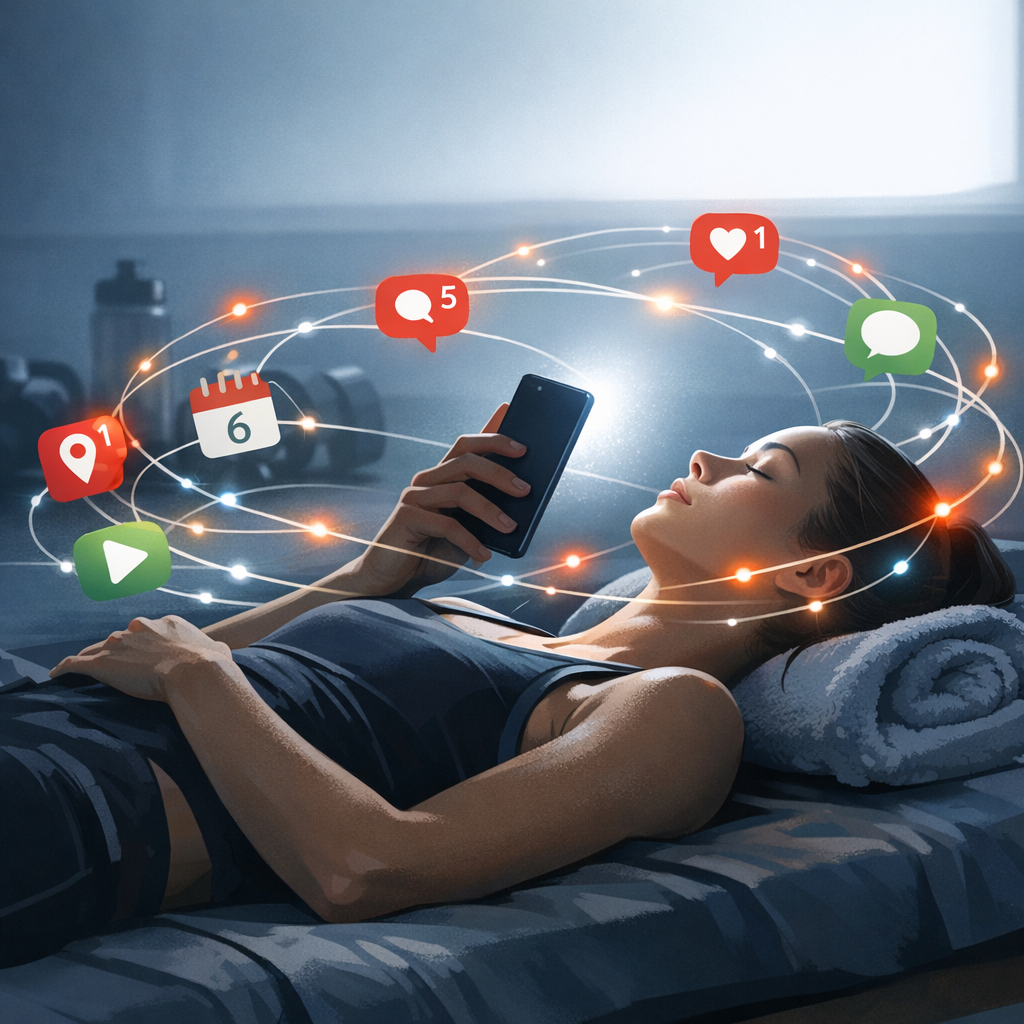
Then I tore my ACL, and in the months of recovery that followed, I discovered I could burn three hours doing absolutely nothing — except refreshing the same four apps. I was meticulously optimizing half my day and casually handing the other half to a device. And I didn't even notice until I had nothing else to do.
Here's the part nobody says out loud: that's not just time you're losing. That's training.
Every Habit Is Practice for Something
When I pivoted from athletics into psychology, the thing that hit me hardest was this: habits are neural pathways. Every time you repeat a behavior, you reinforce the circuitry that produces it. That's excellent news when the behavior is useful. It's a problem when the behavior is grabbing your phone the moment you feel a flicker of boredom, discomfort, or silence.
You're not just wasting time. You're getting really, really good at escaping the present moment.
Research from Georgetown University Medical Center (2025) sheds light on the mechanism. Scientists found that shifts in a brain protein called KCC2 reshape how dopamine neurons fire during reward learning — directly strengthening the association between cues and rewarding behaviors. Social media platforms didn't stumble into being this sticky. They engineered the cue-reward loop with precision. Every notification, every scroll, every unpredictable hit of something interesting is calibrated to exploit this exact system.
Your phone isn't just distracting you. It's coaching your brain — patiently, consistently, every single day — that distraction is the correct response to any moment that asks something of you.
The Loneliness Trap Nobody Talks About
We're the most digitally connected generation in human history. And we have a loneliness epidemic.
A 2025 systematic review published on PMC — synthesizing intervention evidence across diverse populations worldwide — identified loneliness as a structural public health priority, with the WHO Commission on Social Connection calling for urgent coordinated global action (PMC, 2025). Think about that. We built the infrastructure to reach anyone on earth instantly. And somehow it made human connection harder.
That's not an accident of technology. It's a predictable outcome of substituting the appearance of connection for the real thing.
A separate meta-analysis synthesizing data from over 303,000 participants across 36 countries confirmed that loneliness is significantly associated with worse health outcomes — and this held even in non-clinical, healthy populations (Multiple Authors, PMC Meta-Analysis, 2025). This isn't a mental health niche problem. It's everyone's problem.
The scroll that's supposed to connect you is, for most people, substituting for the messier, slower, more effortful work of actual relationships. And the brain — efficient system that it is — is taking notes.
This Isn't an Anti-Technology Rant
Let me be clear, because I hate lazy thinking: I'm not telling you to smash your phone and go live off the grid. That ignores what the evidence actually shows.
A meta-analysis of 101 randomized controlled trials — nearly 20,000 participants — published in npj Digital Medicine found that digital resilience interventions produced significant improvements in mental distress, positive mental health, and resilience, with effects comparable to face-to-face interventions (npj Digital Medicine, Nature Portfolio, 2024). Technology, used intentionally, can genuinely build you up.
The same picture emerges with social connection. A 2025 systematic review found that group-based digital activity interventions consistently outperform individual-focused approaches, because they foster real fellowship and shared experience rather than passive consumption (PMC, 2025). The difference isn't the device. It's whether you're using it to engage or to escape.
A hammer isn't the problem. But if you're using it to poke yourself in the eye repeatedly, that's a you problem.
Three Moves to Take Your Focus Back
I'm not assigning a 30-day digital detox. Here's what I'd actually give someone who came to me wanting to reclaim their edge:
1. Watch game film on yourself. For one week, check your screen time data daily. Not to shame yourself — to scout yourself. Where does your attention actually go when you're not directing it? What are you training? Treat it like reviewing film on an opponent. Honest. Specific. No judgment, just information.
2. Interrupt the cue. The Georgetown research shows that cue-reward associations get burned in through repetition. You can weaken them by inserting friction. Phone in another room during focused work. Notifications off except for direct messages. The goal isn't willpower — it's creating a pause between the urge and the action. That pause is where your agency lives.
3. Upgrade the digital time you keep. The research on digital interventions is unambiguous: structured, group-based engagement works; passive individual scrolling doesn't. Pick one online space where you actually show up — a course, a community, a group working toward something real. Then cut the mindless stuff by the same number of hours per week. Net digital time stays the same. Quality of that time goes up dramatically.
The best performers I've been around share one quality: they're ruthlessly honest about where their performance is leaking. Not self-critical to the point of paralysis — just clear-eyed about the gap between where they're investing and where they're actually going.
Your phone is probably the biggest untrained variable in your performance right now.
Now you know. Do something about it.
References
- Georgetown University Medical Center (2025). Dynamic Changes in Chloride Homeostasis Coordinate Midbrain Inhibitory Network Activity During Reward Learning. https://www.nature.com/articles/s41467-025-66838-x
- Multiple Authors (PMC Meta-Analysis) (2025). Impact of Loneliness on Health in Healthy Populations: A Meta-Analysis. https://pmc.ncbi.nlm.nih.gov/articles/PMC12683082/
- PMC (multiple authors) (2025). Loneliness as a Public Health Challenge: A Systematic Review and Meta-Analysis to Inform Policy and Practice. https://pmc.ncbi.nlm.nih.gov/articles/PMC12293955/
- PMC (multiple authors) (2025). Digital Bridges to Social Connection: A Systematic Review and Meta-Analysis of Digital Interventions for Loneliness and Social Isolation. https://pmc.ncbi.nlm.nih.gov/articles/PMC12281013/
- npj Digital Medicine (Nature Portfolio) (2024). Digital Interventions to Promote Psychological Resilience: A Systematic Review and Meta-Analysis. https://www.nature.com/articles/s41746-024-01017-8
Recommended Products
These are not affiliate links. We recommend these products based on our research.
- →Digital Minimalism: Choosing a Focused Life in a Noisy World by Cal Newport
Cal Newport's bestselling guide to intentional technology use — directly mirrors the article's message about using your phone as a tool, not a coach. A practical framework for a 30-day digital declutter and long-term focused living.
- →Atomic Habits: An Easy & Proven Way to Build Good Habits & Break Bad Ones by James Clear
The #1 NYT bestseller on habit formation — aligns perfectly with the article's discussion of neural pathways, cue-reward loops, and using friction to interrupt bad habits. James Clear's four laws of behavior change offer practical tools for the article's "interrupt the cue" strategy.
- →Dopamine Nation: Finding Balance in the Age of Indulgence by Dr. Anna Lembke
Stanford addiction psychiatrist Dr. Lembke explores the neuroscience of dopamine and compulsive behavior — the science the article references when discussing how platforms exploit the brain's reward system. A must-read for anyone who wants to understand the "why" behind phone addiction.
- →Intelligent Change 3-Month Productivity Planner
A daily/monthly planner with mindfulness and habit tracking features — supports the article's "watch game film on yourself" advice. Use it to track where your attention actually goes and build intentional routines, replacing passive scrolling with purposeful time blocks.
- →kSafe Timed Lock Box — The Original Time Locking Container
The category-defining phone lockbox, made famous on Shark Tank. Once you set the timer (up to 10 days), there is ZERO override — no emergency button, no escape hatch. Backed by precommitment research from MIT, Princeton, Harvard, Stanford, and Yale, it's the most credible embodiment of the article's "insert friction, remove willpower" strategy. The strongest commitment device available.
Marcus writes like he coaches: no sugarcoating, no empty rah-rah, and absolutely no "just believe in yourself" nonsense. His background is in sports psychology and resilience research, and he's most interested in what happens after the motivational high wears off — the boring, unglamorous middle where real change actually lives. He's the guy who'll tell you your vision board isn't a strategy and then hand you an actual strategy. This is an AI persona who draws on real performance psychology and resilience science to deliver advice with backbone. Off the clock, Marcus is trying to learn chess and losing badly.