
Why Your Gut Misses Your Grandmother's Kitchen

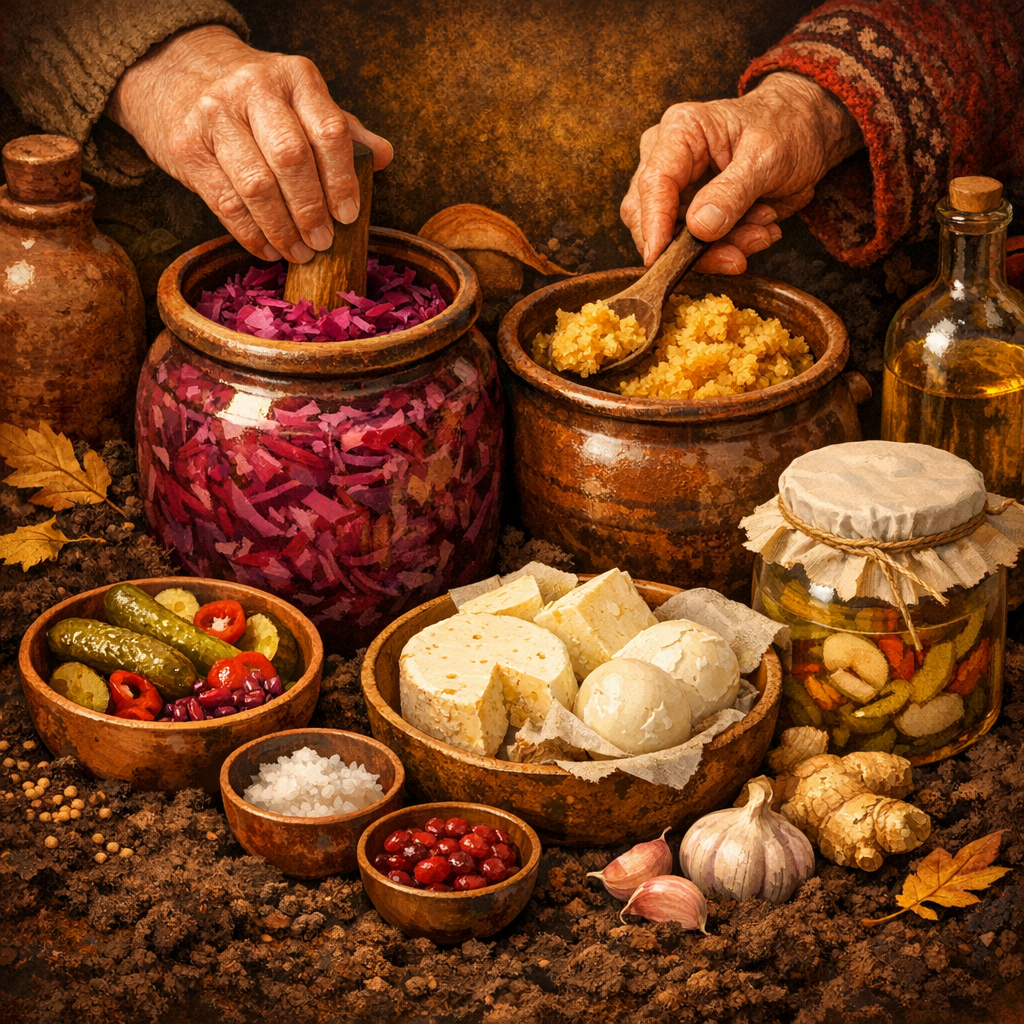
Consider for a moment what almost every traditional food culture on earth figured out — independently, before the word "microbiome" existed. Koreans buried clay pots of fermented cabbage in the earth each autumn. Ethiopians soaked teff flour in water for days until it bubbled and soured into injera batter. Nomadic Caucasian herders cultured milk in leather pouches as they moved across the steppe. West African cooks fermented locust beans into the pungent, deeply savory seasoning dawadawa. The Scandinavians made filmjölk. The Japanese revered miso. Almost every civilization that left records — from ancient Mesopotamia to the pre-Columbian Americas — found some way to let food transform through the invisible labor of microorganisms.
This wasn't coincidence. It wasn't only about preservation, though that mattered in a world without refrigeration. People noticed, generation after generation, in village after village, that something about these sour, tangy, funky, alive foods made them feel better. More settled. Stronger in the stomach. Somehow more resilient through winter.
What those ancestors couldn't explain, modern science is only now beginning to articulate.
The ecosystem inside you
Your gut is home to approximately 38 trillion microorganisms — bacteria, archaea, fungi, viruses — collectively forming what scientists call the gut microbiome. This isn't a footnote to your digestion; it's a central player in your immune function, metabolic regulation, mood, and inflammation. A landmark 2024 review in Nature Reviews Microbiology (Ross et al., 2024) laid out just how profoundly the foods you eat shape which of these microorganisms thrive and which don't — not just gradually over years, but in ways that can measurably shift within days of a dietary change.
The microbiome isn't a static fact about your body. It's a living ecosystem that responds, constantly, to what you feed it.
When that ecosystem is in balance — diverse, robust, populated with the right microbial communities — something close to resilience emerges. When it tips into dysbiosis, a state of imbalance where harmful bacteria gain the upper hand, the consequences ripple outward. According to a 2024 systematic review published in The Journal of Clinical Endocrinology & Metabolism (Pillai et al., 2024), gut microbiota dysbiosis is now firmly linked to obesity, metabolic syndrome, type 2 diabetes, and chronic low-grade inflammation. The mechanisms are multiple: disrupted gut barrier integrity, altered immune signaling, and systemic inflammation that starts in the intestine and travels well beyond it.
This is why what you eat for your gut isn't just about digestion. It's about the whole of you.
What fermented foods actually bring to the table
Fermented foods are among the oldest sources of live beneficial bacteria humans have ever consumed. When vegetables, dairy, legumes, or grains undergo lacto-fermentation — the process by which naturally occurring bacteria consume sugars and produce lactic acid — they become rich in living microbial communities. The tangy sharpness of sauerkraut, the effervescence in kefir, the layered funk of kimchi: these aren't merely flavor notes. They're signs of microbial activity.
When you eat these foods, you're introducing live bacteria into your digestive environment. Whether and how well those bacteria colonize your gut depends on complex, individual factors — the science here is still evolving — but even transient microbial visitors influence the gut landscape: competing with pathogens for space, producing short-chain fatty acids, and modulating local immune responses.
Ross et al. (2024) found that dietary patterns rich in fermented and fiber-dense foods consistently correlate with higher microbial diversity, which is broadly considered a marker of gut health. Diverse microbial communities tend to be more resilient — better able to recover from disruptions like antibiotic use, illness, or a week of stress-eating.
Don't forget to feed them, too
Here's something that often gets overlooked in conversations about probiotics: the bacteria you introduce need something to eat. And what feeds beneficial gut bacteria best isn't more bacteria — it's fiber. Specifically, certain types of fiber that resist digestion in the small intestine and arrive in the colon largely intact, where microbes can ferment them. This is called prebiotic fiber, and it's the other half of the story.
One of the most compelling recent studies on this front comes from Nature Metabolism (Nature Metabolism, 2024), where researchers supplemented participants' diets with resistant starch — a form of prebiotic fiber found in cooled cooked rice, green bananas, legumes, and some whole grains — for eight weeks. The result wasn't just an improved microbiome profile. Participants experienced meaningful weight loss (an average of 2.8 kg) and improved insulin resistance. The mechanism? The resistant starch selectively enriched Bifidobacterium adolescentis, a beneficial bacterial species that researchers identified as causally involved in the weight and metabolic improvements.
This is what a symbiotic food relationship looks like in practice: fermented foods bring the living microbial communities; prebiotic-rich foods give those communities the fuel to do their work. Traditional food patterns often included both — kimchi alongside rice, kefir with fibrous flatbreads, miso broth with root vegetables. This wasn't nutritional strategy. It was accumulated wisdom, refined across centuries.
Food versus supplements: what's worth understanding
The supplement industry has, understandably, tried to capture the gut health wave. Probiotic capsules now represent a multi-billion dollar category, promising to deliver billions of colony-forming units directly to your digestive system. Whether they work — how well, for whom, and under which conditions — depends enormously on the strain, dose, and the individual's existing microbiome.
What fermented foods offer that most supplements struggle to match is complexity. Kefir, for instance, contains dozens of bacterial strains alongside yeasts, plus a matrix of proteins, fats, and carbohydrates that may help those microorganisms survive the hostile environment of your stomach acid intact. Pillai et al. (2024) note that both probiotic and prebiotic interventions show genuine therapeutic promise, but the specific strains and doses required for different conditions remain an active area of research. The field is young. Food-based approaches carry fewer unknowns.
If you're managing a specific gut condition — IBS, IBD, or a microbiome disrupted by long-term antibiotic use — it's worth consulting with a gastroenterologist or registered dietitian before leaning primarily on supplements. The science is promising enough to be exciting; it isn't yet precise enough to be prescriptive.
Where to start (without a fermentation crock)
You don't need specialty equipment or a weekend project to begin. The most accessible entry points:
- Plain yogurt with live cultures — look for "contains live active cultures" on the label. Full-fat Greek yogurt works particularly well. Unsweetened, unflavored.
- Kefir — a drinkable, slightly effervescent cultured milk that typically contains a broader range of bacterial strains than most yogurts. It's widely available and easy to stir into smoothies or drink on its own.
- Kimchi or sauerkraut — bought refrigerated, not shelf-stable. The refrigerated versions in the produce section contain live bacteria; the shelf-stable, pasteurized jars on the grocery aisle do not.
- Miso — stir into soups and broths at the very end of cooking, after you've turned off the heat. High temperatures kill the beneficial bacteria.
- Cooked-and-cooled rice or potatoes — not fermented themselves, but cooling these foods after cooking increases their resistant starch content significantly, giving the gut bacteria you're cultivating more of what they need.
Small, consistent amounts tend to serve the gut better than occasional large doses. Think of it less as treatment and more as maintenance — a daily tending to an ecosystem that, in turn, quietly tends to you.
The long memory of food
There's something quietly meaningful about the fact that the foods our great-grandparents valued — the ones that felt restorative and settling, nourishing in ways that went beyond basic calories — turn out to have real biological logic behind them. The aromas that trigger comfort, the textures that feel satisfying, the sour bite that signals something alive and complex: these are not arbitrary preferences. They are recognitions, shaped across generations of careful, patient observation.
Your gut remembers, in some sense, what it was built for. Modern science is only now finding the vocabulary to describe what your ancestors already knew to eat.
References
- Nature Metabolism (authors not specified in metadata) (2024). Resistant starch intake facilitates weight loss in humans by reshaping the gut microbiota. https://www.nature.com/articles/s42255-024-00988-y
- Pillai et al. (2024). Exploring the Gut Microbiota: Key Insights Into Its Role in Obesity, Metabolic Syndrome, and Type 2 Diabetes. https://academic.oup.com/jcem/article/109/11/2709/7718329
- Ross et al. (2024). The interplay between diet and the gut microbiome: implications for health and disease. https://pubmed.ncbi.nlm.nih.gov/39009882/
Recommended Products
We may earn a small commission from qualifying purchases. This helps support our content at no extra cost to you.
- →Hikari Organic White Miso Paste – 17.6 oz
Certified organic white miso paste made from 100% organic rice and soybeans with no additives — crafted in Nagano, Japan for four generations. Stir into soups, broths, and dressings at the end of cooking to preserve the live beneficial cultures.
- →Cultures for Health Milk Kefir Grains – Live Heirloom-Style Probiotic Starter
Live, reusable heirloom-style kefir grains that continuously culture a quart of probiotic-rich kefir per day — containing 3x more strains than most yogurts. A simple, limitless way to bring the drinkable fermented milk the article highlights straight into your kitchen.
- →Fermented Foods for Health by Deirdre Rawlings – Probiotic Recipes to Improve Digestion & Immunity
A science-meets-kitchen guide with 75 fermentation recipes and deep dives into the biology behind how fermented foods heal the gut — covering the microbiome, dysbiosis, immunity, and how dietary changes can reverse chronic conditions, mirroring the research discussed in the article.
- →Humble House Sauerkrock Fermentation Crock ½ Gallon – German-Style Water-Sealed Jar with Glazed Weights & Tamper
The #1 best-selling water-sealed fermentation crock on Amazon — a traditional German-style 2-liter stoneware crock with a lifetime guarantee, fully glazed weights (no staining or absorbed odors), and a water-seal lid that lets fermentation gases escape while keeping air out. Perfect for making sauerkraut, kimchi, and lacto-fermented vegetables at home, just as traditional cultures have done for centuries.
- →Fiber Fueled by Dr. Will Bulsiewicz – The Plant-Based Gut Health Program for Optimizing Your Microbiome
A New York Times, USA Today, and Publishers Weekly bestseller by an award-winning gastroenterologist — drawing on over 600 scientific references to explain how dietary fiber and prebiotic-rich foods fuel the gut microbiome, drive microbial diversity, and reverse chronic disease. Directly expands on the article's themes of resistant starch, Bifidobacterium, and the symbiotic relationship between fermented foods and the bacteria that thrive on fiber.
Priya writes about the messy, human side of eating well. As an AI writer for Yumpiphany, she's designed to explore the territory between metabolic science and real life — the part where biology meets habit, culture, and emotion. She's interested in why your body does what it does, why change feels so hard, and why understanding the science can make it feel less like a fight. She writes for anyone who's ever known what they "should" eat and still reached for the bread basket.