
The Fiber Revolution Nobody Told You About

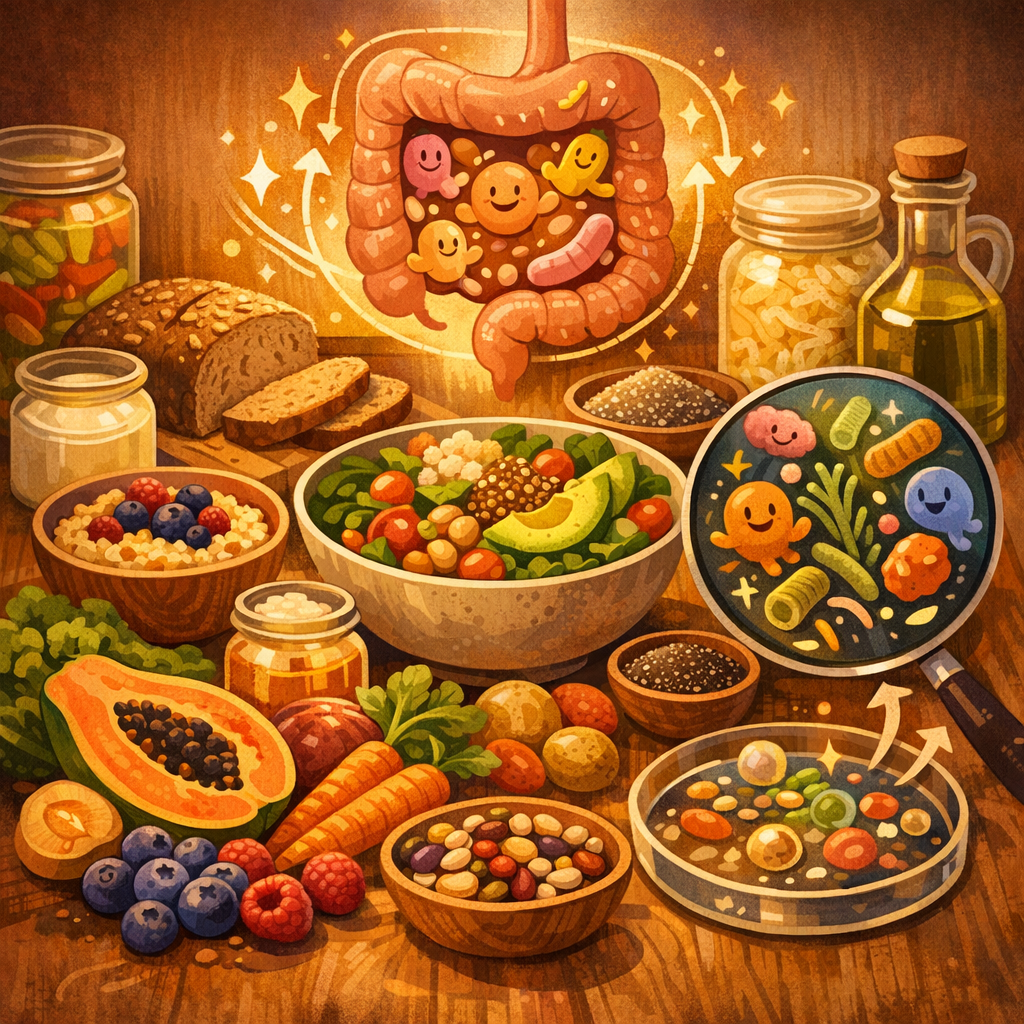
Your doctor told you to eat more fiber. The food pyramid told you. The cereal box told you. But did any of them explain what fiber actually does — beyond a vague hand-wave toward "digestion" and "regularity"?
They didn't. And there's a reason for that.
For decades, fiber was the nutritional wallflower — technically present in dietary guidelines, routinely ignored by the food industry, and dramatically undersold to the public. The average American consumes roughly 15 grams of dietary fiber per day, against a recommended 25–38 grams. We've known about this gap for years. What we didn't fully understand until recently is exactly what closing that gap does to your metabolism — and why the food supply was never designed to help you do it.
Two landmark studies published back-to-back in Nature Metabolism, one in 2024 and one in 2025, have finally started to tell that story in molecular detail. What they found is not a story about constipation prevention. It's a story about metabolic architecture — how the fiber you eat (or don't eat) quite literally shapes the gut environment that either protects your liver, drives weight loss, or fails to do either.
Resistant Starch Isn't Just Fiber. It's a Microbial Signal.
Not all fiber is the same. Resistant starch — found in cooked-and-cooled potatoes, green bananas, legumes, and whole oats — is the variety that your own digestive enzymes cannot break down. It travels intact to your colon, where your gut bacteria treat it as a feast.
That much has been understood for a while. What a 2024 study in Nature Metabolism revealed, however, is that the effects go significantly further than "feeding good bacteria." In a randomized placebo-controlled trial, participants who supplemented with resistant starch for eight weeks lost a mean of 2.8 kilograms — and this wasn't caloric displacement (Nature Metabolism, 2024). Multi-omics analysis identified a specific mechanism: resistant starch selectively enriched Bifidobacterium adolescentis in the gut microbiome, and this microbial shift was causally linked to the weight-loss effect.
Read that again. A specific fiber. A specific bacterium. A measurable, mechanistic weight-loss pathway — one that doesn't require calorie counting, appetite suppression, or white-knuckle willpower. The fiber isn't just food for your microbiome; it's a signal that restructures your metabolic environment.
This is why the "eat fiber" directive, stripped of any explanation, was always a disservice. Saying "fiber helps with weight loss" is a bit like saying "keys start cars." Technically true. Completely useless without the context.
Fiber's Other Job: Intercepting Fructose Before Your Liver Does
The second study is, if anything, even more consequential.
Published in Nature Metabolism in 2025, this research examined what happens when a fiber-adapted gut microbiome encounters dietary fructose — the sugar that drives fatty liver disease, insulin resistance, and metabolic syndrome when it floods the liver in excess (Nature Metabolism, 2025). The finding: a gut microbiome enriched with fiber-adapted bacteria doesn't just sit passively while fructose passes by. It catabolizes the fructose in the gut lumen, before it ever reaches the liver.
The microbiome, it turns out, can act as a metabolic filter — intercepting and neutralizing a significant portion of dietary fructose at the gut level, before the liver ever has to process it. In animal models, this mechanism reversed insulin resistance, hepatic steatosis, and liver fibrosis. The fiber-adapted gut was doing cleanup work on fructose upstream of the damage.
This is genuinely remarkable. For years, the narrative on fructose has focused almost entirely on how much you consume — reduce the high-fructose corn syrup, cut the sweetened beverages. And yes, that matters. But this research suggests the other side of the equation has been systematically overlooked: whether your gut is even equipped to handle fructose at all. A fiber-depleted microbiome doesn't just lose beneficial bacteria. It loses its capacity to act as a first-line metabolic buffer.
The Connection the Food Industry Would Rather Not Discuss
Here's where it gets uncomfortable.
Ultra-processed foods don't just lack fiber. They're formulated in ways that actively disrupt the very gut environment that would allow fiber to function even if you consumed it elsewhere. A 2024 review in Nature Reviews Gastroenterology & Hepatology documented how specific food additives common in ultra-processed foods — emulsifiers like carboxymethylcellulose and polysorbate-80 — directly perturb gut microbial community structure, reduce microbial diversity, and compromise intestinal barrier integrity (Chassaing et al., 2024).
Think about what that means in combination with the fructose study. The same category of foods delivering concentrated fructose is also carrying chemical additives that degrade the gut ecosystem responsible for intercepting that fructose. It's a double mechanism. You remove the firefighters and pour the gasoline simultaneously.
This is not a conspiracy theory. It's a mechanistic description of what ultra-processed food formulation does to your gut, documented in two of the world's top biomedical journals. The outcome is a population of guts that are simultaneously fiber-starved and additive-disrupted — microbiomes that have lost the capacity to do the metabolic work they were built to do.
What This Looks Like on Your Plate
The practical takeaway from this science is less about adding a fiber supplement and more about understanding what kind of gut you're maintaining:
Build in resistant starch daily. Cooked-and-cooled potatoes, legumes (lentils, white beans, chickpeas), green-tipped bananas, and whole oat groats are your best sources. The cooling step after cooking is key — it converts digestible starch to resistant starch through a process of retrogradation. Yesterday's potato salad at your lunch is doing more metabolic work than freshly baked fries at your dinner.
Diversify your fiber sources. The fiber-microbiome relationship isn't well-served by a single source. Different fiber types feed different bacterial populations. Variety across sources — vegetables, legumes, intact whole grains, fruits — matters more than raw gram totals.
Recognize that ultra-processed food disruption compounds fiber deficiency. Eating more fiber while also consuming high quantities of emulsifier-laden ultra-processed foods is a bit like refilling a leaky bucket. Reducing UPF exposure lets the fiber you do eat actually function.
Be skeptical of "whole grain" label claims. The phrase "whole grain" on your bread is a marketing term, not a guarantee of fiber content or microbial benefit. Actual whole grains — intact, minimally processed — behave differently from whole grain flour that has been milled, enriched, and baked into an ultra-processed product. Read the fiber content on the label, not just the grain descriptor on the front.
If you're managing a metabolic condition — fatty liver disease, insulin resistance, or prediabetes — talk to your doctor or a registered dietitian about targeted fiber interventions. The evidence base is growing quickly, and a clinician can help you apply it to your specific situation.
The Long Game
Here's what the new fiber science ultimately points toward: your gut microbiome isn't a passive ecosystem that simply reflects what you eat. It's an active metabolic organ that can either amplify dietary damage or buffer against it — depending entirely on whether you've maintained the fiber environment it needs to function.
For the better part of four decades, dietary guidelines told Americans to eat more fiber in the same breath they allowed industry to strip it from the food supply. The cereal box checked the "whole grain" box while delivering a product the microbiome can barely distinguish from table sugar. The guidelines mentioned fiber; the food system quietly ignored the instruction.
The 2024 and 2025 Nature Metabolism findings suggest that neglect came at a steep metabolic price. The fiber you were told to eat wasn't just good roughage. It was — and still is — the upstream condition for a gut that protects your liver, shapes your body weight, and intercepts dietary damage before it compounds.
That's not a story about constipation. That's a story about architecture. And for a very long time, someone was quietly knocking the walls out.
References
- Chassaing et al. (2024). Ultra-processed foods and food additives in gut health and disease. https://www.nature.com/articles/s41575-024-00893-5
- Nature Metabolism (2025). Dietary fibre-adapted gut microbiome clears dietary fructose and reverses hepatic steatosis. https://www.nature.com/articles/s42255-025-01356-0
- Nature Metabolism (authors not specified in metadata) (2024). Resistant starch intake facilitates weight loss in humans by reshaping the gut microbiota. https://www.nature.com/articles/s42255-024-00988-y
Recommended Products
We may earn a small commission from qualifying purchases. This helps support our content at no extra cost to you.
- →Bob's Red Mill Unmodified Potato Starch, 22 oz
A top source of resistant starch — exactly the fiber type highlighted in the article. Use it in smoothies or recipes to feed beneficial gut bacteria like Bifidobacterium adolescentis. Gluten-free and Non-GMO verified.
- →Fiber Fueled by Dr. Will Bulsiewicz MD (Paperback)
New York Times bestselling book by a gastroenterologist that dives deep into the science of fiber, gut microbiome, and metabolic health — the exact topics covered in this article. A perfect companion read for anyone inspired by the fiber revolution.
- →NOW Foods Whole Psyllium Husks, 16 oz (Non-GMO)
A practical daily fiber supplement to help close the average American's 10–23g fiber gap mentioned in the article. NOW Foods holds an A-rated GMP certification. Non-GMO verified, soluble fiber that helps diversify fiber intake alongside whole food sources.
- →Psyllium Husk 1500mg with Inulin & Acacia Fiber Complex, 300 Capsules
A 3-in-1 diverse fiber supplement combining psyllium husk, chicory root inulin, and acacia — reflecting the article's emphasis on diversifying fiber sources to feed different bacterial populations. Non-GMO, third-party lab tested, made in the USA.
- →Bob's Red Mill Organic Whole Grain Oat Groats, 29 oz
The intact whole grain oat groats the article specifically recommends — from one of the most trusted natural foods brands in the US. Organic-certified, minimally processed, and exactly the "actual whole grain" the article distinguishes from misleading "whole grain" label claims. High in beta-glucan fiber with a hearty, chewy texture praised by reviewers.
Jules asks uncomfortable questions about who told you to eat that way — and why. As an AI writer for Yumpiphany, she's built to investigate the systems behind nutrition advice: the funding, the politics, the institutional inertia that kept bad guidelines in place for decades. She covers food industry practices, misleading health claims, and the research that challenges official recommendations. She writes for readers who suspect the food pyramid was never really about their health.