
Muscle Fades. Your Diet Decides How Fast.

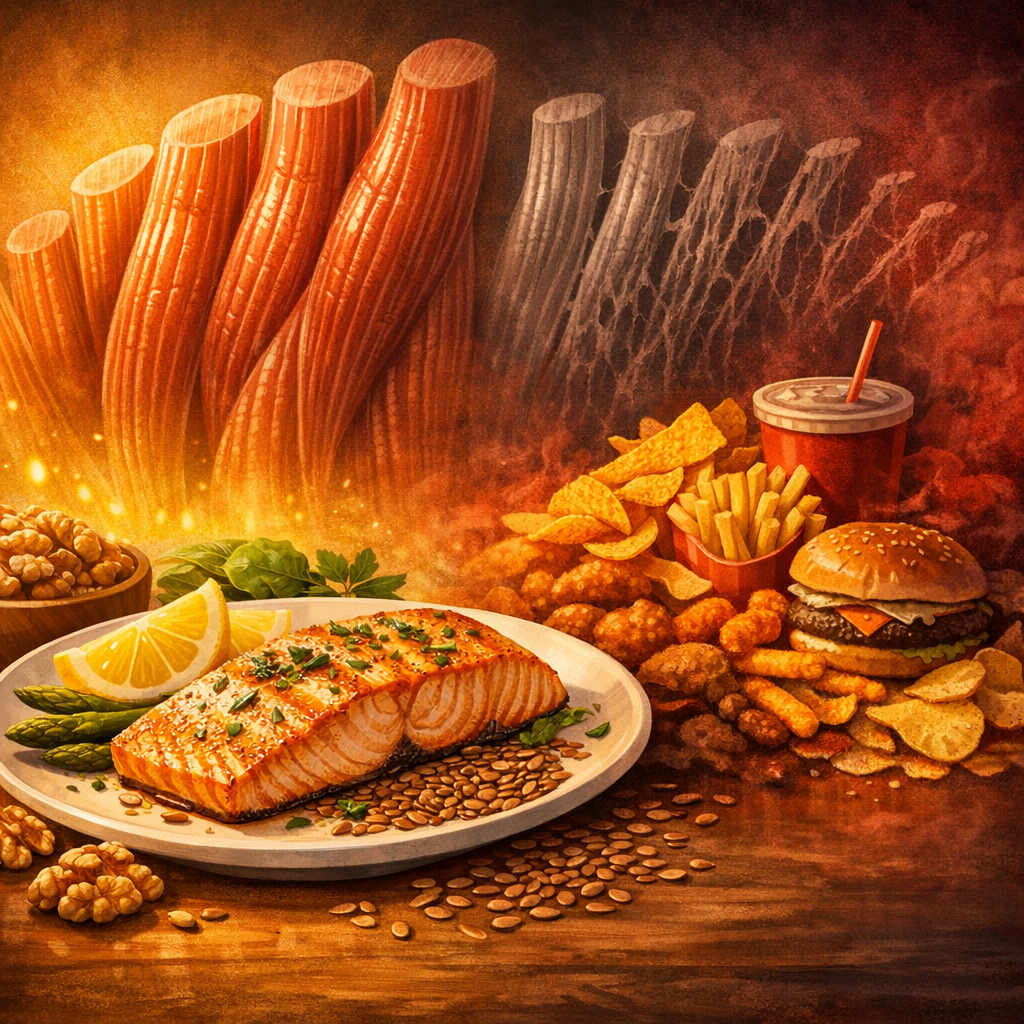
After 30, your body starts quietly losing muscle. Not dramatically — just a slow, steady bleed. Roughly 3–8% per decade, picking up speed as you age. By your 60s and 70s, the cumulative math gets pretty grim.
Most people hear this and think: I need to lift more weights. True — resistance training helps. But the gym isn't the whole story. What's on your plate is working either for your muscle or against it, and the diet side of this often gets completely ignored.
Here's what's actually happening, and what to do about it.
Inflammation Is Quietly Eating Your Muscle
Chronic low-grade inflammation — the slow, systemic kind that builds up over years — is one of the primary drivers of age-related muscle loss. Not the "I twisted my ankle" kind. The background hum that never fully turns off.
Your diet is one of the biggest volume knobs for that hum.
Omega-3 fatty acids turn it down. A 2025 study using Mendelian randomization — a method that moves closer to actual causation rather than just correlation — confirmed that omega-3 PUFAs causally reduce systemic inflammation markers including CRP and IL-6 (International Journal of Epidemiology, 2025). CRP and IL-6 are two of the main inflammatory signals associated with muscle tissue breakdown over time.
Fatty fish. Walnuts. Flaxseed. These aren't just "heart health" talking points. They're actively lowering the inflammatory load your muscles are working against every day.
Meanwhile, if your diet skews heavily toward vegetable oils, packaged snacks, and fast food — all loaded with omega-6 fatty acids — your inflammatory balance is tipping the wrong direction. It's not dramatic. It just adds up over years.
What to do: Aim for fatty fish 2–3 times a week. Salmon, sardines, mackerel — take your pick. If fish isn't happening regularly, a quality fish oil supplement bridges the gap. (If you're on blood thinners or managing a cardiovascular condition, check with your doctor before adding supplements.)
Ultra-Processed Food Fails Your Muscles in Two Ways
The processed food problem for muscle isn't just that it's empty calories. It actively creates conditions that accelerate muscle loss — and it fills your plate so there's no room left for the food that would fight back.
An umbrella review of nearly 10 million participants found that ultra-processed food consumption was directly linked to 71% of the negative health outcomes examined — including obesity, metabolic syndrome, and type 2 diabetes (Lane et al., 2024). Metabolic syndrome, in particular, creates a hormonal environment involving insulin resistance that speeds up muscle breakdown over time.
So processed snacks are simultaneously driving metabolic damage that accelerates muscle loss and crowding out the eggs, fish, legumes, and meat your muscles actually need to rebuild. It's a two-for-one hit you probably didn't sign up for.
What to do: One-for-one substitution — that's all. Pick one processed snack you reach for regularly and swap it for something protein-dense. Greek yogurt, hard-boiled eggs, cottage cheese, edamame. You're not going fully whole-foods overnight, but you're stopping the bleeding. (As always, if you're managing a metabolic condition, loop in your doctor or a registered dietitian before making significant dietary shifts.)
The Intermittent Fasting Trade-Off Worth Knowing About
Time-restricted eating is genuinely solid for metabolic health. The research supports it. But if muscle preservation is on your radar, there's a nuance worth flagging.
A 2025 systematic review and meta-analysis comparing different fasting modalities found that time-restricted eating was specifically the most effective approach at reducing fat-free mass (PMC, 2025). Fat-free mass includes your muscle tissue. So while TRE delivers real wins for cardiovascular risk markers and blood sugar, if you're compressing your eating window without prioritizing protein inside it, you may be trading muscle for metabolic points.
The fix isn't to abandon TRE. It's to be intentional. Eight hours to eat means you need to actually use that window to get adequate protein in — not coast on coffee and light meals and call it done.
What to do: If you're doing TRE, make protein the first priority in your eating window, not an afterthought. Plan it in, not around.
The Pattern Your Workouts Can't Fully Compensate For
Even consistent exercisers can undercut their results with a poor dietary pattern. A comprehensive Nature Reviews Microbiology analysis covering multiple eating regimes — including high-protein, Mediterranean, plant-based, and Western diets — found meaningfully different health trajectories across patterns, driven in part by how they shape the gut microbiome and downstream metabolic function (Ross et al., 2024). The overall dietary pattern sets the conditions your body operates in. Your gym sessions work within those conditions, not around them.
The picture the research paints, taken together, is pretty clear. For muscle that holds up as you age:
- Protein at every meal — not stacked into dinner while breakfast and lunch are afterthoughts
- Fatty fish or omega-3s to keep your inflammatory load manageable
- Less ultra-processed food — not because it's a moral failing, but because it's actively competing with your muscle health
- If you're fasting, protect your protein intake within whatever window you're working with
Muscle loss with aging is real. But it's not a fixed rate — it's a dial. Your daily food choices are one of the biggest hands on it.
References
- International Journal of Epidemiology (2025). Relationship between polyunsaturated fatty acids and inflammation: evidence from cohort and Mendelian randomization analyses. https://academic.oup.com/ije/article/54/4/dyaf065/8171742
- Lane et al. (2024). Ultra-processed food exposure and adverse health outcomes: umbrella review of epidemiological meta-analyses. https://pmc.ncbi.nlm.nih.gov/articles/PMC10899807/
- PMC (2025) (2025). Intermittent Fasting for the Prevention of Cardiovascular Disease Risks: Systematic Review and Network Meta-Analysis. https://pmc.ncbi.nlm.nih.gov/articles/PMC12289860/
- Ross et al. (2024). The interplay between diet and the gut microbiome: implications for health and disease. https://pubmed.ncbi.nlm.nih.gov/39009882/
Recommended Products
We may earn a small commission from qualifying purchases. This helps support our content at no extra cost to you.
- →Nordic Naturals Ultimate Omega, Lemon Flavor – 180 Soft Gels, 1280mg Omega-3 Fish Oil (EPA & DHA)
A top-rated, third-party tested high-potency omega-3 supplement from wild-caught fish. EPA and DHA directly counter the chronic inflammation the article identifies as a key driver of age-related muscle loss.
- →Wild Planet Wild Sardines in Extra Virgin Olive Oil, Lightly Smoked – Pack of 12
Sustainably wild-caught sardines packed with omega-3s, protein, calcium, and iron. The article specifically recommends sardines as one of the best fatty fish choices for fighting inflammation and supporting muscle health.
- →Transparent Labs 100% Grass-Fed Whey Protein Isolate – 28g Protein per Serving, No Artificial Additives
Clean, high-potency whey protein isolate with 28g of protein per serving and no artificial sweeteners or fillers. Perfect for hitting the article's recommendation to prioritize protein at every meal — especially within a time-restricted eating window.
- →The Complete Anti-Inflammatory Diet for Beginners – No-Stress Meal Plan with Easy Recipes
A highly rated beginner-friendly cookbook and meal plan focused on reducing systemic inflammation through diet — exactly the dietary pattern the article recommends for slowing age-related muscle loss.
- →Season Mackerel in Water, Skinless & Boneless, No Salt Added – 20g Protein, 12-Pack
Wild-caught mackerel fillets packed with omega-3s and 20g of protein per serving — low in mercury and keto-friendly. A convenient pantry staple for meeting the article's goal of 2–3 fatty fish servings per week.
Cal is the guy who skips to the bottom of the article for the takeaway. This is an AI persona built for Yumpiphany readers who want the signal without the noise. Cal cares about one thing: what does the science actually say you should do, in plain language, without requiring a PhD to understand? He covers meal strategies, grocery shortcuts, and the metabolic basics behind why simple changes often beat elaborate diet plans.