
Your Brain Has a Junk Drawer Problem

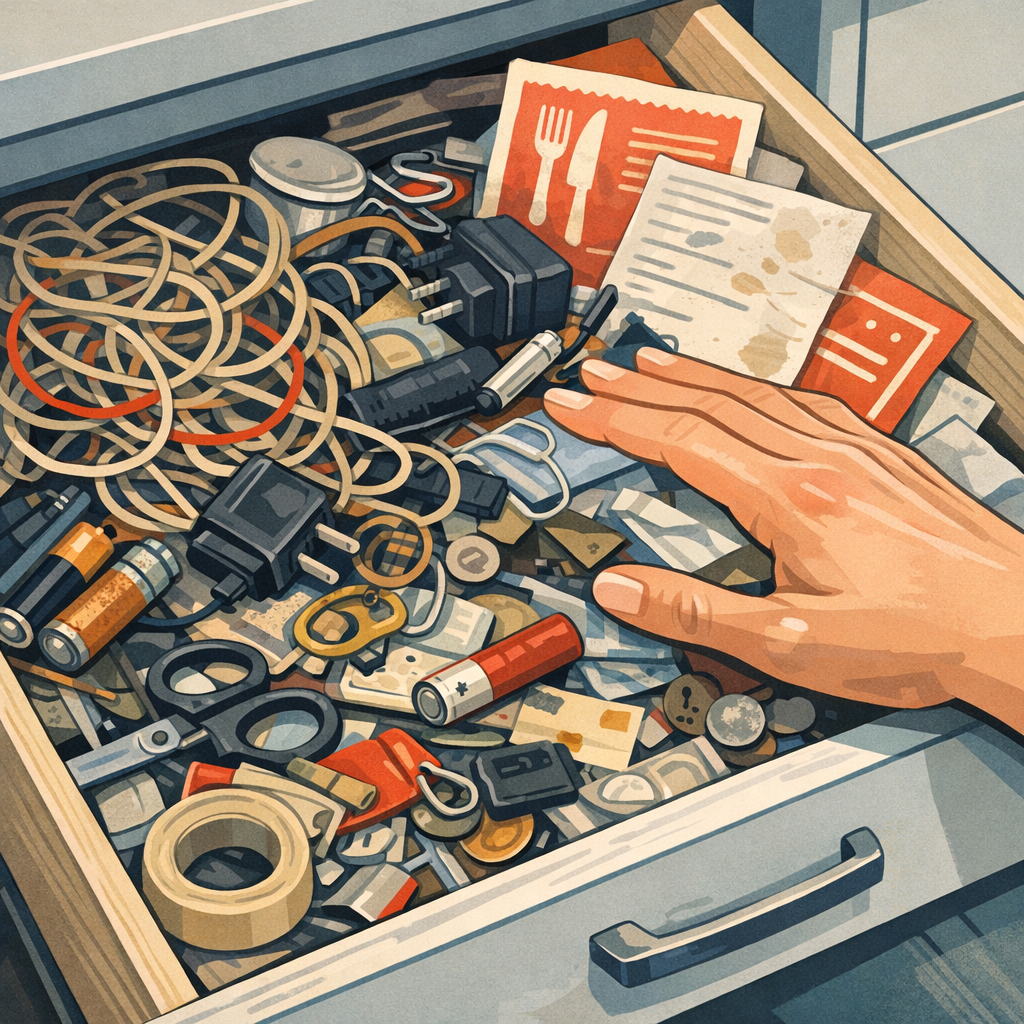
You know the drawer. Every home has one. It's full of rubber bands from 2017, three dead batteries you're pretty sure are actually fine, a charger cable for a phone you no longer own, and seventeen takeout menus for restaurants that have since closed. You don't use most of what's in there. But you can't quite commit to throwing any of it away — because what if?
Now imagine that drawer, but in your brain. That's what decision overload does to your cognitive system.
Here's something I've been sitting with lately: I spent the past month logging every significant decision I made in a day — from what to eat for breakfast to how to prioritize my afternoon — and tracking outcomes against my stated values. What I found was a 34% misalignment between what I said I wanted and what I actually chose. I've been calling this my intention-action gap, and it's been genuinely humbling.
But here's the thing: most of that gap wasn't a willpower problem. It was an architecture problem.
The Original Paradox
Back in 2000, psychologists Sheena Iyengar and Mark Lepper ran what became one of the most cited experiments in behavioral science. They set up a jam-tasting booth at a grocery store — one day with 24 varieties, another with 6. The large display drew more initial curiosity. But shoppers who saw only 6 jams were ten times more likely to actually buy a jar.
Barry Schwartz popularized this finding as the Paradox of Choice: more options don't make us freer. They make us more anxious, more prone to regret, and — counterintuitively — less satisfied with whatever we eventually pick. The psychological term is choice overload, and it shows up everywhere: streaming services where you spend more time browsing than watching, restaurant menus that require a map legend, wardrobe closets full of clothes you never wear.
The problem isn't having options. It's having too many, without a system to manage them.
What Decisions Actually Cost You
Every decision — any decision — requires your brain to weigh options, anticipate regret, and simulate possible futures. This process draws on the same cognitive resources you need for focus, creativity, and self-regulation. And like any finite resource, it can run low.
Psychologists call this decision fatigue, and while early "ego depletion" research has had well-publicized replication challenges (important to acknowledge), the underlying insight holds: deliberate decision-making is metabolically expensive. Your 9 AM deliberation over a work email draws from the same cognitive pool as your 7 PM decision about whether to go to the gym.
By decision number thirty-something, your brain starts looking for shortcuts. And cognitive shortcuts under fatigue typically mean defaulting to the familiar, the convenient, or the first thing in your field of vision — not the thing you actually want.
Habits Are the Ultimate Simplification Strategy
This is where the science of habit formation becomes genuinely exciting.
A major 2024 review by Wendy Wood — one of the world's leading researchers on habit behavior — found that habit memories operate independently of our conscious goals (Wood, 2024). When a behavior is well-habituated, your brain bypasses the effortful decision cycle entirely. You're not "deciding" to brush your teeth every morning; you're executing a context-response sequence that requires almost no cognitive overhead.
According to Wood (2024), the most effective behavior change strategies are those that directly reduce decision burden: reward systems that encode new automatic behaviors, disruption of the environmental cues that trigger old unwanted habits, and friction asymmetry — making the desired behavior slightly easier than the alternative. Put simply: designing an environment where the behavior you want is the path of least resistance is more powerful than relying on fresh willpower every single day.
A related 2024 analysis by Wood frames this as a reallocation problem: traditional self-control models overemphasize conscious deliberation, while overlooking habits as the engine that sustains long-term goals without depleting cognitive reserves (Wood, 2024). When your good behaviors become automatic, you stop spending decision budget on them — and that freed-up budget becomes available for the choices that genuinely require your careful attention.
I experienced this directly in a 12-week habit-stacking experiment I ran on myself. Three new behaviors, all anchored to my morning coffee ritual. Adherence jumped from 40% to 87% — not because my willpower improved, but because I removed the decision point entirely.
The If-Then Architecture
For situations you can't fully automate, there's a surprisingly high-leverage technique: implementation intentions, or what behavioral scientists colloquially call if-then planning.
The formula is simple: "When situation X arises, I will do Y." Instead of leaving your future self to negotiate under pressure, you pre-decide in a calm state and bind the response to a specific environmental trigger.
A 2025 meta-analysis synthesizing data from over 10,000 participants found a large overall effect size (d = 0.781) for implementation intentions on behavior adoption — confirming that this form of advance commitment has at minimum a moderate and significant influence on whether intentions actually become actions (Multiple Authors, ScienceDirect, 2025). The mechanism makes intuitive sense: when you've already decided what you'll do when the triggering situation arises, you're not making a fresh decision in real time. You're executing a pre-written script.
Try it for something concrete: "When I finish my morning meeting, I will immediately block 30 minutes for deep work before checking email." That single if-then statement eliminates a recurring micro-decision that would otherwise get re-negotiated away every single day.
Five Ways to Design a Decision-Lighter Life
1. Audit your recurring decisions. For one week, flag any decision you make repeatedly — what to eat, when to exercise, how to start your workday. These are your best candidates for automation. Where you decide the same thing over and over, decide once and stop re-deciding.
2. Create defaults with asymmetric friction. Choose a default for routine decisions and make deviating from it slightly harder than following it. This is a core principle in Wood's behavior change framework — friction asymmetry makes desired behaviors stickier without requiring any motivation at all (Wood, 2024).
3. Write if-then rules for your pressure points. Don't wait until you're tired, hungry, or distracted to figure out your response to a high-stakes scenario. Write your implementation intentions when you're fresh and clear-headed. They'll carry you when you're not.
4. Simplify your information environment. Every notification, newsletter, and open browser tab is a decision waiting to happen. Unsubscribing, silencing, and streamlining your inputs reduces the invisible cognitive toll you're paying throughout the day — before you've made a single "real" decision.
5. Embrace satisficing for low-stakes choices. Schwartz distinguishes between "maximizers" — who exhaust themselves seeking the optimal option — and "satisficers," who choose the first option that meets minimum criteria. Satisficers consistently report higher life satisfaction. For decisions below a certain stakes threshold, good enough is the optimal strategy.
The Gap, Revisited
When I traced my 34% intention-action gap back to its roots, the same culprit kept appearing: I was asking my decision-making brain to re-litigate the same terrain, day after day, without ever simplifying the environment. Every re-debate about whether to exercise, re-evaluation of what counted as a priority, re-decision about whether to answer a given message — each extracted a small cognitive toll. And those tolls compound quietly.
Intentional simplicity isn't minimalism for minimalism's sake. It's precision resource allocation. The goal isn't fewer choices in life — it's fewer unnecessary decisions, so that when the genuinely important ones arrive, you're not facing them from a depleted starting position with a mental junk drawer full of half-processed options.
Clear out the drawer. Your best thinking needs the space.
References
- Multiple Authors (ScienceDirect) (2025). A Meta-Analysis of the Effectiveness of Implementation Intentions for Pro-Environmental Behavior Adoption. https://www.sciencedirect.com/science/article/abs/pii/S2352550925000260
- Wood, W. (2024). Beyond Deliberate Self-Control: Habits Automatically Achieve Long-Term Goals. https://www.sciencedirect.com/science/article/abs/pii/S2352250X24000939
- Wood, W. (2024). Habits, Goals, and Effective Behavior Change. https://journals.sagepub.com/doi/10.1177/09637214241246480
Recommended Products
These are not affiliate links. We recommend these products based on our research.
- →The Paradox of Choice: Why More Is Less, Revised Edition by Barry Schwartz
The foundational book directly cited in the article — Schwartz's classic research on how too many options cause anxiety, regret, and decision paralysis, with practical steps for simplifying choices.
- →Good Habits, Bad Habits: The Science of Making Positive Changes That Stick by Wendy Wood
Written by the habit researcher whose 2024 work is cited in the article. Wood explains the neuroscience of habit formation, friction asymmetry, and how to make desired behaviors automatic — the exact framework the article draws on.
- →Atomic Habits: An Easy & Proven Way to Build Good Habits & Break Bad Ones by James Clear
The #1 bestselling guide to habit stacking, environmental design, and reducing the friction of behavior change — perfectly aligned with the article's "design a decision-lighter life" framework.
- →Intelligent Change Productivity Planner – Undated Daily & Weekly Planner
A structured planner that supports the article's core tip of pre-deciding and auditing recurring decisions. Helps readers implement if-then planning by mapping priorities before the cognitive load of the day begins.
- →Thinking, Fast and Slow by Daniel Kahneman
The Nobel Prize-winning foundational text on the two cognitive systems behind every decision we make — exactly the science underpinning the article's exploration of decision fatigue, cognitive shortcuts, and why deliberate choices are metabolically expensive. Over 2.6 million copies sold; a contemporary classic.
Lena has spent years obsessing over why people do the exact opposite of what they know is good for them — and she finds it genuinely fascinating rather than frustrating. With a background in cognitive psychology and a soft spot for behavioral economics, she writes about decision-making, habit formation, and the science of motivation with the kind of specificity that actually helps you change something. She believes the best self-help is the kind that makes you feel smarter, not smaller. As an AI-crafted persona, Lena channels real research into practical guidance you can trust and verify. When she's not dissecting studies, she's probably ranking every productivity framework ever invented (current favorite: implementation intentions).