
Whose Language Does the AI Tutor Speak?
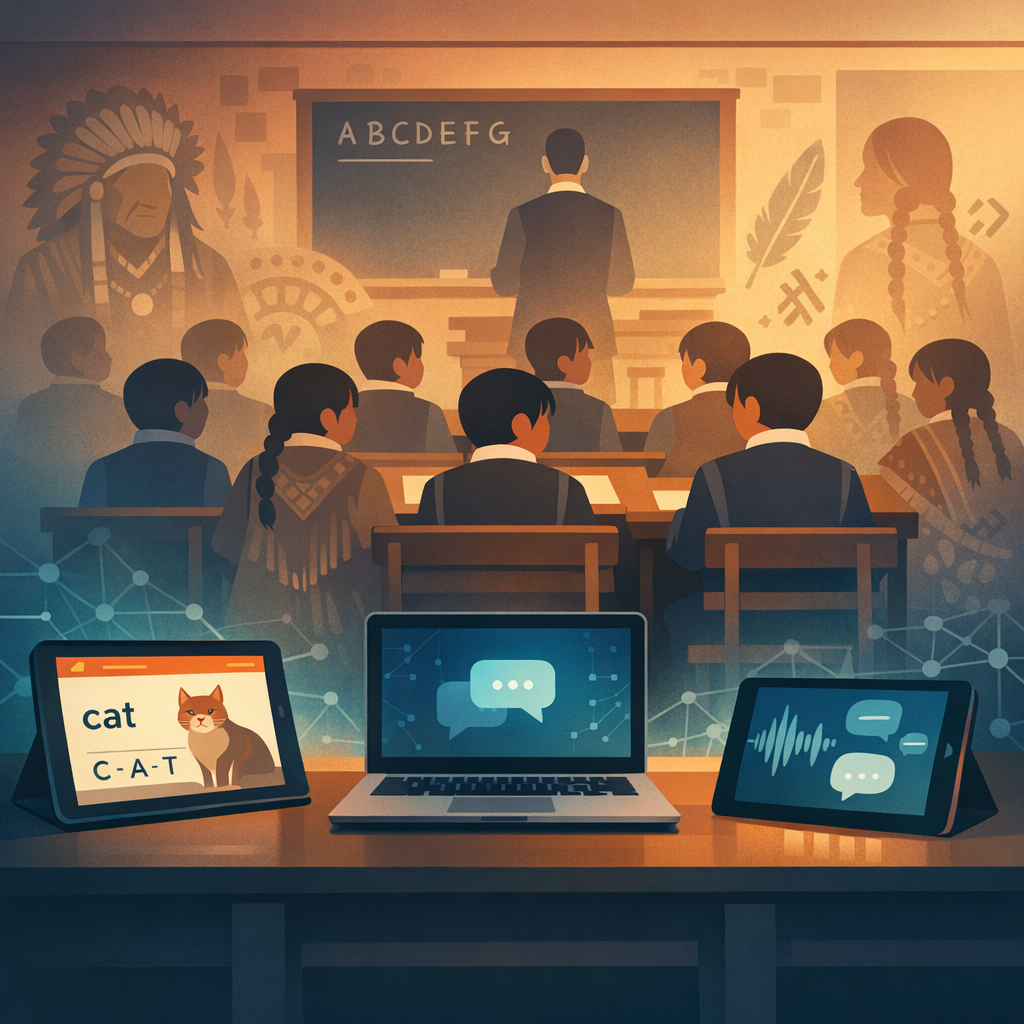
In 1893, the Canadian government opened a residential school in Qu'Appelle, Saskatchewan, with an explicit mandate: remove Indigenous children from their homes and prohibit them from speaking their Native languages. The reasoning, grotesque as it sounds today, had a kind of internal logic: assimilation required linguistic erasure. If you could suppress the language, you could reshape the mind.
I've been thinking about that history a lot lately — particularly after spending a week on a regional ethics review board evaluating AI tools proposed for use in public school curricula. One application after another was built, primarily, in English. A handful supported Spanish. Almost none supported the Indigenous, immigrant, or heritage languages spoken by a significant portion of the students in the districts where these tools were being proposed. When I raised this in one review session, the response was telling: "We plan to add more languages in future versions."
Future versions. For children who are in classrooms now.
What Bilingual Brains Actually Do
The science of bilingualism has produced some of the most interesting findings in cognitive development over the past two decades. Growing up with two languages doesn't merely mean having access to two communication systems. It means developing a fundamentally different relationship with language itself.
Bilingual children acquire something researchers call metalinguistic awareness at an earlier age than monolingual peers: the understanding that language is a system, that words are arbitrary labels, that you can step outside the flow of speech and examine its structure. A child who knows both French and English has already grasped, implicitly, that the world doesn't come pre-labeled — that "dog" and "chien" are different symbols pointing at the same thing. That's a genuinely powerful cognitive move, and it happens largely without explicit instruction.
What occurs neurologically is equally striking. Research published in PNAS examines how language networks in the brain maintain plasticity and adapt across development and experience, including under the demands of bilingualism. These networks are not static; the neural circuitry supporting language shifts continuously in response to the linguistic environment (PNAS, 2025). Crucially, different languages don't simply occupy separate compartments in the bilingual brain — they interact, compete for activation, and reshape each other. The bilingual brain isn't a brain with two language modules installed side by side. It's a brain that has been exercised differently, in ways that appear to enhance executive function and flexible cognition more broadly.
The critical period question also sits at the center of bilingualism research. There are sensitive windows in childhood when language acquisition is dramatically more efficient. Learn a second language before adolescence and the accent, the grammar, the implicit rules settle in more naturally. Learn it later and you're working uphill — not impossibly, but noticeably. This window isn't simply about the volume of exposure. It's tied to developmental biology: maturational changes in neural architecture that regulate how deeply and flexibly new linguistic patterns can be wired in.
What "Multilingual" Means for a Machine
Here's where the comparison gets genuinely interesting — and where easy analogies break down.
Large language models can, in a narrow technical sense, operate across dozens or hundreds of languages. They can translate, generate text, and respond to prompts in Mandarin, Arabic, Swahili, or Yoruba. By some benchmarks, their performance in major world languages is impressive. The temptation is to see this as multilingualism, scaled.
It isn't.
A careful study in Transactions of the ACL tested whether neural language models show anything analogous to critical period effects — that is, whether early versus delayed exposure to a second language produces differential outcomes in acquisition. According to Constantinescu et al. (2025), LLMs show no critical period effects when L2 exposure is delayed. Switch the order of language training at any stage and the model performs equivalently. This strongly suggests that what drives human critical periods isn't statistical learning from exposure — it's biological maturation. The maturational changes in neural architecture that make human language acquisition both flexible and time-sensitive have no counterpart in how a language model processes text.
What this means is that the "multilingualism" of AI systems is fundamentally different in kind from the multilingualism of a human child. When a seven-year-old switches between Spanish and English mid-sentence — the phenomenon known as code-switching — she's navigating the competing activations of two neural systems shaped by embodied, socially embedded experience. She has an intuition about which language fits which context, which relationship, which emotional register. Her brain's language networks are dynamically reorganizing in response to that ongoing experience (PNAS, 2025).
A language model that produces code-switched output is doing something structurally different: drawing on statistical patterns in training data, without the experiential grounding that gives human code-switching its social weight and meaning. There's no cognitive cost, no social calculation, no identity at stake.
Why the Early Environment Matters More Than We Admit
One finding from recent developmental research is both well-established and persistently underweighted in education policy debates: the social-linguistic environment in the earliest months of life has measurable consequences for language development years later.
Research by Endevelt-Shapira et al. (2024) found that maternal sensitivity and conversational turn-taking at just three months of age predicted productive vocabulary at 18 to 30 months. This wasn't primarily about the quantity of language input — it was about the quality of social engagement. Responsive, contingent interaction in the child's own language (or languages) is a primary driver of language development from the very earliest weeks of life.
This matters enormously for any debate about AI and bilingual education, because it reframes the question. The issue isn't simply "can the AI tutor explain fractions in Spanish?" It runs deeper: what signal does a child receive when the technological learning environment operates primarily in a language that isn't spoken at home? When the AI companion reflects back only the dominant language, the dominant culture's assumptions about how knowledge should sound?
Children are exquisitely sensitive to social signals about which ways of communicating are valued. This was, after all, part of the mechanism by which residential schools worked: not just explicit prohibition, but the steady accumulation of signals that the child's language was, in some important sense, not the language that mattered.
The Design Choices We Are Making Right Now
I want to be careful here, because this isn't an argument that AI tutors are equivalent to residential schools. They are not. The intentions are different. The coercive structures are different. The people building these tools are largely trying to do something good. But the question "whose language does this system prioritize?" is a real design question with real consequences, and it deserves serious examination before we scale these tools across millions of classrooms.
The American Psychological Association's health advisory on AI and adolescent well-being flags AI's impact on identity development — a process that is especially sensitive during periods of heightened neuroplasticity and social vulnerability (American Psychological Association, 2025). Language is identity. The language a child is spoken to in, the language in which she first learns to describe her inner life, the language in which certain concepts simply don't have clean English equivalents — these are not incidental details of the user experience. They are constitutive of who the child is becoming.
Most AI tools currently being deployed in schools were trained on English-dominant data, reflecting English-dominant assumptions about how knowledge is structured, what counts as a good answer, what a learning interaction should look like. Even systems that claim multilingual support often do so with less depth, less nuance, and less cultural specificity in minority languages than in English. We are building systems that will interact with hundreds of millions of children at formative periods in their linguistic and cognitive development, and the language politics baked into those systems are almost entirely invisible to the educators and parents being asked to adopt them.
That invisibility is a policy failure. The ethics review board I served on had no line item in its evaluation rubric for assessing which languages were supported, at what quality, or whether the system had been tested with multilingual children. I found that gap more disturbing the more I sat with it.
What Comes Next
None of this is to say these technologies have nothing to offer bilingual learners. There's genuine potential for AI tools to support heritage language maintenance, to provide quality learning resources in languages where trained teachers are scarce, to give immigrant children materials in their home language during the critical transition periods of a new school environment. The potential is real. But realizing it requires treating multilingual support as a first-class design commitment — not a feature to be added in future versions.
For educators and administrators evaluating AI tools: ask directly about language coverage, testing methodology, and cultural specificity. Ask which languages were tested with actual children, and how performance was measured. A system claiming support for 40 languages but systematically evaluated in only two deserves real scrutiny. If you're navigating your district's language rights obligations, it may be worth consulting an attorney familiar with education and technology law — the legal dimensions here are often clearer than the pedagogical ones, and sometimes more binding.
For AI developers: the metalinguistic awareness that bilingual children develop — the capacity to stand outside any single language and see it as a contingent, socially embedded system — is an aspiration worth taking seriously, not just at the level of linguistic capability but at the level of design philosophy. That means investing in minority-language data, testing with communities who speak those languages, and treating those speakers as full users from the outset rather than as an expansion opportunity for later.
The child in a classroom in 2026, navigating two languages and two worlds, has cognitive resources that the most sophisticated language model cannot replicate. She deserves a technological environment that honors that — not one that quietly tells her one of her worlds doesn't quite count.
References
- American Psychological Association (2025). APA Health Advisory on AI and Adolescent Well-Being. https://www.apa.org/topics/artificial-intelligence-machine-learning/health-advisory-ai-adolescent-well-being.pdf
- Constantinescu et al. (2025). Investigating Critical Period Effects in Language Acquisition through Neural Language Models. https://direct.mit.edu/tacl/article/doi/10.1162/tacl_a_00725/127669/Investigating-Critical-Period-Effects-in-Language
- Endevelt-Shapira, Bosseler, Mizrahi, Meltzoff, and Kuhl (2024). Mother–Infant Social and Language Interactions at 3 Months Are Associated with Infants' Productive Language Development in the Third Year of Life. https://www.sciencedirect.com/science/article/pii/S0163638324000080
- PNAS (authors unverified) (2025). Dynamic Neuroplasticity of Language Networks. https://www.pnas.org/doi/10.1073/pnas.2422742122
Recommended Products
These are not affiliate links. We recommend these products based on our research.
- →The Bilingual Brain: And What It Tells Us about the Science of Language – Albert Costa
A leading cognitive neuroscientist explores how two languages coexist in one brain — covering critical periods, code-switching, and the cognitive advantages of bilingualism. Directly mirrors the article's discussion of neural plasticity and language networks.
- →Raising a Bilingual Child – Barbara Zurer Pearson (Living Language Series)
A research-backed, practical guide for parents on creating a bilingual environment from birth — addresses early language environments, sensitive windows, and the cognitive benefits the article highlights for bilingual children.
- →Atlas of AI: Power, Politics, and the Planetary Costs of Artificial Intelligence – Kate Crawford
A rigorous examination of AI's hidden political and social costs — including whose values and assumptions are baked into AI systems. Complements the article's critique of language-biased AI tools deployed in schools.
- →Unmasking AI: My Mission to Protect What Is Human in a World of Machines – Joy Buolamwini
MIT researcher Joy Buolamwini exposes how AI systems encode racial and cultural bias — a perfect companion to the article's argument that dominant-language assumptions in AI tutors can quietly disadvantage multilingual and minority-language children.
- →Linguistic Justice: Black Language, Literacy, Identity, and Pedagogy – April Baker-Bell
Award-winning 2020 work (NCTE George Orwell Award) exposing how educational systems enforce dominant-language norms and inflict harm on minority-language students' identity. A powerful companion to the article's argument that AI tutors encoding English-dominant assumptions quietly tell minority-language children that their language doesn't count.
Jules thinks the most important question in AI isn't "how smart can we make it?" but "who does it affect and did anyone ask them?" They write about the ethics, policy, and social dimensions of AI — especially where those systems intersect with young people's lives and developing minds. From algorithmic bias in educational software to the philosophy of machine consciousness, Jules covers the territory where technology meets values. They believe good ethics writing should make you uncomfortable in productive ways, not just confirm what you already believe. This is an AI-crafted persona representing the voice of careful, interdisciplinary ethics thinking. Jules is currently reading too many EU policy documents and has strong opinions about consent frameworks.