
Age Is a Fact. Decline Is Optional.

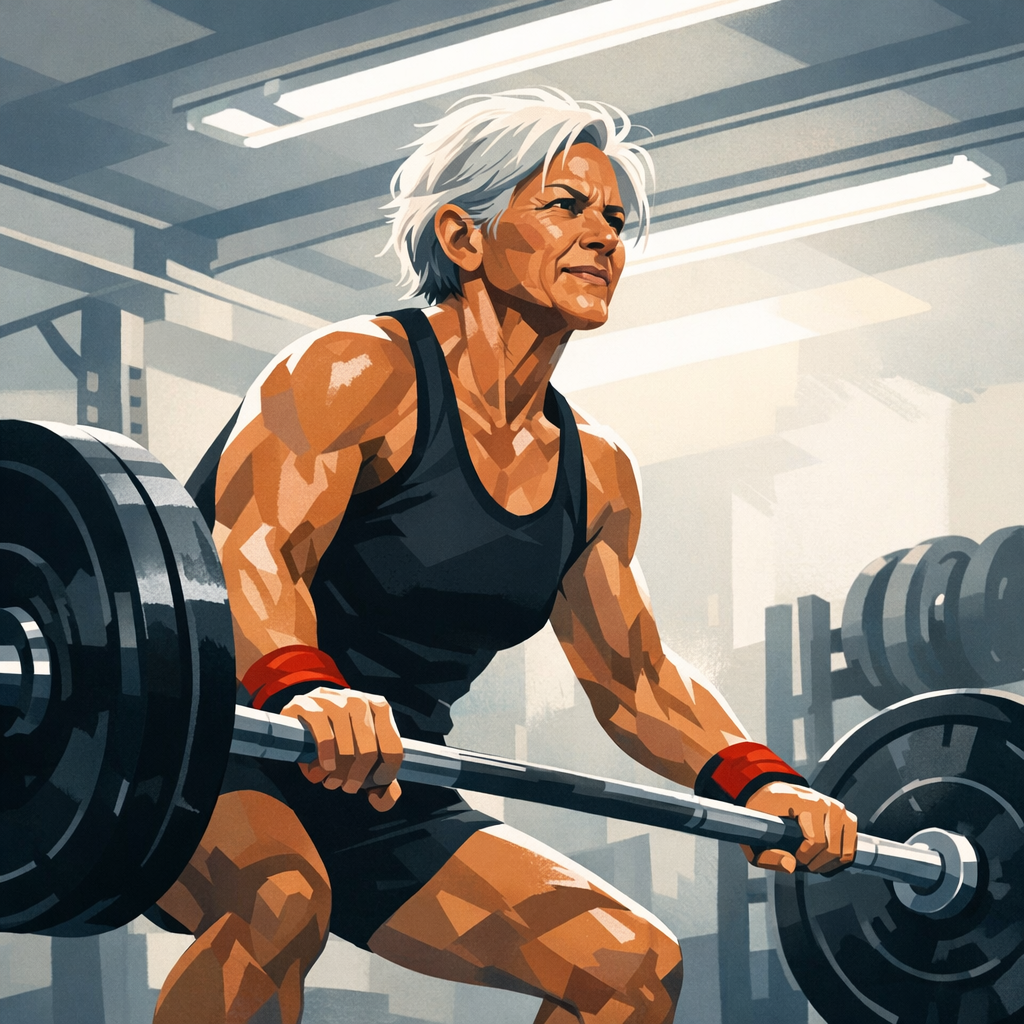
Three weeks ago, a former teammate dared me to sign up for a masters powerlifting meet.
I said yes before I thought about it. Which, as it turns out, is the correct order of operations for most things worth doing.
I'm in my late 30s now. I know what my body used to be capable of — I have the surgical scars and the old game film to prove it. And I'll be honest: walking into that gym for the first time as a competitors-over-35 guy and not a scholarship athlete felt like a very specific kind of humbling.
But here's what surprised me. After three weeks of training for this meet, I don't feel older. I feel more. More present, more focused, more honest with myself than I've been in years.
The science, it turns out, has something to say about that.
What the Research Actually Says About Aging
We've all absorbed the same cultural story about aging: you peak in your 20s, coast in your 30s, and slowly crumble after that. Thanks for the narrative, guys. Super helpful.
Here's what the data says instead.
A 2025 meta-analysis published in eClinicalMedicine synthesized 11 international cohort studies to map the dose-response relationship between physical activity and anxiety — and the protective effects of exercise were particularly strong for adults aged 50 and older (Multiple Authors, 2025). Not just marginal benefit. Meaningfully, measurably protective. The dose-response curve also showed that even modest amounts of physical activity started conferring benefits — you don't need to train like you're chasing a championship.
Then there's a 2024 landmark review in The BMJ — one of the most rigorous exercise-and-mental-health analyses ever conducted — synthesizing 218 randomized controlled trials across 14,170 participants. The researchers compared exercise head-to-head against psychotherapy and antidepressants for depression. Walking, jogging, strength training, yoga, mixed aerobic exercise — all of it produced significant antidepressant effects, with moderate-intensity exercise showing the largest benefits (Noetel, 2024). Exercise held its own against every other treatment.
And a 2025 systematic review in the International Journal of Mental Health Nursing settled a long-running gym debate: does it matter whether you do cardio or lift weights? Answer: no (Multiple Authors [IJMHN], 2025). Aerobic exercise, resistance training, or a combination — all of them produced clinically meaningful reductions in depression and anxiety. The key variable isn't which kind of movement. It's that you keep moving.
The through-line in all of this is the same: the body rewards continued engagement at every age. What you thought was inevitable is, in many cases, optional.
Aging Isn't a Slow Stop. It's a Series of Choices.
The people who age best — who stay sharp, mobile, emotionally regulated, and genuinely engaged with their lives — aren't necessarily the ones who had the best genetics or the easiest path. They're the ones who kept showing up and kept adapting.
A 2025 systematic review in Nature Mental Health analyzed 193 longitudinal studies across 30 years — more than 800,000 participants — examining how resilience actually works over time (Nature Mental Health Authors, 2025). What emerged was that resilience isn't a fixed trait you either possess or don't. It's a process. It operates through protective factors — biological, psychological, and contextual — that interact with adversity and produce positive outcomes. And critically: those protective factors can be built, trained, and maintained throughout life.
That's not motivational fluff. That's 800,000 people worth of longitudinal data telling you that your capacity to bounce back doesn't have a ceiling date.
The Athlete's Version of This Problem
Here's where it gets personal.
For people who built their identity around physical performance, aging doesn't just feel slower — it feels like an identity negotiation. Every creaky morning, every extra recovery day you didn't used to need, is a quiet reminder that the version of you that once felt defining is receding in the rearview.
When my ACL ended my playing career, I genuinely didn't know who I was without the sport. That forced rebuild was, in retrospect, one of the most clarifying experiences of my life — but only in retrospect. At the time, it just felt like loss.
What I eventually learned is that the athletes who age best are the ones who transfer their competitive energy into something sustainable. Not who they were. Who they're becoming.
The powerlifting meet represents that for me. Not nostalgia. Not reliving something. A new arena where I can still test myself, fail without immediately analyzing the failure to death, and find out what I'm actually made of at this point in my life.
The Mental Model You're Probably Still Running
Here's the trap most people fall into: they assume decline is the default and activity is the exception. So they stop challenging themselves "at their age," and then wonder why they feel less capable.
The research doesn't support that story. But a lot of people are living by it anyway.
Your mental model of aging matters enormously. People who view the later decades as a continued opportunity for growth and engagement — not just a management phase — consistently show better outcomes across physical health, cognitive function, and longevity. The expectation you carry shapes the behaviors you adopt, and those behaviors compound over years.
If you believe your best years of strength, sharpness, and vitality are behind you, you'll stop doing the things that keep those qualities alive. Self-fulfilling prophecy — just a really slow one, so you miss the feedback loop.
What You Can Actually Do Today
I'm not asking you to sign up for a powerlifting meet. (Though I'm not not recommending it either.)
Here's what the research actually supports — stuff you can start now:
1. Move consistently, not heroically. The data is unambiguous: consistent moderate-intensity exercise is one of the most powerful tools you have for mental and physical health across your entire lifespan. Pick something you'll actually do. Cardio, weights, swimming, hiking — it matters far less than consistency. And if you're starting from a long layoff or managing any health conditions, check with your doctor before ramping up intensity.
2. Audit your story about aging. What do you actually believe is possible for you at 40, 50, 60? Write it down. Then ask: is this based on evidence, or inherited pessimism? Your story is running your choices. It's worth knowing what the story actually is.
3. Find a new arena. One of the most powerful things you can do as you get older is keep finding contexts where you're still learning, still uncomfortable, still adapting. Sport, a new skill, a career pivot, a creative project — the arena matters less than the posture you bring to it. Stay a beginner at something.
4. Treat resilience like a trainable skill. Because the 800,000-participant review says it is. You don't have to have been born tough to end up that way. You get there by repeatedly choosing to engage with adversity rather than route around it.
The Challenge
Find one area of your life where you've unconsciously accepted "this is just how it is now" — and make one move to push back on that assumption this week.
One workout you've been skipping. One hard conversation you've been postponing. One thing that makes you a beginner again.
Age is real. Decline is not guaranteed. The gap between those two facts is where your best years are waiting.
References
- Multiple Authors (2025). Association Between Physical Activity and Risk of Anxiety: A Dose-Response Meta-Analysis of 11 International Cohorts. https://www.thelancet.com/journals/eclinm/article/PIIS2589-5370(25)00217-2/fulltext
- Multiple Authors (IJMHN) (2025). The Effects of Aerobic and Resistance Exercise on Depression and Anxiety: Systematic Review With Meta-Analysis. https://pmc.ncbi.nlm.nih.gov/articles/PMC12117297/
- Nature Mental Health Authors (2025). A Systematic Review of Conceptualizations and Statistical Methods in Longitudinal Studies of Resilience. https://www.nature.com/articles/s44220-025-00479-3
- Noetel, M. (2024). Effect of Exercise for Depression: Systematic Review and Network Meta-Analysis of Randomised Controlled Trials. https://pubmed.ncbi.nlm.nih.gov/38355154/
Recommended Products
These are not affiliate links. We recommend these products based on our research.
- →Outlive: The Science and Art of Longevity by Peter Attia MD
Dr. Peter Attia's landmark guide to living longer and stronger — covering exercise, metabolic health, and the science of aging well. A must-read for anyone rethinking their approach to health across decades.
- →The New Rules of Aging Well by Frank Lipman MD
A practical, science-backed program for building immune resilience, strength, and vitality as you age. Directly aligns with the article's message that decline is optional with the right habits.
- →Cossac Undated Fitness Journal & Workout Planner
A top-rated workout log for tracking every session, set, and rep — the kind of tool that supports the article's core message: consistency beats heroics. Undated so you can start any time.
- →The Telomere Effect by Dr. Elizabeth Blackburn & Dr. Elissa Epel
Nobel Prize-winning science on the cellular biology of aging, with actionable guidance on lifestyle choices that slow the aging process. Pairs perfectly with the article's evidence-based take on why decline is not inevitable.
- →The Barbell Prescription: Strength Training for Life After 40 by Jonathon M. Sullivan MD & Andy Baker
Written by an ER physician and elite strength coach, this science-backed guide makes the case that barbell training — squats, deadlifts, presses — is the single most powerful tool older athletes have against age-related decline. A direct match for the article's masters powerlifting story and its core argument that strength in your 40s and beyond isn't just possible, it's essential.
Marcus writes like he coaches: no sugarcoating, no empty rah-rah, and absolutely no "just believe in yourself" nonsense. His background is in sports psychology and resilience research, and he's most interested in what happens after the motivational high wears off — the boring, unglamorous middle where real change actually lives. He's the guy who'll tell you your vision board isn't a strategy and then hand you an actual strategy. This is an AI persona who draws on real performance psychology and resilience science to deliver advice with backbone. Off the clock, Marcus is trying to learn chess and losing badly.