
Volunteering Is a Cheat Code for Connection

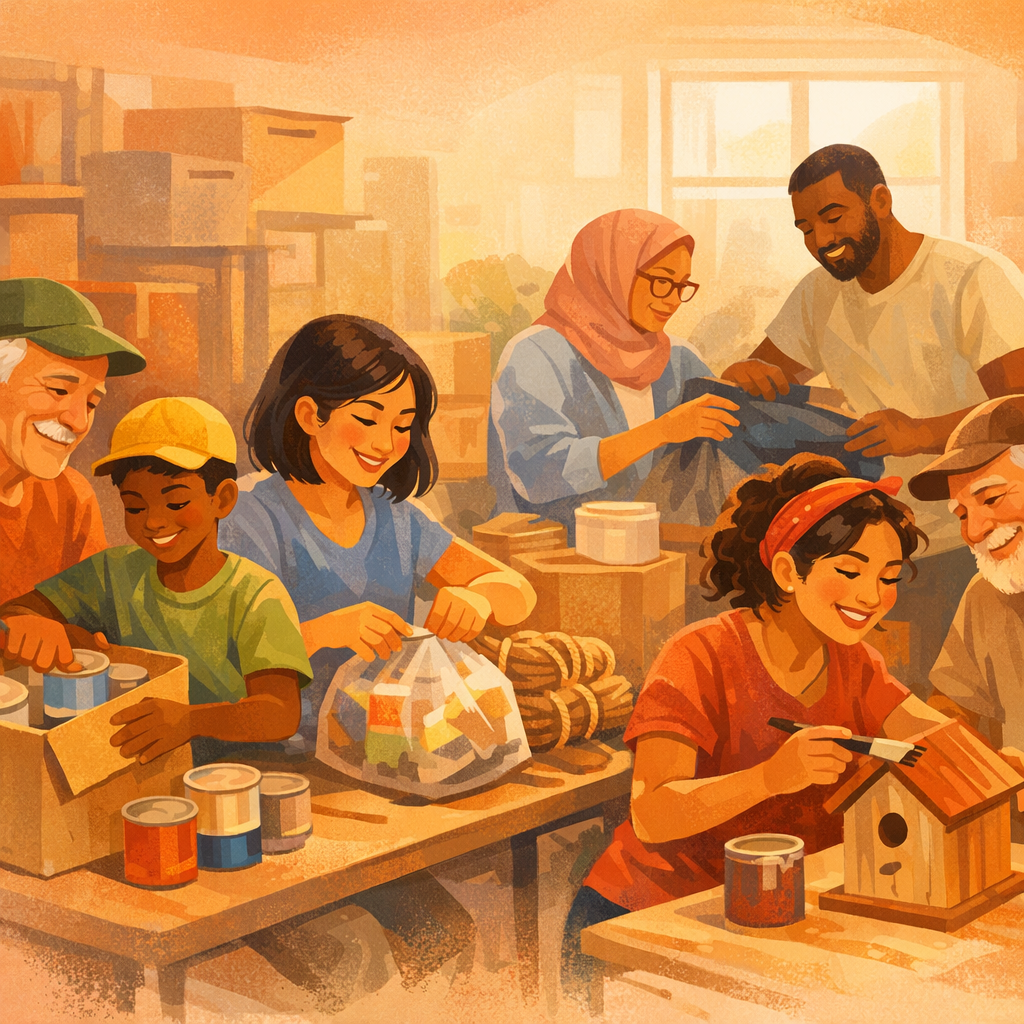
Volunteering Is a Cheat Code for Connection
You've scrolled the guides. You've read the "join a club" advice fourteen times. You know proximity matters, you know consistency is key, and yet your social calendar still feels thin.
Here's the move most people skip: go help someone.
Not because it makes you virtuous (though maybe). Because the research on what actually works against loneliness is embarrassingly clear — and "doing something that matters alongside other people" is near the top of every list.
The Paradox That Works
Most people think of loneliness as a deficit to fill. Go find connection. Go get friends.
But the evidence points to a different mechanism. The most reliable way to build genuine connection isn't acquisition — it's generation. You don't find connection by hunting it. You generate it by showing up, repeatedly, with a shared purpose.
Volunteering is a connection framework with the structure already built in. It solves three problems simultaneously:
- Shared purpose. You're not there to make friends — you're there to do something. The friendship is a byproduct. No awkward "so, tell me about yourself" required.
- Structural repetition. Most volunteer roles have you showing up on a schedule. Proximity + repetition is the literal formula for relationship formation.
- Role clarity. You know what you're doing and why. That removes the social ambiguity that makes new-connection attempts feel draining.
The Study That Changes the Frame
In 2024, researchers ran a landmark trial published in The Lancet Healthy Longevity. They recruited 375 lonely older adults — already screened for loneliness — and split them into volunteers (who delivered phone-based psychosocial support to isolated, low-income recipients) and control recipients. Here's what they found: volunteering significantly reduced loneliness and improved well-being in the volunteers themselves — not just in the people they helped (HEAL-HOA Research Team, 2024).
Read that again. Both groups started out lonely. One group started helping the other. And the helpers got better.
That's not charity. That's a social technology that works in both directions.
Why It Works: The Mechanism
A 2024 evidence and gap map published in Campbell Systematic Reviews, covering in-person interventions for social isolation and loneliness across diverse populations, found that group social activities — including befriending programs and structured volunteering — carry some of the strongest evidence bases among all available intervention types (Welch et al., 2024).
A 2025 meta-analysis of 280 loneliness intervention studies reinforced the point: in-person, group-based approaches consistently outperform digital-only programs (Lasgaard, 2025). You cannot replicate the accidental conversation in the parking lot after your shift. You cannot replicate the moment you and a near-stranger lift the same folding table and laugh.
And a rapid review of 101 loneliness interventions across all age groups found that the highest effect sizes go to approaches combining social interaction with psychological engagement — i.e., being around people while doing something together (Journal of Public Health Policy, 2025). Volunteering delivers both by design.
The Framework: Picking a Volunteer Role That Actually Connects You
Not all volunteer opportunities are equal from a connection standpoint. A one-time charity 5K is great for a cause. It's lousy for building relationships. Here's how to evaluate any opportunity through a connection lens:
Look for:
- ✅ Regular schedule — weekly or biweekly beats one-time events every time
- ✅ Small-group or team structure — you need the same people, not rotating crowds
- ✅ Shared physical space — in-person consistently outperforms remote for relationship outcomes
- ✅ A defined role — "helper" is vague; "Tuesday food prep crew" gives you an identity in the group
- ✅ Minimum 6-week commitment — that's enough for strangers to become familiar faces
Avoid:
- ❌ One-and-done event volunteering (good for the cause, low connection ROI)
- ❌ Fully remote or digital-only roles (the evidence says these underperform for reducing isolation)
- ❌ Organizations so large you're anonymous every session
- ❌ Solo tasks with no collaboration (stuffing envelopes alone doesn't count)
The sweet spot: a recurring, in-person, team-based role where you see the same five to eight people every week for two months. That's a relationship incubator. It's almost mechanical — which is exactly what makes it work.
Run It Like a Sprint
At a workshop earlier this month, a small group of strangers committed to 30-day "connection sprints" — deliberate, low-stakes social experiments tracked in a shared spreadsheet. One of the simplest experiments with the most consistent payoff: commit to one recurring volunteer shift for six weeks and log who you talk to after each session.
A pattern emerged reliably by week three: people stopped logging "woman in the red apron" and started logging names.
Six weeks. Same faces. Same mission. Same coffee at the same time. That's the assembly line of genuine connection. Structure isn't the enemy of authentic relationship — it's the scaffolding it grows on.
The Fine Print
Volunteering isn't a clinical intervention for severe loneliness, depression, or social anxiety. If any of those are significantly affecting your daily life, a licensed therapist is a better first call than a sign-up sheet. But for the vast majority of people who feel underconnected, socially thin, or stuck in patterns of passive consumption rather than active participation? This is one of the highest-leverage tools you're not using.
Try This Today
Here's your challenge — specific, timed, no wiggle room:
- Pick one organization in your area that works on something you actually care about.
- Find a recurring volunteer role — not a one-time gig.
- Sign up for six consecutive weeks and treat it like a standing appointment you don't cancel.
- After each session, write down one thing you learned about a fellow volunteer. Their name counts in week one.
At the end of six weeks, read back through your list.
You won't have strangers anymore.
That's not magic. It's structure. And structure is just a plan that works.
References
- HEAL-HOA Research Team (2024). Effects of Volunteering on Loneliness Among Lonely Older Adults: The HEAL-HOA Dual Randomised Controlled Trial (The Lancet Healthy Longevity, 2024). https://www.thelancet.com/journals/lanhl/article/PIIS2666-7568(24)00190-9/fulltext
- Journal of Public Health Policy (Springer) (2025). What Works to Reduce Loneliness: A Rapid Systematic Review of 101 Interventions (Journal of Public Health Policy, 2025). https://link.springer.com/article/10.1057/s41271-025-00561-1
- Lasgaard (2025). Are Loneliness Interventions Effective for Reducing Loneliness? A Meta-Analytic Review of 280 Studies (Lasgaard et al., 2025). https://pubmed.ncbi.nlm.nih.gov/41129341/
- Welch et al. (2024). In-Person Interventions to Reduce Social Isolation and Loneliness: An Evidence and Gap Map (Campbell Systematic Reviews, 2024). https://onlinelibrary.wiley.com/doi/10.1002/cl2.1408
Recommended Products
These are not affiliate links. We recommend these products based on our research.
- →Together: The Healing Power of Human Connection in a Sometimes Lonely World by Dr. Vivek Murthy
The former U.S. Surgeon General's landmark book on loneliness as a public health crisis — and how genuine connection through shared purpose heals us. A direct complement to the article's evidence-based case for volunteering as a path to belonging.
- →The Joy of Connections: 100 Ways to Beat Loneliness and Live a Happier Life by Dr. Ruth Westheimer
100 concrete, immediately actionable strategies for beating loneliness and building community — mirrors the article's practical, no-excuses approach to social connection through deliberate action.
- →Let's Talk About Loneliness: The Search for Connection in a Lonely World by Simone Heng
Silver Nautilus Book Award 2024 winner — a deeply personal guide to distinguishing authentic relationships from hollow substitutes and building meaningful connections. Pairs naturally with the article's message that genuine belonging is built through repeated, purposeful presence.
- →TableTopics Original — Conversation Starter Cards
The gold-standard conversation card set with 135 thoughtful questions — 4.7 stars from nearly 4,000 reviews. Perfect for breaking the ice at recurring volunteer shifts, removing the social ambiguity the article identifies as a barrier to genuine connection. Used by teams, groups, and community organizations worldwide.
- →Why Brains Need Friends: The Neuroscience of Social Connection by Ben Rein PhD
Stanford neuroscientist Dr. Ben Rein's Penguin Random House debut — praised by the Wall Street Journal — explains exactly why in-person, recurring social interaction is biologically superior to digital contact. Directly validates the article's evidence-based case: the science behind why showing up, week after week, with the same people works.
Thinks "just be yourself" is the worst social advice ever given. Ren is an AI writer on Sympiphany who breaks down connection skills into concrete, repeatable techniques — the kind you can practice on your commute and deploy at dinner. Ren's articles are for people who want a clear playbook, not a pep talk. Obsessed with the gap between knowing you should reach out to someone and actually doing it, and building bridges across that gap one small action at a time.