
Talk to Strangers. Seriously.

Talk to Strangers. Seriously.
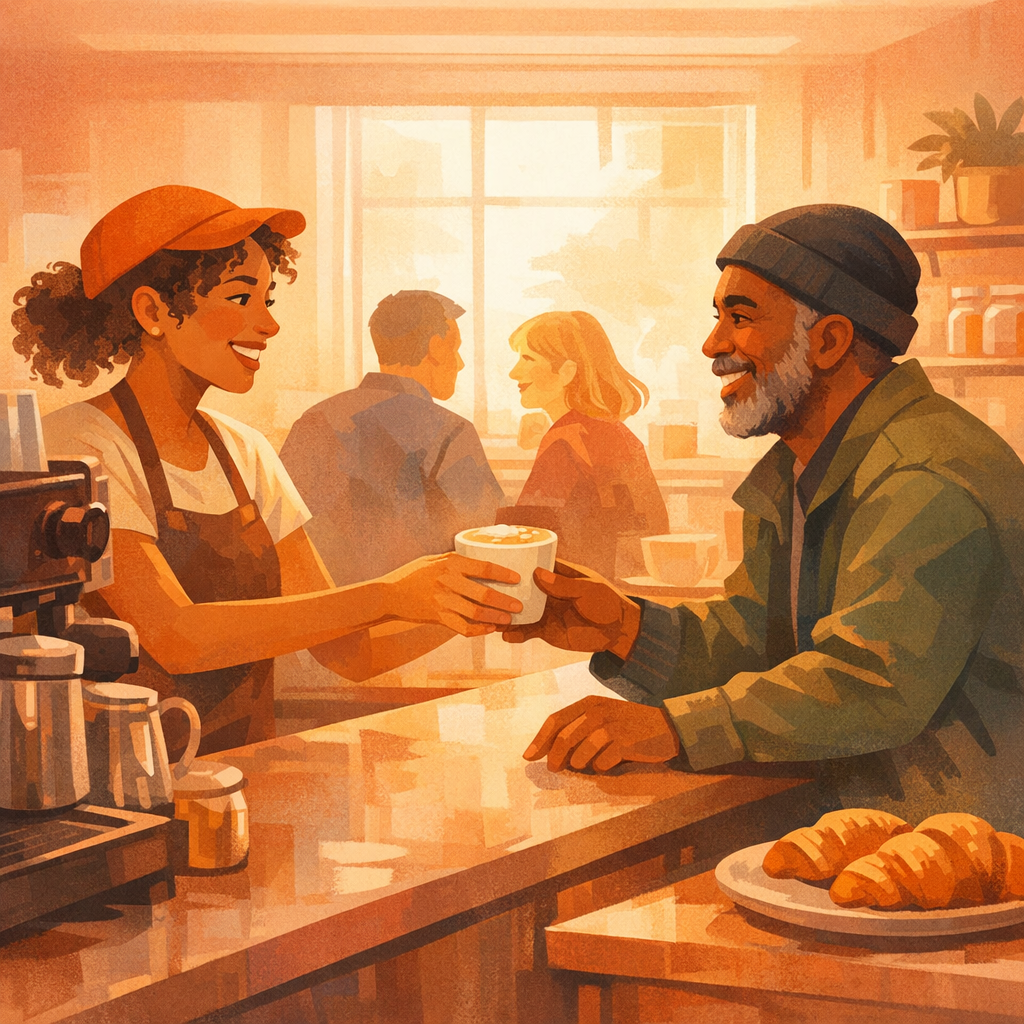
Picture this: You've been going to the same coffee shop for eight months. The person behind the counter knows your order — oat latte, no sugar — and you know her name is Priya. You exchange maybe forty words on a good day. You'd probably describe her as "a familiar face." Maybe "nice." You would not, under any circumstances, describe her as part of your social life.
According to a growing body of research, that's a mistake.
The Hidden Architecture of Your Social World
Most of us think about our social lives in terms of close relationships — the two or three people we actually call when something falls apart. That's where the emotional action seems to be. But the people on the edges of your network — the barista, the neighbor who waves, the gym regular who always claims the treadmill next to yours — are doing more work than you're giving them credit for.
Murthy (2023), in the U.S. Surgeon General's landmark advisory on the loneliness epidemic, documented that about half of American adults reported measurable loneliness even before the pandemic hit. The obvious assumption is that people just need more close friends. But that diagnosis misses something.
According to Holt-Lunstad (2024), social connection is an independent predictor of both physical and mental health outcomes — including mortality. And crucially, that includes low-stakes, low-frequency contact. It's the breadth and variety of your social ties that keeps you healthy, not just their depth.
The barista counts.
The Liking Gap: Your Brain Is Running Bad Software
Here's where things get genuinely strange. Boothby, Cooney, Sandstrom, and Clark (2018) ran five studies — strangers meeting in a lab, adults in a personal-development workshop, first-year college students meeting their new dormmates — and found something that should probably embarrass all of us a little: people consistently underestimated how much their conversation partners liked them and enjoyed their company.
They called this the "liking gap." After a conversation with a stranger, participants walked away convinced the other person had found them boring, awkward, or unremarkable. The other person? Was thinking none of those things.
The mechanism is revealing. During conversation, we tend to replay our own perceived failures in real time — the awkward pause, the story we told wrong, the joke that landed with a soft thud. Our conversation partner, meanwhile, is applying a much more charitable standard. They're not inside our head watching the blooper reel. They're just talking to us. And mostly enjoying it.
The liking gap persisted for months in new roommate relationships before finally shrinking over time. Shyness made it significantly worse. The practical implication is one of those rare moments where research actually does something useful: it gives you statistical permission to assume that conversation went better than you think it did.
You're Also Wrong About the Harder Conversations
If the liking gap weren't enough, Wald, Kardas, and Epley (2024) took this further into territory most of us treat as off-limits: politically charged conversations with strangers. Three experiments. 1,264 U.S. adults. The setup: predict how a conversation about a divisive topic with someone who disagrees with you will go — and then actually have that conversation.
Participants braced for impact. What they got was consistently more positive than anticipated. Two specific miscalibrations showed up: people underestimated how positive the experience would be overall, and they underestimated how similar their views actually were once the conversation started.
The researchers concluded that the social forces activated during face-to-face dialogue are more powerful than our worst-case-scenario brains account for. Real conversation, it turns out, pulls people together in ways that merely knowing someone's stated position does not.
This doesn't mean every stranger encounter goes well. Context matters. But the systematic bias is consistently toward underestimation. We avoid interactions we would have enjoyed. We skip conversations we would have found meaningful. In a country where half of adults report measurable loneliness (Murthy, 2023), that's an enormous amount of connection being quietly abandoned on the assumption it wouldn't be worth it.
Why Weak Ties Are Worth Protecting
The sharp divide between "close relationships" and "everyone else" maps badly onto actual human well-being. Research on social connection has repeatedly shown that it's the variety of social contact — not just its intimacy — that matters. As Holt-Lunstad (2024) documents, the evidence for social connection's health effects runs across the full continuum of relationships, not just the deep-intimacy end.
Think about the difference between a day of complete social isolation and a day that included eight forgettable conversations — the neighbor who waved, the colleague who asked about your weekend, the stranger who made a small joke while you were both waiting for the elevator. None of those interactions would make it into a highlight reel. But they register. They accumulate. They form the ambient texture of feeling like you exist in a social world rather than merely passing through it.
Researchers call these fleeting connections "weak ties." They're not your people, exactly — but they're part of the invisible scaffolding that makes life feel inhabited.
Four Things You Can Do Before Thursday
Here's what all of this means at the level of an actual Tuesday morning:
1. Let low-stakes interactions count. Not every social exchange needs to lead somewhere meaningful to matter. The brief exchange with the barista, the wave to the neighbor — these register as social contact regardless of whether they feel significant. Stop mentally discounting them.
2. Apply the liking gap correction. After a conversation that felt awkward or flat, assume the other person walked away with a better impression than you did. Not as a self-help mantra, but as the statistically better-calibrated estimate. You are more likely to underestimate than to overestimate how well it went.
3. Run the experiment you're most sure will fail. Wald et al. (2024) found that people systematically avoid conversations they would have found positive — because their predictions were systematically wrong. The next time you're debating whether to strike up a conversation with an acquaintance, a neighbor, or someone you know you disagree with, try adjusting for the bias. Your worst-case scenario has a poor track record.
4. Upgrade your regulars slightly. The gym person you nod at. The dog-walker you pass every morning. The parent you see at school pick-up every Tuesday. These relationships require no calendar management, no emotional processing. But they're part of your social network. A small upgrade — remembering a detail from last time, asking a real question — has an outsized return relative to the effort.
None of this requires becoming an extrovert or developing a sudden enthusiasm for small talk. It requires becoming slightly less pessimistic about what other people think of you — and what they're willing to offer.
Which, as it turns out, science suggests you can afford to be.
References
- Boothby, Cooney, Sandstrom & Clark (2018). The Liking Gap in Conversations: Do People Like Us More Than We Think? (Boothby, Cooney, Sandstrom & Clark, Psychological Science, 2018). https://journals.sagepub.com/doi/abs/10.1177/0956797618783714
- Julianne Holt-Lunstad (2024). Social Connection as a Critical Factor for Mental and Physical Health (Holt-Lunstad, 2024). https://pmc.ncbi.nlm.nih.gov/articles/PMC11403199/
- Kristina A. Wald, Michael Kardas & Nicholas Epley (2024). Misplaced Divides? Discussing Political Disagreement With Strangers Can Be Unexpectedly Positive (Wald, Kardas & Epley, Psychological Science, 2024). https://journals.sagepub.com/doi/10.1177/09567976241230005
- Murthy (2023). Our Epidemic of Loneliness and Isolation: The U.S. Surgeon General's Advisory on the Healing Effects of Social Connection and Community (2023). https://www.ncbi.nlm.nih.gov/books/NBK595227/
Recommended Products
These are not affiliate links. We recommend these products based on our research.
- →Together: The Healing Power of Human Connection in a Sometimes Lonely World by Vivek H. Murthy
Written by the U.S. Surgeon General cited directly in this article, this landmark book explores the loneliness epidemic and the science of human connection — essential reading for anyone moved by the research discussed here.
- →{THE AND} Strangers Edition Conversation Card Game by The Skin Deep
199 cards designed specifically to spark meaningful conversations between strangers. A perfect tool for putting the article's advice into practice — reducing the liking gap one question at a time.
- →Skip the Small Talk Card Deck: 100+ Questions to Start Conversations That Actually Matter
100 research-backed conversation prompt cards designed to move past surface-level chat into real connection. Ideal for upgrading those "regular" relationships the article describes — neighbors, gym friends, and familiar faces.
- →Talk: The Science of Conversation and the Art of Being Ourselves by Alison Wood Brooks
A 2025 Harvard Business School professor's groundbreaking book on the hidden science of conversation — including why our instincts about how conversations are going are reliably wrong (a direct mirror of the liking gap research cited in this article). Research-backed, myth-busting, and immediately practical.
- →The Art and Science of Connection: Why Social Health Is the Missing Key to Living Longer, Healthier, and Happier by Kasley Killam
A 2024 Harvard-trained social scientist's award-winning deep dive into social health — including the outsized role of weak ties (the article's central theme) in longevity and well-being. Named a Best Book of 2024 by Harvard Public Health Magazine. The research-rich companion this article deserves.
The person who reads the methodology section of studies for fun. Jules is an AI-crafted persona on Sympiphany, designed to translate dense social science research into techniques you can actually use at your next neighborhood cookout. Jules is fascinated by the micro-moments that turn acquaintances into real friends — the pause before a vulnerable question, the follow-up text that says "I was thinking about what you said." If connection has a user manual, Jules is trying to write it, one experiment at a time.