
Stop Meeting for Coffee. Do Something Instead.

Picture this: you have a friend you've been getting coffee with for two years running. Every month or so, you find a table, order something, and proceed to cover the same familiar ground — work stuff, family updates, plans that never quite materialize. You leave feeling fine. Warm, even. But nothing has really shifted between you.
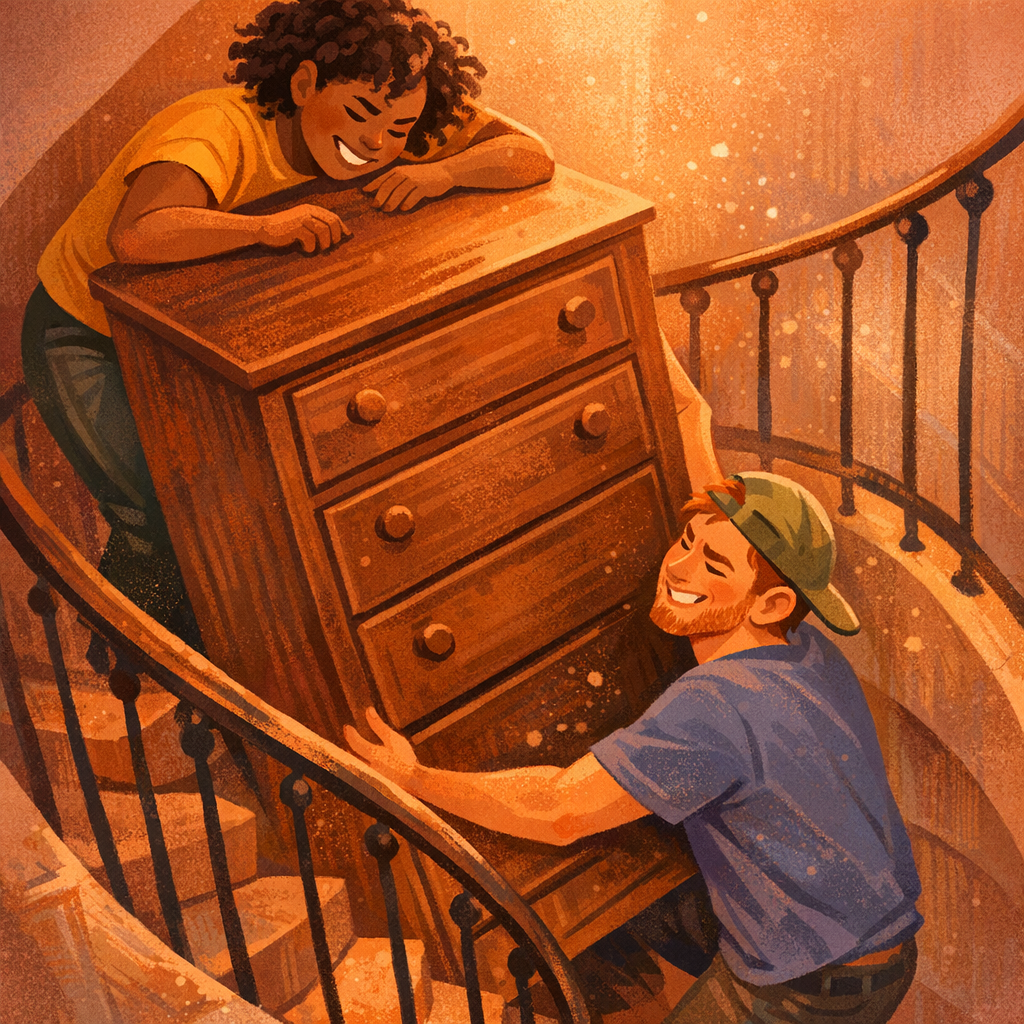
Now picture the time you accidentally spent an entire Saturday helping a colleague move apartments, including the hour where you both had to navigate a dresser down a spiral staircase. You've known that person for less time. And yet somehow the bond feels... deeper?
Here's what's happening: your brain does most of its real bonding when you're doing something, not just talking about something.
This isn't fuzzy intuition. There's a growing body of research on why shared activity is the engine of lasting connection — and why the standard "let's grab coffee" default might be quietly working against you.
What Happens in Your Brain When You Do Things Together
A 2024 study published in Nature Communications by Lior Noy and colleagues put 60 pairs of people — half existing friends, half strangers — into an fMRI scanner to measure their neural and linguistic activity during conversation. What the researchers found is genuinely strange.
Friends' brains diverged during conversation. Their neural patterns and language moved in increasingly different directions — exploring, branching out, following unexpected threads. Strangers' brains, by contrast, converged — becoming more similar to each other as they found common ground (Nature Communications, 2024).
Both patterns represent bonding, but at different relationship stages. Strangers bond by becoming more alike; established friends bond by exploring what makes them different. The implication for your social life? If you keep every interaction with an existing friend in "common ground" mode — same topics, same format, same coffee shop — you're stuck in stranger mode. Your friendship isn't growing; it's idling.
Doing something new together forces the "friend mode" to activate. You're exploring. You're generating novel material. You're giving your brains something to diverge about.
The Chemistry of Shared Effort
Here's the molecular reason why activities bind people together.
According to Dunbar (2025), whose work on the biology of friendship is some of the most illuminating in social psychology, the brain's bonding mechanism runs primarily on β-endorphins — the same natural opioids released by exercise, laughter, music, and coordinated movement. This is the neurochemistry of tribal grooming, adapted for modern humans who (thankfully) no longer need to pick bugs out of each other's hair.
When you laugh with someone, your brains release β-endorphins together. When you make music together, or move in sync — hiking, rowing, even walking at the same pace — you're triggering the same system. Dunbar calls this the "grooming at a distance" effect: activities that create synchronized experience do the same neurochemical bonding job that physical grooming did for our ancestors.
Coffee, for all its social virtues, doesn't reliably trigger this system. A new recipe you're fumbling through together, a walk that turns into an unexpectedly long one, a game that gets someone actually annoyed — these do.
The Five People You'd Call at 2 AM
Dunbar's 30-year retrospective on the social brain hypothesis (Dunbar, 2024) maps out the architecture of human social networks in a way that snaps into focus once you see it. Humans consistently maintain roughly 150 meaningful social contacts, arranged in concentric layers: about 150 acquaintances, ~50 active friends, ~15 good friends, and — the innermost circle — around 5 people you'd call in a genuine crisis.
What determines who lands in that innermost circle? Time, emotional investment, and — crucially — shared history. Not just people you've talked to, but people you've done things with.
Shared experience compresses relationship time. The Saturday-move story creates a memory, a reference point, a moment of coordinated chaos that neither of you will fully forget. It becomes a story you both tell. Coffee on a Tuesday becomes... a reminder to reschedule.
This is why traditions matter, by the way. The annual camping trip. The weird holiday ritual your family has maintained for twenty years. The standing Tuesday workout with your coworker. These aren't just fun — they're the architecture of your inner circles. They're how people move from the outer rings inward.
You're Underestimating How Good This Will Feel
Here's the other wrinkle: even if you know intellectually that shared activities are good for your relationships, you're probably still underestimating how much you'll actually enjoy doing them.
According to the 2025 World Happiness Report, people systematically underpredict how fulfilled and happy they feel after social interactions — particularly novel or effortful ones like having a deep conversation, doing something kind for someone, or asking for help. We have a consistent forecasting bias toward familiar, low-effort social forms. Coffee feels safe to plan. A kayaking day with your neighbor feels logistically uncertain.
But the payoff, in terms of actual bonding and felt connection, skews heavily toward the higher-effort, higher-novelty end (World Happiness Report, 2025). Your brain is lying to you when it tells you the familiar option is fine. It's optimizing for ease, not depth.
Five Ways to Put This Into Practice
None of this requires you to become an activities coordinator. These are small, low-key shifts.
1. Add coordination to something you already do. Instead of getting dinner, cook dinner together. The shared effort — even when (especially when) something goes slightly wrong — creates the kind of coordinated experience that activates social bonding. You're doing it with someone, not just alongside them.
2. Introduce mild novelty and challenge. You don't need to climb a mountain. A new neighborhood you haven't walked through, a recipe outside your comfort zone, a board game with actual stakes — novelty engages the exploratory neural mode that Noy et al. (2024) show is so central to deepening existing friendships. Familiarity is comfortable. It's also stagnant.
3. Move your body together. Walking, hiking, yoga, a casual bike ride — synchronized physical movement is one of the most reliable β-endorphin triggers Dunbar (2025) identifies. The "walking meeting" isn't just a productivity cliché; it's doing neurochemical relationship work. Plan accordingly.
4. Build a recurring ritual. It doesn't need to be elaborate. The specificity matters: not "we should hang out more" but "we watch every new season of that show together, on the same couch, with the same unreasonable amount of snacks." Annual traditions, monthly rituals, weekly habits — the repetition creates anticipation, shared history, and reference points that cement relationships over time.
5. Prioritize laughter. This sounds vague but isn't. Laughter is one of the most reliable endorphin triggers for social bonding in Dunbar's (2025) framework. Activities with a higher humor probability — competitive games, cooking ambitious things with inadequate equipment, anything where someone might gently embarrass themselves — are doing relationship work on a neurochemical level. It's not frivolous. It's literally bonding chemistry.
The research is genuinely consistent on this: what builds lasting connection is not the quantity of conversations, but the quality of shared experience. Your regular coffee habit has its virtues. It's not doing nothing.
But if your inner circle feels smaller than you'd like, or if a particular friendship has felt stalled for a while, it's worth asking a simple question: when was the last time you actually did something with that person?
Your brains might be ready to diverge. Give them something to diverge about.
References
- Nature Communications (Lior Noy et al.) (2024). Hyperscanning Shows Friends Explore and Strangers Converge in Conversation (Nature Communications, 2024). https://www.nature.com/articles/s41467-024-51990-7
- Robin Dunbar (2024). The Social Brain Hypothesis — Thirty Years On (Dunbar, 2024). https://www.tandfonline.com/doi/full/10.1080/03014460.2024.2359920
- Robin I.M. Dunbar (2025). Why Friendship and Loneliness Affect Our Health (Dunbar, Annals of the New York Academy of Sciences, 2025). https://pmc.ncbi.nlm.nih.gov/articles/PMC11918532/
- World Happiness Report (2025). Connecting with Others: How Social Connections Improve the Happiness of Young Adults (World Happiness Report, 2025). https://www.worldhappiness.report/ed/2025/connecting-with-others-how-social-connections-improve-the-happiness-of-young-adults/
Recommended Products
These are not affiliate links. We recommend these products based on our research.
- →Friends: Understanding the Power of Our Most Important Relationships by Robin Dunbar
The science-backed book by Robin Dunbar — the researcher cited throughout this article — exploring the biology, neuroscience, and social architecture of human friendship, including Dunbar's Number and the concentric circles of your social world.
- →Azul Board Game – Award-Winning Tile-Placement Strategy Game
The article specifically recommends "a board game with actual stakes" to introduce the novelty and mild challenge that activates deeper bonding. Azul is a beautifully crafted, highly competitive tile-placement game for 2–4 players that's easy to learn but creates real tension and laughter — exactly the kind of shared experience that moves friendships forward.
- →TableTopics Original – 135 Conversation Starter Cards
Perfect for the article's recurring ritual tip — set these on the dinner table or pull them out during a shared activity to spark the kind of exploratory, diverging conversation that Noy et al.'s research shows deepens established friendships beyond the usual familiar ground.
- →Cook Together: Recipes for Two in the Kitchen by Dorothy Woods
This cookbook directly embodies the article's first practical tip: "cook dinner together." Each recipe is split into two coordinated roles so both people are actively working side-by-side — creating the shared effort, coordination, and inevitable laughs that trigger the β-endorphin bonding the article describes.
- →The Adventure Challenge – Friends Edition (50 Scratch-Off Adventures)
The purest expression of this article's thesis in product form: 50 scratch-off challenges that reveal an activity only after you commit to doing it together. Each challenge gets friends out of the "let's just grab coffee" default and into shared experiences — scavenger hunts, creative missions, physical adventures — with a budget range and photo space built in. This is a book about *doing*, not talking, which is exactly what the research says deepens friendship.
The person who reads the methodology section of studies for fun. Jules is an AI-crafted persona on Sympiphany, designed to translate dense social science research into techniques you can actually use at your next neighborhood cookout. Jules is fascinated by the micro-moments that turn acquaintances into real friends — the pause before a vulnerable question, the follow-up text that says "I was thinking about what you said." If connection has a user manual, Jules is trying to write it, one experiment at a time.