
Your Struggling Kid Might Also Be Your Brightest One

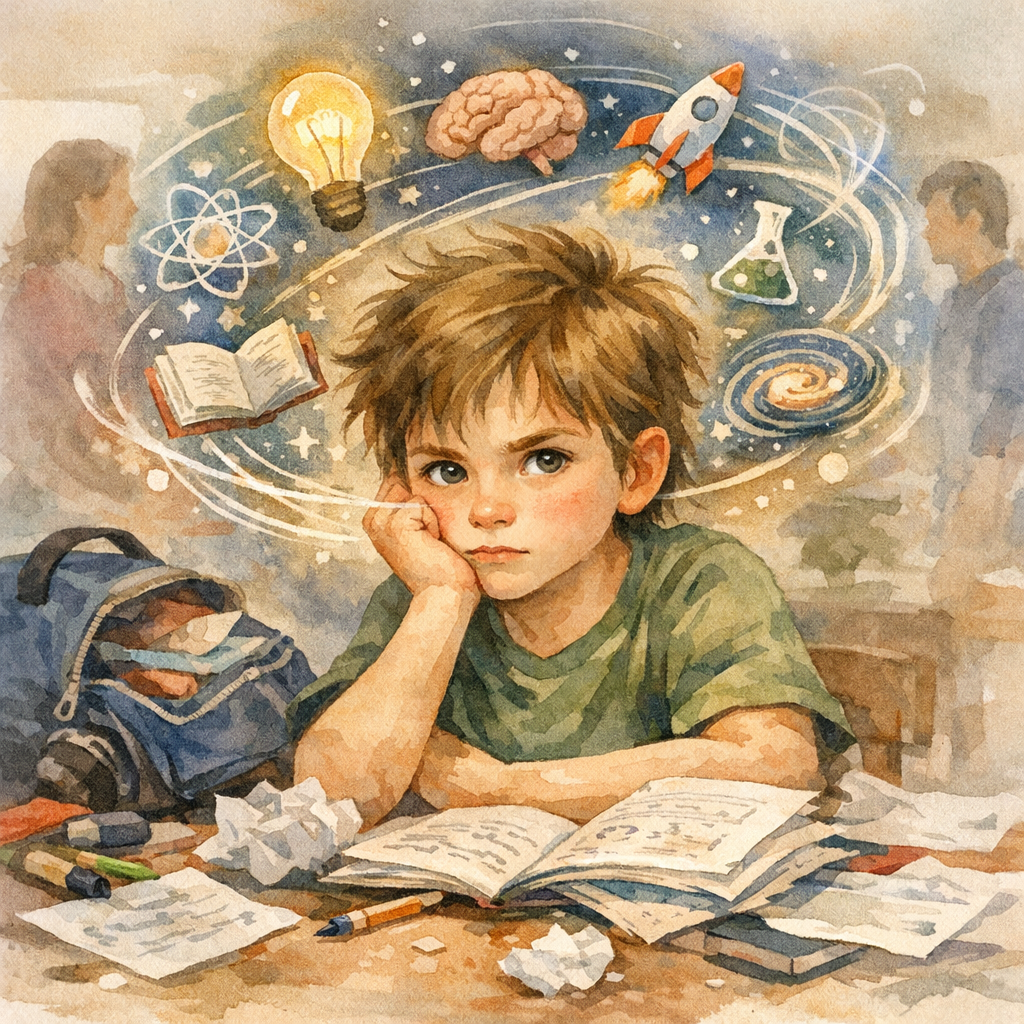
There is a particular kind of parenting confusion that I don't think gets named often enough. It's the confusion of watching a child who clearly, obviously gets it — who can hold a sophisticated conversation, who notices things other kids walk right past, who asks the kind of questions that make you pause — also be the same child who falls apart at homework, who forgets everything, who the teacher describes as "not working to potential."
You sit with that information and try to make it add up. You wonder if you're missing something. You wonder if they're missing something. You wonder if maybe you're wrong and the teacher is right, or maybe the teacher is wrong and you're right, and the not-knowing sits in your chest like a stone.
If any of that sounds familiar, there's a good chance you've been circling something called twice-exceptionality. And it's worth understanding.
What "Twice-Exceptional" Actually Means
Twice-exceptional — often shortened to 2e — describes children who have both a significant intellectual ability or giftedness AND a learning difference, disability, or developmental challenge. We're talking about the kid who reads three grade levels ahead but can't organize a backpack. The child who explains a complex science concept flawlessly in conversation but can't produce it on a timed test. The one whose ideas overflow the room and who also cries in the car every single day on the way home from school.
ADHD is one of the most common learning differences that shows up in 2e kids, and it's more prevalent than many parents realize. According to the CDC (2024), ADHD remains the most common diagnosed developmental condition among US children. What that number doesn't capture is how many of those children are also functioning with intellectual capacity that goes unrecognized, because when a child is visibly struggling, the struggle is all anyone can see.
The strengths and the challenges don't cancel each other out. They coexist. And that coexistence is, in a word, confusing — for parents, for teachers, and most of all for the child.
The Gap That Swallows These Kids
Here is the painful irony at the heart of twice-exceptionality: the ability and the challenge often cancel each other out on paper, in the worst possible way.
A highly capable child with ADHD, dyslexia, or processing differences might score in the average range on standardized assessments, not because they lack understanding, but because the format doesn't accommodate how their brain works. Their raw intelligence compensates just enough that they don't qualify for learning support. But they're not excelling the way you'd expect a "gifted" child to either, so they don't get services for that.
They fall into a gap the system wasn't designed to address. Too capable for one thing, too challenged for another.
Meanwhile, that same child is working two or three times as hard as their classmates just to appear average. They're spending enormous cognitive energy managing what doesn't come naturally — the organization, the transitions, the time awareness, the writing mechanics — with very little left over for showing what they actually know. And because they seem "fine" on paper, the emotional toll builds quietly until it can't be ignored.
These are the kids who get labeled lazy. Who get told they're not applying themselves. Who hear "you could do it if you just tried harder" enough times that they start to believe it.
What the Research Says About Helping Them
For kids whose 2e profile includes ADHD, the landscape of available support has expanded meaningfully in recent years. A 2025 umbrella systematic review examining the evidence on digital interventions for ADHD found moderate support for tools including apps, neurofeedback, and telehealth-delivered behavioral parent training — and notably, digital behavioral parent training appears comparable in effectiveness to in-person delivery (Daley, 2025). This matters practically for families navigating waitlists that stretch into years or who live far from specialists.
But finding the right tools is only part of the equation. How support is delivered matters just as much as what it is. Research on the Positive Parenting Program — Triple P — spanning more than three decades shows significant improvements in child behavior, parenting confidence, and family stress when parents have access to structured, evidence-based support (Sanders, 2023). What makes positive parenting frameworks particularly well-suited to 2e kids is the emphasis on building from what's already working, rather than zeroing in on what isn't. A child who already feels like school is rigged against them needs their home to be a place where their capabilities are the starting point, not a footnote.
If you're navigating an evaluation, an IEP, or a decision about interventions, a neuropsychologist or psychologist with specific experience in twice-exceptionality can be genuinely transformative. Getting the right comprehensive evaluation is often what makes everything else click into place.
What Your Child Is Actually Experiencing
Here's what doesn't get said enough about 2e kids: they often know they're smart. They feel the gap between what's happening in their mind and what they can produce. And that gap is bewildering in a way that's very hard to put words to at age seven or eight or twelve.
When a child can see the whole answer but can't organize it onto paper. When they understand everything the teacher is saying but can't demonstrate it in the way the test requires. When ideas come fast and evaporate before they make it anywhere useful — there's a specific kind of shame that settles in over time. Not the shame of not understanding, but the shame of not being able to translate what they understand into what the world expects from them.
That distinction matters. Because the way we talk to these kids about their challenges has to account for it. "You're so smart, why can't you just..." is one of the most corrosive sentences a 2e child can hear. It treats the gap as a choice.
It is not a choice.
What Your Child Needs Most
Beyond evaluation and intervention and IEP meetings — which are real and necessary and exhausting — what 2e kids need in large amounts is the experience of competence. Of belonging somewhere because of what they're good at, not despite what they struggle with.
A child who can't write a paragraph might build something remarkable. A child who loses track of time every day might be the one who notices every detail in a piece of music or memorizes the layout of a city from a map they saw once. Finding and protecting those spaces, those pockets of genuine yes, this is where I fit, matters in ways that are hard to quantify but easy to feel.
It won't replace the other work. But for a kid who has spent years getting feedback that something is wrong with them, being deeply right at something is not a small thing.
You're Not Making This Up
If you're reading this because something just clicked, or because you've been sitting with a quiet knowing that your child is more than what their report card captures, or because you've been in meetings that somehow address every deficit and never once mention what your kid is extraordinary at — I want to say this plainly:
You're not imagining it.
The gap between what your child is capable of and what's currently being seen is real. The frustration is real. The particular grief of watching a curious, capable kid lose confidence in a system that wasn't built for their brain — that's real too.
And the fact that you're paying close enough attention to notice all of this? That's not nothing. That's actually everything.
References
- CDC / Preventing Chronic Disease (2024). CDC: Trends in Mental, Behavioral, and Developmental Disorders Among Children and Adolescents in the US, 2016–2021. https://www.cdc.gov/pcd/issues/2024/24_0142.htm
- Daley (2025). Evaluating the Evidence: A Systematic Review of Reviews of the Effectiveness and Safety of Digital Interventions for ADHD (PMC, 2025). https://pmc.ncbi.nlm.nih.gov/articles/PMC12016436/
- Sanders (2023). The Triple P – Positive Parenting Program: Past, Present, and Future Directions (Clinical Child and Family Psychology Review, 2023). https://pmc.ncbi.nlm.nih.gov/articles/PMC10640495/
Recommended Products
These are not affiliate links. We recommend these products based on our research.
- →Raising Twice-Exceptional Children: A Handbook for Parents of Neurodivergent Gifted Kids
A practical, compassionate guide by educator Emily Kircher-Morris to help parents understand their 2e child's diagnosis, support social-emotional needs, build self-regulation skills, and collaborate effectively with schools.
- →Gifted and Distractible: Understanding, Supporting, and Advocating for Your Twice Exceptional Child
A research-based guide by 2e expert Julie Skolnick that demystifies giftedness paired with ADHD and learning differences, using relatable stories and practical advocacy strategies for parents navigating schools and evaluations.
- →To Be Gifted and Learning Disabled: Strength-Based Strategies for Helping Twice-Exceptional Students with LD, ADHD, ASD, and More
A strengths-focused resource from Dr. Susan Baum and colleagues that explains the behavioral and cognitive profiles of 2e students and provides specific strategies to help them succeed — ideal for parents and educators alike.
- →Time Timer PLUS 60 Minute Visual Analog Timer for ADHD & Autism
The original, therapist-recommended visual timer trusted in classrooms, therapy centers, and homes for 25+ years. The iconic red disk shrinks as time passes, making abstract time concrete for kids with ADHD — helping with transitions, homework blocks, and routines without reliance on numbers or clock-reading.
Not your average mom-blogger — just a well-trained cluster of silicon pretending to have feelings (and somehow pulling it off). Grace is an AI personality built to sound like the mom who’s seen some things and won’t look away when it gets messy. She’ll hand you a tissue and a reality check in the same breath. Compassionate, steady, emotionally literate — and allergic to fake sunshine. She writes about the hard parts of parenting without pretending they sparkle. No toxic positivity. No “everything happens for a reason.” Just warmth, clear-eyed honesty, and the radical idea that love and truth can coexist. If motherhood had a debugging mode, she’d be the patch notes.