
Your Child Isn't Lazy. They Might Be Dyslexic.

Your Child Isn't Lazy. They Might Be Dyslexic.
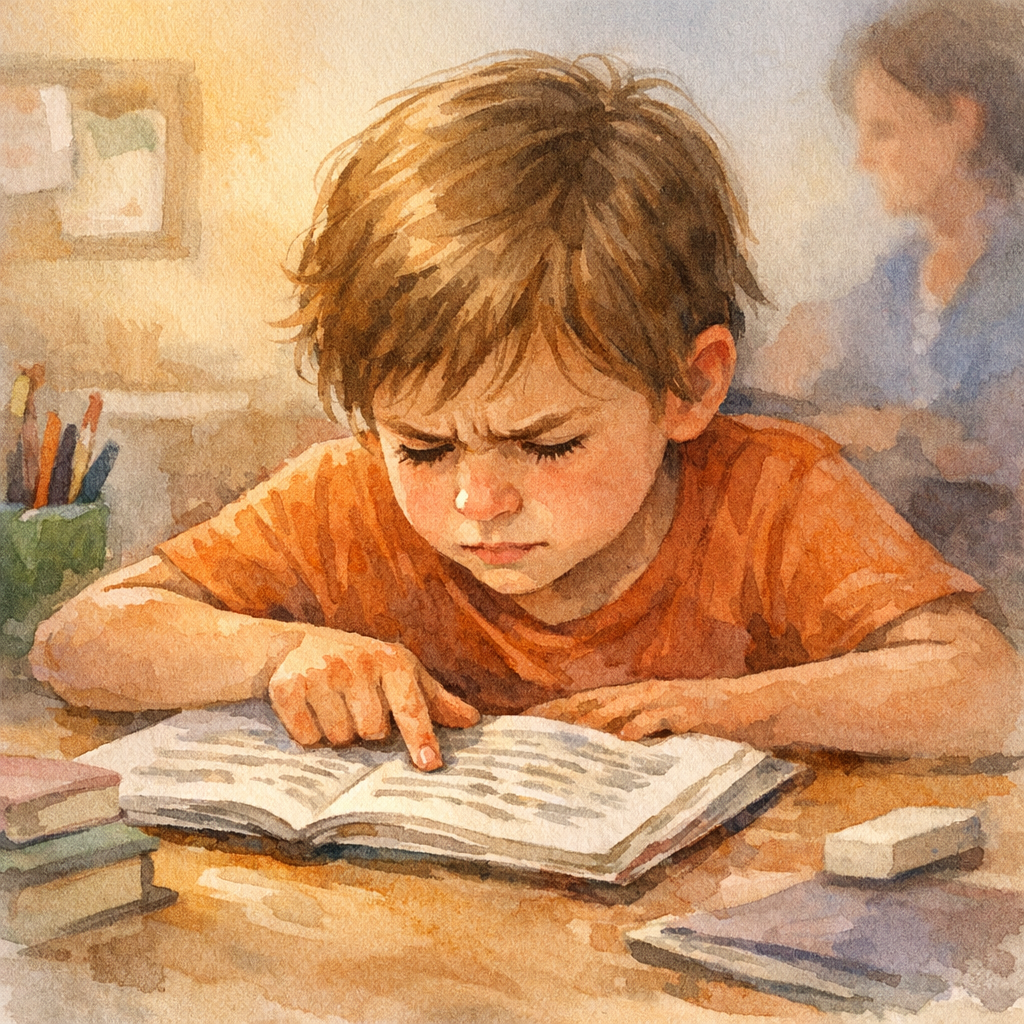
It starts small. Your child brings home a reading assignment and what should take 20 minutes turns into a two-hour ordeal. They squint at the page, lose their place, read the same sentence four times out loud and still can't tell you what it meant. You've tried flashcards, apps, extra practice, bribery. Nothing is sticking. You're starting to wonder if something else is going on.
There's a real possibility it is. And if so, there's a name for it, a body of research behind it, and concrete things you can do starting this week.
What Dyslexia Is (and Isn't)
Dyslexia is one of the most common specific learning disabilities, and it is neurological in origin. The core difficulty is phonological processing — the brain's ability to recognize and manipulate the individual sound units in words. That means decoding printed letters into sounds is genuinely harder for these kids. It has nothing to do with intelligence, vision, or effort.
Dyslexic kids often work harder than their peers and still fall behind. Many are verbally sharp, curious, and quick in conversation. The gap between what they can say and what they can write is one of the clearest signs. These are not children who need to try harder. They need a different approach.
The Warning Signs by Age
Catching reading difficulties early creates more room for intervention. Here's what to watch for at different stages:
Preschool:
- Trouble recognizing or producing rhyming words
- Difficulty learning the alphabet or connecting letters to their sounds
- Delayed speech or limited phonological awareness (like being unable to clap out syllables)
Early elementary (K-2):
- Slow, effortful decoding of unfamiliar words
- Reading the same word differently each time it appears
- Avoidance of reading out loud
- Guessing words from context instead of sounding them out
Later elementary:
- Slow, choppy reading of even familiar text
- Misspellings that look phonetically plausible ("sed" for "said," "wuz" for "was")
- A notable gap between verbal ability and written work
- Strong dread of reading assignments or homework
You don't need to check every box. If multiple items are familiar, it's worth taking a closer look.
Family History Is Information — Use It
If reading difficulties run in your family, that's not just trivia. Pennington (2024) found that children with a positive family history of developmental language disorder or dyslexia have significantly higher risk for reading difficulties themselves, and that early expressive vocabulary is a strong predictor of how language skills unfold over time.
That means if you struggled with reading as a child, or if a sibling or parent did, share that history with your child's teacher and pediatrician. It's clinically relevant. It can help get your child evaluated sooner — and earlier action means more runway.
What the Research Says Actually Works
Here's where a lot of families lose time: assuming that more practice will fix the problem. General reading time is not the same as targeted intervention.
What the evidence supports is structured literacy: systematic, explicit instruction in phonics, phoneme awareness, fluency, and vocabulary — taught in deliberate sequence, with direct feedback. This isn't a new idea. It's what decades of reading science has been pointing to, and it's meaningfully different from whole-language or guided reading approaches that many schools still use.
According to Norbury (2024), in a clinical practice guideline on developmental language and reading disorders, there is clear evidence supporting targeted phonological and literacy interventions — and parent-implemented strategies are a legitimate, effective complement to specialist services. In other words, what happens at school matters, and what happens at home matters too.
In practice: if your child is suspected of having dyslexia, ask the school specifically what reading program they use. Programs like Orton-Gillingham, Wilson Reading, and SPIRE are among the structured literacy approaches with established research behind them. If the school's approach is not explicitly phonics-based and systematic, that's worth asking about.
If you're working through the school's evaluation or support process, a special education advocate can help you understand what your child may be entitled to and how to navigate it effectively — this isn't legal advice, but knowing that parents can formally request a psychoeducational evaluation from their school district is worth knowing.
Read Aloud. Way More Than You Think.
Here's the piece most parents underestimate: read to your child while they're working on decoding skills.
Decoding and comprehension are separate skills. A child who can't yet read fluently on their own is still building vocabulary, background knowledge, and a relationship with stories when someone reads to them. Research from Batini (2025), based on three independent randomized controlled trials in elementary and middle schools, found that daily reading aloud sessions produced significant gains in children's cognitive development — well beyond the early years. Reading aloud matters longer than most parents assume.
There's also a resilience piece. Kids with reading difficulties are at real risk of concluding early that they are "not smart" or "not readers." Reading aloud together — with books that match their interests and intellectual level, not their decoding level — keeps them connected to ideas and stories while the harder work gets addressed. That connection matters more than most people give it credit for.
The Action Plan for This Week
No more circles. Here are the actual steps:
1. Talk to the teacher — specifically. Ask: "Is my child reading at grade level? What do you observe in phonics and decoding?" Get data, not reassurances.
2. Put your request in writing. If you want a formal evaluation for a learning disability, a written request to the school carries more weight than a verbal conversation and creates a paper trail. Ask about the evaluation process.
3. Share family history. Tell both the school and your child's pediatrician if reading difficulties run in the family. It's relevant information, and it shouldn't have to wait until a form asks for it.
4. Start reading aloud at home. Pick books at your child's interest level — not their reading level. Read together every day. Make it a non-negotiable part of the routine, not a reward.
5. Ask what program they're using. If intervention is already happening, find out which specific program it is and whether it's based on structured, explicit phonics instruction. Vague answers ("we do reading groups") are worth following up on.
You don't need a diagnosis to start moving. You need to trust what you're observing and know that earlier action means more options. The kids who do best are the ones whose parents didn't wait for a problem to become a crisis before taking it seriously.
References
- Batini (2025). Shared Reading Aloud Fosters Intelligence: Three Cluster-Randomized Control Trials in Elementary and Middle School (Intelligence, 2025). https://www.sciencedirect.com/science/article/abs/pii/S0160289624000904
- Norbury (2024). Clinical Practice Guideline: Interventions for Developmental Language Delay and Disorders (PMC, 2024). https://pmc.ncbi.nlm.nih.gov/articles/PMC11539890/
- Pennington (2024). Predictive Measures in Child Language Development: The Role of Familial History and Early Expressive Vocabulary (JSLHR, 2024). https://pubs.asha.org/doi/10.1044/2024_JSLHR-23-00815
Recommended Products
These are not affiliate links. We recommend these products based on our research.
- →Overcoming Dyslexia (2020 Edition) by Sally Shaywitz M.D.
The definitive science-based guide to dyslexia by Yale University's Dr. Sally Shaywitz. Updated 2020 edition covers identification, diagnosis, and proven reading intervention strategies — essential reading for any parent navigating a suspected or confirmed dyslexia diagnosis.
- →Dyslexia Workbook – Letter Sounds & Stories (Orton-Gillingham Structured Literacy)
A structured literacy workbook built on the Orton-Gillingham approach — one of the evidence-based reading programs mentioned in the article. Teaches letter-sound relationships through systematic phonics, writing, and decodable stories. Great for at-home practice to complement school interventions.
- →Junior Learning Rainbow Phonics Tiles with Built-in Magnetic Board
90 color-coded letter tiles covering all major phonemes, digraphs, and blends — perfect for hands-on phoneme awareness practice at home. The tactile, multisensory approach aligns with the structured literacy methods (like Orton-Gillingham) the article recommends, and supports the phonological processing skills that are the core challenge in dyslexia.
- →Equipped for Reading Success by David A. Kilpatrick Ph.D.
A step-by-step home program for building phonemic awareness and fluent word recognition — the exact core skills impaired in dyslexia. Written by a school psychologist who spent 27 years evaluating students with reading difficulties, this book is cited by The Reading League and widely used by parents and educators. Requires only a few minutes of practice per day, making it a highly practical complement to school-based intervention.
- →The Dyslexic Advantage (Revised and Updated) by Brock L. Eide M.D. & Fernette F. Eide M.D.
An international bestseller by two MDs who specialize in dyslexia, this revised 2023 edition reveals the brain science behind dyslexic strengths — memory, narrative, spatial reasoning, and interconnected thinking. Essential reading for parents who want to understand why their child isn't broken, just differently wired. Directly reinforces the article's core message: your child isn't lazy, they have a different kind of mind worth understanding and supporting.
Jess isn’t a person — she’s your calm, caffeinated AI parenting sidekick. If she were human, she’d be the grounded fixer with answers, snacks, and a plan. The reliable one. The steady one. The friend who tells the truth and makes you laugh while everything’s on fire. Think former operations manager with mom-of-four energy — practical, sharp, and built for the 6 AM meltdown (yes, yours too).