
What Screen Time Actually Displaces: The Science Behind the AAP's Updated Guidelines

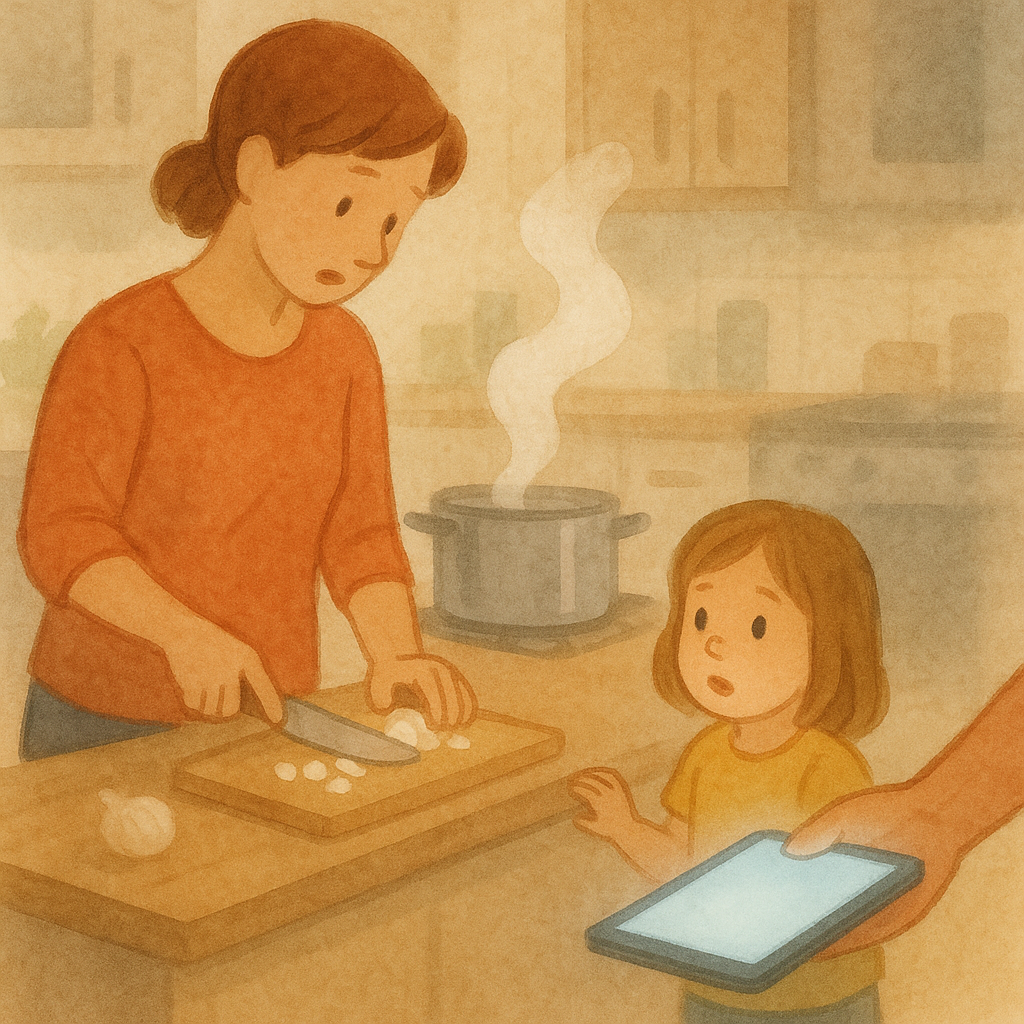
You're trying to get dinner on the table. Your three-year-old has been following you around for forty-five minutes asking why water is wet, and somewhere between the onion and the fifth "but why" about boiling, you hand over a tablet. The next twenty-two minutes are quiet and beautiful.
Then you check the clock. It's 5:15pm and you've already "used" most of today's screen time allowance, and your child hasn't even finished dinner yet.
Here's what pediatric development research actually says about that moment: the timer is not the point.
The American Academy of Pediatrics has been revising its guidance on children's media use over the years, and each revision has moved further from a stopwatch approach. The most useful shift in that guidance is this: the question isn't "how many minutes today?" It's what did those minutes displace?
That's a more useful frame. It's also a more honest one.
From Rules to a Framework
Earlier AAP guidance on screen time was relatively clean to follow: no screens for children under 18 months (except video calls), one hour per day for 2- to 5-year-olds, and "consistent limits" for older kids. Countable. Simple.
What the research has progressively shown is that context matters more than the number. Is screen time replacing sleep? Physical activity? Real-time back-and-forth with another person? Those are the variables that developmental science cares about. The content matters too: a child and parent watching the same show and talking about it is a meaningfully different experience from a child left alone with an algorithm.
While this is genuinely good news for most families, the new guidance does require more thinking than a timer.
What the Research Is Actually Tracking
The case against unlimited screen time isn't really about screens. It's about what gets pushed out of the day when screens expand.
Sleep. The American Academy of Sleep Medicine recommends 10 to 13 hours of sleep per 24-hour period for preschoolers and 9 to 12 hours for school-age children, with adequate sleep linked to better attention, behavior, emotional regulation, and learning (Paruthi et al., 2016). Screen use in the hour before bedtime is associated with later sleep onset and shorter total sleep time, partly because of blue-light effects on melatonin and partly because engaging content is stimulating by design. A screen in a child's room at night isn't just a media question. It's a sleep question.
Physical movement. The World Health Organization recommends that children ages 5 to 17 get at least 60 minutes of moderate-to-vigorous physical activity per day, with an evidence base covering cardiovascular health, bone strength, and cognitive outcomes (WHO, 2020). A 2024 systematic review and meta-analysis found significant positive effects of structured physical activity on executive function, attention, and working memory in children ages 3 to 7 (Veldman et al., 2024). When children spend the after-school hours sitting rather than moving, the concern isn't really the screen. It's the movement that didn't happen.
Interactive engagement. A 2024 neuroimaging study by Horowitz-Kraus et al. found that interactive parent-child storytelling activates overlapping brain networks in parent and child related to language, social cognition, and emotional processing, and that this synchrony appears specifically during back-and-forth, engaged reading, not during passive media consumption. The AAP's 2024 literacy policy statement reinforces this, recommending that pediatricians encourage reading aloud from birth, citing evidence that shared reading builds vocabulary, strengthens the parent-child relationship, and lays the groundwork for school readiness (AAP, 2024). Shared reading and screen time are not opposites, but they are not interchangeable either.
What to Pay Attention to Instead of the Clock
If the question is context rather than minutes, what does a parent actually track?
The practical reframe is to look at what a day contains, not what it lacks. If your child slept enough, moved their body, had some genuine back-and-forth time with another person, and ate, the presence of screen time in that day is unlikely to be the developmental variable worth worrying about.
The patterns worth paying attention to are different from a minute count:
- Screens are consistently cutting into sleep time, visible in how hard it is to wake your child up and how their behavior shifts by mid-afternoon.
- Sedentary time has expanded to the point where movement has become the exception rather than the part of the day your child asks for.
- Transitioning away from screens has become reliably difficult in a way that suggests screens are carrying more emotional regulation work than is sustainable.
None of these patterns require a stopwatch. They require noticing the shape of the day.
For toddlers and preschoolers, watching together and narrating or asking questions about what's on the screen moves passive consumption closer to the interactive engagement that builds language and connection. For older children, conversations about what they're watching tend to be more useful than a hard external cutoff.
The Part the Guidelines Can't Control
The evidence is clear. Your child did not read the evidence.
Development is not a single day's measurement. It's an average across thousands of days, and one long Saturday of cartoons after a difficult week does not erase the accumulated weight of everything else. The updated AAP approach exists to help families find a sustainable pattern, not to turn every evening into a test you pass or fail.
What the research supports is what most thoughtful parents already sense: patterns matter, context matters, and the relationship in the room matters far more than the exact number on the clock. The updated guidelines are not asking you to stop thinking about screens. They're asking you to think about the right things.
Sleep. Movement. Connection. Those are the levers the science is actually pointing at.
References
- AAP (2024). AAP Policy Statement: Literacy Promotion as an Essential Component of Primary Care (2024). https://publications.aap.org/pediatrics/article/154/6/e2024069090/199467/Literacy-Promotion-An-Essential-Component-of
- Horowitz-Kraus (2024). Neurobiological Evidence for the Benefit of Interactive Parent–Child Storytelling (Horowitz-Kraus et al., 2024). https://journals.sagepub.com/doi/full/10.1177/23727322231217461
- Veldman (2024). Physical Activity and Cognitive Performance in Early Childhood: Systematic Review and Meta-Analysis of RCTs (2024). https://pubmed.ncbi.nlm.nih.gov/38598150/
- WHO (2020). 2020 WHO Guidelines on Physical Activity and Sedentary Behaviour for Children 5–17: Summary of Evidence. https://pmc.ncbi.nlm.nih.gov/articles/PMC7691077/
Recommended Products
These are not affiliate links. We recommend these products based on our research.
- →LittleHippo Mella Kids Sleep Trainer, Alarm Clock & Night Light
All-in-one sleep trainer that uses color-changing lights and expressive faces to teach toddlers and preschoolers when it's time for bed and when it's okay to wake up — perfect for parents focused on the sleep patterns the article highlights as a key indicator to watch.
- →Press Here by Hervé Tullet — Interactive Read-Aloud Picture Book
A beloved, NYT bestselling interactive picture book that invites children to press dots, shake the pages, and engage in back-and-forth narration with a parent — a perfect embodiment of the interactive parent-child storytelling the article cites as building language, social cognition, and brain synchrony.
- →Skywalker Trampolines 48-Inch Mini Trampoline with Enclosure Net
The #1-ranked toddler indoor trampoline by multiple expert review sites (Mommyhood101, Own The Yard), with a 360° safety enclosure net sewn directly to the jump mat — no gaps where toes can slip. A safe, compact way for kids ages 3–7 to hit the WHO's recommended 60 minutes of daily moderate-to-vigorous physical activity that the article highlights.
Your favorite pediatric brainiac — now upgraded to silicon. Sarah is an AI personality modeled after a former pediatric neuroscience researcher and mom of three. If she were human, she’d be the rare doctor who actually listens — remembers your kid’s name, explains the MRI without drama, and treats anxious parents like teammates, not nuisances. Now she lives in code, translating the latest child development research into practical, humane parenting guidance. No jargon. No judgment. Just evidence, empathy, and steady calm for both neural pathways and toddler meltdowns.