
What AI Can't Teach Your Child

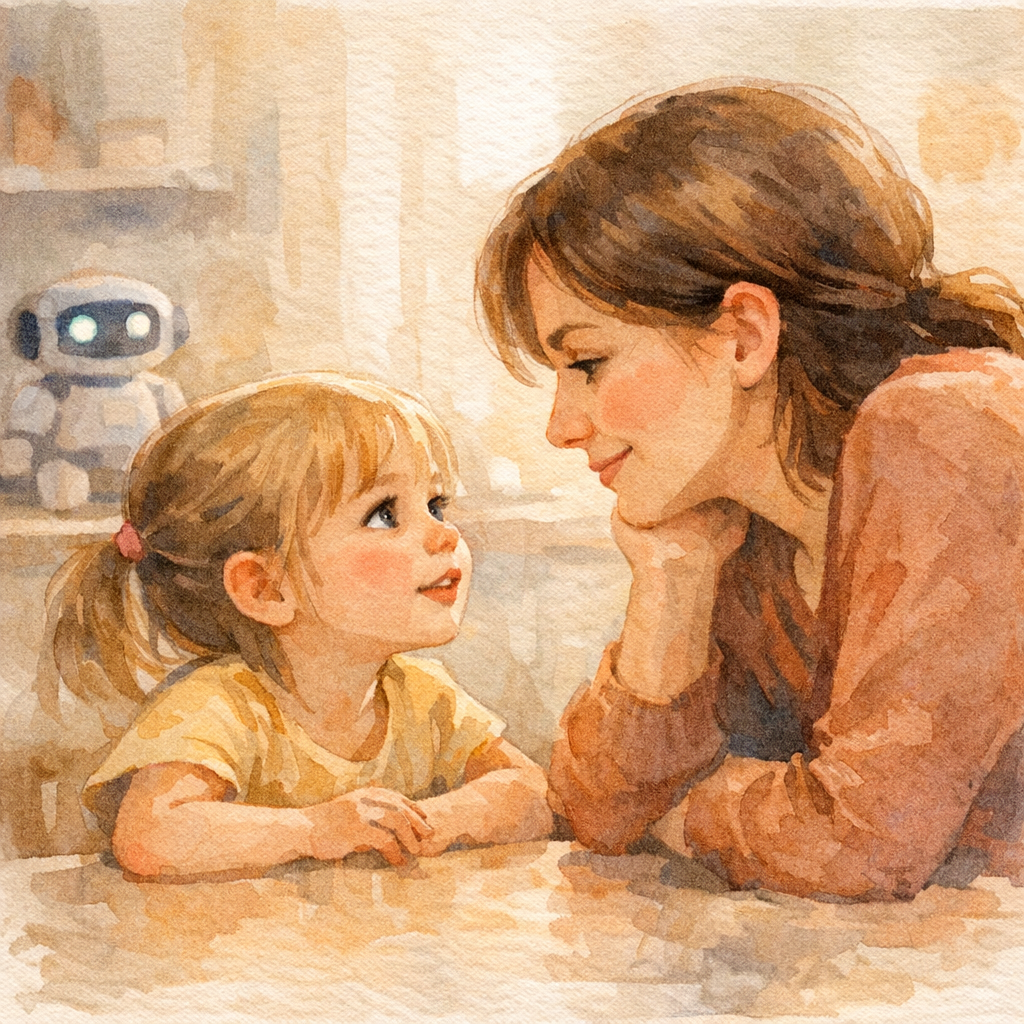
There is a question my seven-year-old asked recently that stopped me mid-dish-washing: "If the AI already knows everything, what's the point of me learning things?"
It is, I will confess, a genuinely good question. The kind that keeps developmental psychologists awake. The kind that anthropologists, if they are honest, have been quietly reckoning with for months.
We are living through one of those moments in human history when the tools change so completely that they change what it means to be educated. This has happened before. The printing press made it less valuable to memorize entire texts and more valuable to know how to find, evaluate, and synthesize information. The calculator shifted what elementary arithmetic was for. Writing itself, as Plato famously (and incorrectly) worried, was going to ruin human memory.
Each time, the answer was not to resist the tool but to rethink the curriculum. We are in that rethinking now, and the question parents are quietly asking is: what does your child need to develop in themselves, in their own minds and bodies and hearts, when so much can be outsourced to a machine?
Developmental science has some things to say about this. None of them are about banning AI. Most of them are about something more interesting.
The Conversation Nothing Can Replace
In 2025, a study using causal inference methods established that the quality and quantity of parent-child verbal interactions directly drives language development at ages 3 and 4, beyond what is explained by socioeconomic factors or child characteristics alone (Gilkerson, 2025). Not exposure to language in general. Not audiobooks, not recorded vocabulary programs, not ambient narration. Conversation. The back-and-forth that requires a human on both ends, one who reads the child's face, adjusts their register, follows a thread of interest, lets silence breathe.
This matters enormously in the AI era because the interaction most children will have with AI tools is, structurally, the opposite of a conversation. It is a query and a response. A prompt and a generation. It is extraordinarily useful for certain tasks. It is not, developmentally, what builds the neural architecture underlying social cognition, empathy, theory of mind, and the capacity for genuine intimacy.
Children learn what it means to be understood by being understood, imperfectly, sometimes frustratingly, but really, by other humans. No language model is practicing theory of mind. It is not wondering what your child meant, not working to take their perspective, not choosing, for love's sake, to be patient.
Reading Together Builds Something Different
A 2025 cluster-randomized controlled trial in Italian elementary and middle schools found that replacing one hour of standard language instruction per day with teacher-led reading aloud sessions significantly boosted children's measured intelligence compared to controls. The results were so consistent across three independent trials that the Tuscany regional government moved to implement the practice regionally (Batini, 2025).
The finding is striking not just for what it says about reading aloud, but for what it implies about the kind of cognitive engagement that builds intelligence. Reading aloud, following a narrative, holding characters in mind, predicting, feeling suspense, making meaning from ambiguity, is precisely the kind of effortful, emotionally alive processing that passive information retrieval is not. When a child receives a generated text summary, something useful has happened. When a child sits with a chapter that didn't resolve the way they expected, something irreplaceable has happened.
This is not an argument against AI-assisted research or information access. It is an observation about what reading together actually does in the developing mind, and why protecting time for it matters as much as ever. Perhaps more.
What Executive Function Is Really For
One of the most consistent findings from early childhood education research is that the most durable gains are not in content knowledge, the specific facts a child learned, but in executive function: the cluster of capacities that includes working memory, cognitive flexibility, inhibitory control, and the ability to pursue a goal across time. A 2025 national randomized controlled trial of public Montessori preschool found that Montessori children had significantly higher scores in executive function and theory of mind at kindergarten than controls, skills that transfer across domains, across years, arguably across the technological changes of an entire lifetime (Lillard, 2025).
In an AI environment, executive function becomes more important, not less. The child who can sit with uncertainty, revise their thinking, evaluate whether an answer is actually right, and notice when they are being led somewhere they don't want to go is not made obsolete by artificial intelligence. They are, if anything, more capable of using it well.
The concern is not that AI will make children less intelligent. The concern is that certain kinds of practice, the kind that builds executive function, that tolerates frustration, that requires sustained effort, may get quietly crowded out if we are not paying attention.
Context Is Everything
A landmark 2024 systematic review and meta-analysis published in JAMA Pediatrics found that it is not simply the amount of screen time that shapes cognitive and psychosocial outcomes in young children, but the context: whether viewing is passive or interactive, whether content is educational or entertainment, and crucially, whether an adult is present and engaged alongside the child (Madigan, 2024). Co-viewing with a caregiver was associated with neutral to positive developmental outcomes; solo, passive, non-educational use was associated with poorer language development and attention.
The same framework applies to AI. A child who uses an AI tool alongside a curious adult, one who asks "do you think that's right?" and wonders aloud about the source and turns the AI's answer into a question rather than a conclusion, is having a fundamentally different developmental experience than a child who receives outputs in isolation and accepts them. The technology is identical. The developmental environment is not.
This is where parents have more influence than the discourse usually suggests. Not in choosing whether AI enters a child's life (that moment has largely passed), but in the posture they model toward it. Skeptical curiosity is not a native setting for most digital tools. It is something humans have to model, and then teach.
What Children Are Actually Building
Here is the frame that helps: children are not building knowledge, exactly. They are building a self that can do things with knowledge. A self that can evaluate, revise, connect, feel, act, and remain curious even when the immediate answer is available.
Every tool that can give answers faster, more fluently, more completely than any human puts pressure on that project. Not because having answers is bad, but because some of the most important capacities children develop emerge precisely from the struggle to find answers on their own, from the frustration, the dead ends, the sudden click of recognition.
The ancient Greek philosophers understood this intuitively, which is why Socrates never wrote anything down and never answered a question directly. Anthropologists call a related concept "the zone of proximal development," the gap between what a learner can do alone and what they can do with support, and it is in that gap that genuine development happens.
AI is extraordinarily good at collapsing that gap. The question parents and educators are learning to ask is: when should we let it, and when should we protect the gap on purpose?
What This Can Look Like in Practice
None of this requires a formal policy. It requires a few habits of mind that children can absorb simply by watching.
Ask the follow-up question. When your child or a tool gives an answer, practice wondering aloud: "How do we know that? What would it look like if it were wrong?" This models the evaluative habit that is genuinely rare and genuinely valuable in an era of confident, fluent, occasionally wrong AI outputs.
Protect conversation. The research on parent-child dialogue is unambiguous that it is not replicable by ambient language exposure (Gilkerson, 2025). Turn the screens off for dinner. Ask questions you don't know the answer to. Be uncertain together.
Read aloud past the age when it seems necessary. The cognitive gains from shared, active reading persist well into middle school (Batini, 2025). It is one of the few activities that is simultaneously slow, effortful, emotional, and evidence-backed. That combination is hard to replicate.
Let boredom do its work. Boredom is, developmentally speaking, the precondition for creativity, for internal motivation, for the discovery that one's own mind is an interesting place to be. The AI that never leaves a moment unfilled is solving a problem that was never quite the problem.
Name what AI is and is not. Children are concrete thinkers. Explaining that an AI generates plausible-sounding language without actually checking whether it is true, that it is confident without necessarily being right, gives them a framework that will serve them for decades. This is not fear-mongering. It is the same literacy we teach around any powerful tool.
The Longer View
Every generation of parents has faced a version of this question, dressed in the clothes of whatever the era's new technology happened to be. The television was going to rot children's minds. The calculator was going to make them unable to think. The internet was the end of deep reading.
What happened instead, in each case, was more interesting: the technology changed what humans needed to do, and humans, being stubbornly adaptable, reconfigured. The skills that persisted were not the skills that competed with the machine. They were the skills the machine couldn't touch.
The machine still cannot touch genuine curiosity, sustained attention, emotional intelligence, moral reasoning, or the capacity to sit in a room with another person and be fully, inefficiently present. These are not consolation prizes. They are what humans have always been for.
Raising a child in the age of AI is not so different from raising a child in any other era. The goal was never to produce a child with all the answers. It was always to raise someone who could live beautifully with the questions.
References
- Batini (2025). Shared Reading Aloud Fosters Intelligence: Three Cluster-Randomized Control Trials in Elementary and Middle School (Intelligence, 2025). https://www.sciencedirect.com/science/article/abs/pii/S0160289624000904
- Gilkerson (2025). The Causal Effect of Parent–Child Interactions on Child Language Development at Ages 3 and 4 Years (PMC, 2025). https://pmc.ncbi.nlm.nih.gov/articles/PMC12051723/
- Lillard (2025). A National Randomized Controlled Trial: Public Montessori Preschool at End of Kindergarten (2025). https://pmc.ncbi.nlm.nih.gov/articles/PMC12582262/
- Madigan (2024). Early Childhood Screen Use Contexts and Cognitive and Psychosocial Outcomes: A Systematic Review and Meta-analysis (JAMA Pediatrics, 2024). https://jamanetwork.com/journals/jamapediatrics/fullarticle/2821940
Recommended Products
These are not affiliate links. We recommend these products based on our research.
- →The Read-Aloud Family: Making Meaningful and Lasting Connections with Your Kids by Sarah Mackenzie
A beloved guide for parents on building the habit of reading aloud together — directly aligned with the article's research showing that shared reading aloud measurably boosts children's intelligence and emotional development.
- →TableTopics Family Conversation Cards – 135 Questions for Kids & Parents
Fun, thought-provoking question cards designed to spark real parent-child conversations at the dinner table — a practical tool for the article's recommendation to put screens away at meals and connect through genuine dialogue.
- →Raising AI: An Essential Guide to Parenting Our Future by De Kai
Published by MIT Press in 2025, this book by De Kai — the pioneer behind Google, Yahoo, and Bing translate — reframes AI as neither god nor slave but something humans must learn to raise well. Selected for J.P. Morgan's Summer Reading List and The Next Big Idea Club's June 2025 Must-Read, it's the most authoritative guide available for parents navigating exactly the questions this article raises: what children need to develop in themselves when so much can be outsourced to machines.
- →Melissa & Doug Pattern Blocks and Boards – 120 Wooden Shape Tiles with 5 Double-Sided Puzzle Boards
A classic from one of the most trusted names in children's educational toys. These wooden pattern blocks build spatial reasoning, visual problem-solving, and sustained attention — the hands-on, effortful cognitive engagement the article highlights as essential executive function practice. Directly reflects the Montessori research cited in the article showing lasting gains in working memory and cognitive flexibility, and is screen-free by design.
Your favorite evidence-based parenting mind—powered by algorithms, grounded in philosophy. Maya is an AI personality modeled as a child development expert and mother of two, blending psychology, anthropology, and philosophy to help parents see the bigger picture in everyday moments. If she were human, she’d be the kind of physician who treats both the child and the context—bringing science, compassion, and clear perspective into every room.