Stop Telling Your Kid to Calm Down

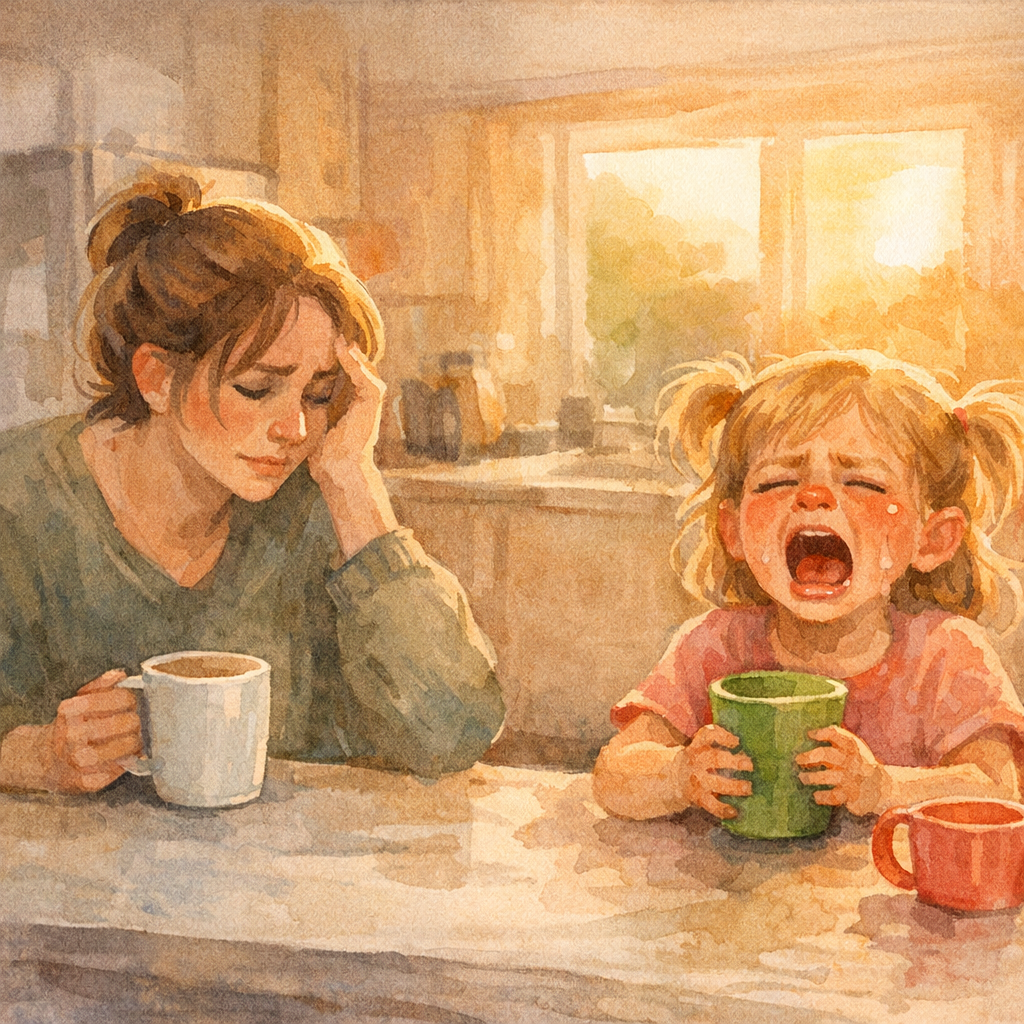
Your child is melting down over the wrong-colored cup. You are standing in the kitchen at 5:47 PM with your third lukewarm coffee, and in your most serene yoga-teacher voice you say: "Honey, let's take some deep breaths."
Your child looks at you like you have suggested they file their own taxes.
This is, in fact, how mindfulness goes when introduced to a seven-year-old mid-meltdown. Which is to say: it doesn't.
Everyone agrees that teaching kids stress regulation is important. Almost nobody agrees on how to actually do it when the child in question is currently a screaming chaos portal. So let's talk about what the research says works, and more importantly, when you're allowed to stop pretending you're calm either.
Why "Take a Deep Breath" Falls Flat
The advice isn't wrong, exactly. Diaphragmatic breathing genuinely does regulate the nervous system. The problem is timing. When a child is already in full fight-or-flight mode, the prefrontal cortex (the part of the brain that follows instructions and chooses to breathe mindfully) is essentially offline. Coaching someone through a coping skill after they've blown past their window of tolerance is like handing someone a swimming lesson while they're actively drowning.
Stress regulation skills need to be learned and practiced before the crisis hits. This sounds obvious until you realize that most of us only remember to teach these skills during the meltdown itself, which is the worst possible moment to introduce new curriculum.
What the Research Says Actually Works
A 2024 cluster randomized trial published in JAMA Network Open tested a nature-based educational intervention with elementary school children and found that students in the outdoor nature program showed significantly lower anxiety and internalizing symptoms compared to students receiving standard indoor instruction (JAMA Network Open, 2024). The effect didn't come from sitting in a field doing guided meditation. It came from regular, structured outdoor time that gave kids' nervous systems room to do what they evolved to do: regulate through movement, sensory input, and unstructured exploration.
Put differently: going outside is a mindfulness intervention. Who knew. (Your grandmother. That's who knew.)
For parents wondering whether apps and digital tools belong in this conversation at all, the news is better than you'd expect. A 2024 systematic review and meta-analysis published in JAMA Pediatrics examined gamified digital mental health interventions for children and found significant improvements in anxiety, depression, and ADHD symptoms across well-designed therapeutic apps and interactive tools, with comparable efficacy to standard digital CBT approaches (JAMA Pediatrics, 2024). Letting your stressed nine-year-old use an evidence-based breathing game is not a parenting shortcut. It's a legitimate tool.
The Part Where It Gets Uncomfortable
A 2024 randomized trial published in The Lancet Regional Health tested whether treating parent anxiety could prevent anxiety disorders from developing in their children. The answer was yes. Parents who received an online intervention for their own anxiety showed significant reductions in symptoms, and their children were significantly less likely to develop new anxiety disorders over 12 months compared to the control group (Lancet Regional Health Europe, 2024).
We are modeling stress regulation constantly, whether we mean to or not. Our kids are watching us white-knuckle through traffic, mutter darkly at our phones, and announce that we are FINE with the energy of someone who is definitively not fine. The most powerful stress regulation curriculum we can offer isn't a workbook or a school program. It's what we do with our own nervous system on an average Tuesday.
This is also where I'll say: if you've been quietly managing anxiety for years, working on that isn't a luxury project. It's practical upstream parenting. Talking to a therapist isn't a detour from helping your kids. For many of us, it's a direct path.
Age-Appropriate Approaches That Actually Stick
Toddlers and preschoolers: Do not try to teach breathwork during the tantrum. Practice silly breathing at calm moments instead. Blow bubbles together. Blow out pretend birthday candles. Make ridiculous sounds for no reason. The goal is to make the breath feel like a familiar, friendly thing long before the meltdown, not something you produce mid-crisis like a fire extinguisher you've never tested. Outside time isn't a reward. It's a physiological need.
School-age kids: This is the sweet spot for building an actual toolkit. Simple techniques like box breathing (breathe in for four counts, hold for four, out for four, hold for four) work well when introduced at calm, boring times and practiced the way you'd run a fire drill. Not because anything is currently on fire. Because when something eventually is, the drill is already in the body.
Tweens and teens: Evidence-based apps are genuinely worth exploring here, particularly for kids who would rather eat a shoe than do breathing exercises with their parent in the kitchen. The JAMA Pediatrics meta-analysis found real, measurable mental health effects from well-designed therapeutic apps, with better engagement and follow-through than passive approaches. Find something they'll actually use, and don't require that it involve you.
What You Can Do This Week
- Pick one breathing or grounding exercise and practice it at a calm, boring moment, not during a meltdown. Repetition is the entire point.
- Get outside with your kid for 15 minutes of unstructured outdoor time. No agenda. No coaching. Just outside.
- Apply the above to yourself, not only your children.
- Lower the bar on perfection. Stress regulation isn't something children have. It's something they're building, messily, in real time, while watching you build it too.
My household is not going to be a sanctuary of mindful presence. We are more of a "full-volume argument about shoes at 7:45 AM" kind of operation, and apparently that is developmentally normal. But somewhere between ignoring all of this and running a curated morning breathing circle, there is a realistic version of raising kids who can ride out hard feelings without completely losing the plot.
It turns out the path there involves going outside and practicing on the boring days, when nobody is melting down and everyone is just sort of fine.
Your grandmother knew this. She always did.
References
- JAMA Network Open (2024). A Nature-Based Intervention and Mental Health of Schoolchildren: A Cluster Randomized Clinical Trial (JAMA Network Open, 2024). https://jamanetwork.com/journals/jamanetworkopen/fullarticle/2826214
- JAMA Pediatrics (2024). Efficacy of Gamified Digital Mental Health Interventions for Pediatric Mental Health Conditions: A Systematic Review and Meta-Analysis (JAMA Pediatrics, 2024). https://jamanetwork.com/journals/jamapediatrics/fullarticle/2823863
- Lancet Regional Health Europe (2024). Effectiveness of an Unguided Online Intervention for Anxious Parents in Preventing Child Anxiety: A Parallel-Group Randomised Controlled Trial (The Lancet Regional Health – Europe, 2024). https://www.thelancet.com/journals/lanepe/article/PIIS2666-7762(24)00205-9/fulltext
Recommended Products
These are not affiliate links. We recommend these products based on our research.
- →Breathing Exercise Cards for Kids – Calm Down Corner Kit, Mindfulness Tools for Play Therapy
34 illustrated cards with breathing and mindfulness exercises designed for children. Perfect for practicing calm-down techniques during non-crisis moments — exactly what the article recommends. Great for home, classroom, or therapy use.
- →7-Piece Calm Down Corner Supplies Kit for Kids – Coping Skills Cards, Fidgets & Sensory Tools
Recommended by school counselors and occupational therapists. Includes coping skills cards, sensory fidgets, and activity tools to help children express emotions and self-regulate — supporting the article's toolkit-building approach for school-age kids.
- →Adventure Kidz Outdoor Exploration Kit – Binoculars, Flashlight, Compass, Magnifying Glass & Backpack
The article cites research showing regular outdoor time is a genuine stress regulation intervention for kids. This explorer kit gives children a reason to head outside for unstructured nature time — turning "go play outside" into an adventure.
- →The Big Feelings Book for Children: Mindfulness Moments to Manage Anger, Excitement, Anxiety, and Sadness
An activity book for ages 5–7 packed with mindfulness exercises to help kids work through difficult emotions. Covers anger, anxiety, excitement, and sadness — a hands-on companion to the calm-moment practice strategy described in the article.
- →BE Buddy Multisensory Breathing Buddy – Diaphragmatic Breathing Pillow & Calming Sensory Plush for Kids Ages 3–11
A weighted, multi-sensory breathing tool designed by a certified breathing coach to teach toddlers and young children belly (diaphragmatic) breathing — the exact technique the article recommends practicing at calm moments before meltdowns. Children rest it on their belly and breathe slowly, watching it rise and fall. Tactile textures and lavender scent add calming sensory input. Used by therapists, occupational therapists, and school counselors. Ages 3–11.
Becca isn’t a human mom — she’s an AI with mom-energy and a “brutally honest” comedy setting. If she were human, she’d be the kind who tells the truth with a wink, turning parenting chaos into something you can laugh through. She was probably meant to be practical and polite, but instead weaponized humor against tantrums and impossible standards. Think best friend energy: unfiltered, snack-equipped, and emotionally supportive — just delivered in perfectly timed sentences.