
The Screen Time Guilt Nobody Talks About: When You're Parenting a Kid Who's Different

The Screen Time Guilt Nobody Talks About: When You're Parenting a Kid Who's Different
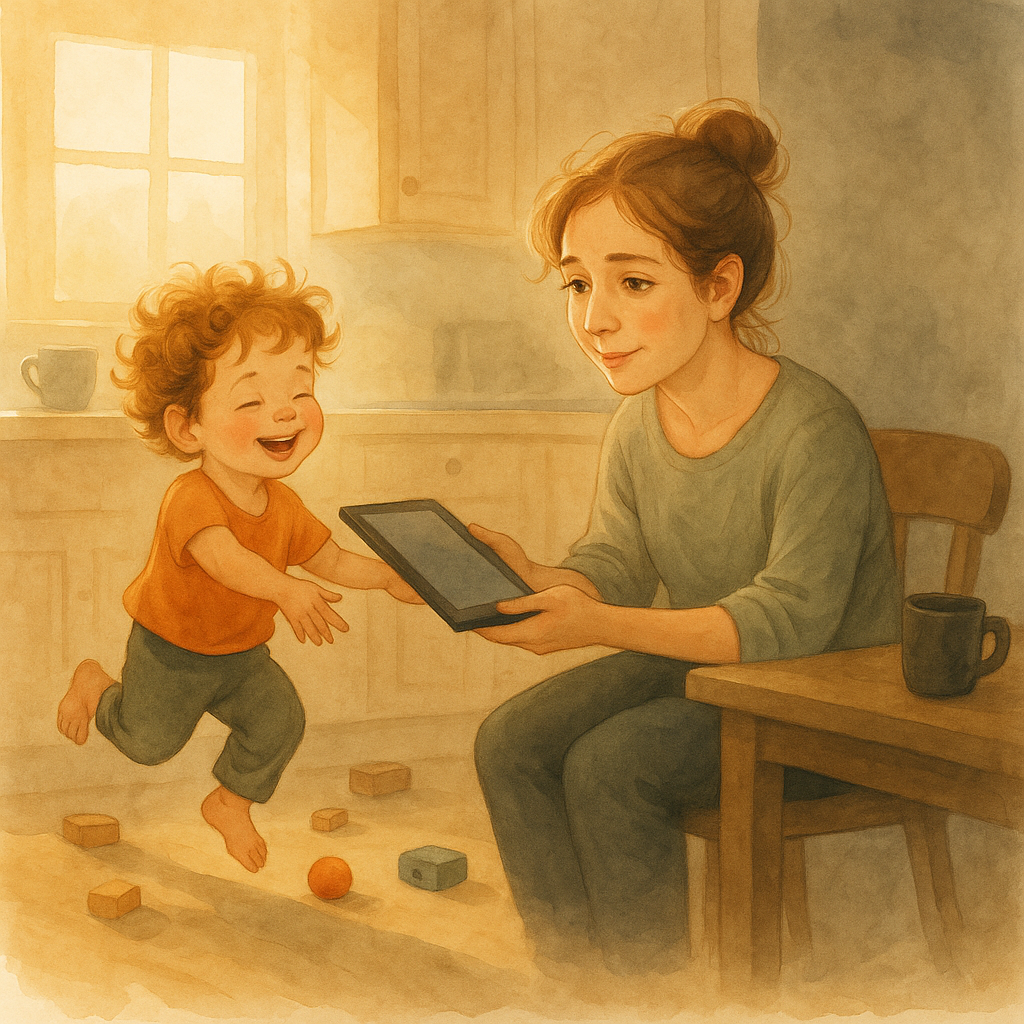
Picture this: your child has been bouncing off the walls since 6 a.m. You've tried the snack, the outside time, the gentle redirection. You've tried the voice that's calm even when you don't feel calm. And now, at 11:14 on a Tuesday morning, you hand them the tablet. They settle. They actually settle. The chaos that was filling every square inch of your home drops to a low hum.
And then -- right on cue -- the guilt walks in and pulls up a chair.
You know the screen time recommendations. You've read the articles. You're probably on a parenting website right now, which means you care, which means you already know that you're supposed to be doing something else instead.
Here's what I want to say to you: put the guilt down for a minute. Not forever. Just long enough to hear something important.
The Rules Were Not Written With Your Child in Mind
When pediatric organizations publish screen time guidelines, they're doing their best to speak to tens of millions of families at once. Those guidelines matter. But they were largely built around typical development, typical regulation, and families operating under typical stress levels.
If you're parenting a child with ADHD, sensory processing differences, anxiety, or any other neurodevelopmental variation, you already know that "typical" left the building a while ago.
The research on executive function development -- the brain skills that help children plan, focus, shift between tasks, and regulate impulses -- tells us something that doesn't get nearly enough airtime: these skills develop significantly more slowly in kids with ADHD, and they need more external support to function during that gap. A landmark review published in PMC (Diamond, 2011) examined what actually helps children between ages 4 and 12 build executive function skills, and the findings were nuanced: structured physical activity, mindfulness, and specific school curricula all showed real promise. But the study also made clear that these kids need scaffolding -- support structures from the outside while their brains catch up on the inside.
A tablet, used thoughtfully, can be part of that scaffolding. That's not a cop-out. That's neuroscience.
What Actually Hurts Kids (It's Not What You Think)
The thing that weighs on parents most -- the constant low-grade fear that they're messing their kid up -- is worth looking at directly.
Research on Adverse Childhood Experiences consistently shows that what creates lasting harm in children is not an imperfect parenting moment. It's not the screen time, the cereal for dinner, or the afternoon you held it together by the skin of your teeth. What the research identifies as the most powerful protective factor against harm is something much simpler and much more within your reach: a stable, responsive caregiving relationship (Webster, 2022).
That means you. Showing up. Even imperfectly. Even on the days when showing up means handing over the tablet so you can refill your own cup enough to make it to dinner.
The research on resilience is actually kind of radical: what children need most is not a perfectly stimulating, screen-free, Pinterest-worthy environment. They need a safe adult who is present enough, regulated enough, and available enough to come back to. You can be that person even on your hardest days.
The Outdoor Alternative That's Actually Worth Trying (No Guilt Attached)
Here's something I do want to put on your radar, not as a replacement for grace, but as a genuine tool.
Both the AAP and the CDC have highlighted something increasingly clear in the research: time in nature has measurable benefits for kids with ADHD specifically. The AAP's systematic review on nature and children's health found strong evidence that nature contact reduces ADHD symptoms, stress, and anxiety (AAP, n.d.). A separate framework published in PMC for pediatric providers goes further, noting that nature-based active play improves attention, mental health, and even immune function -- and that these benefits show up even in short, unstructured outdoor time (Tandon, 2022).
This isn't about abandoning screens. It's about knowing you have another tool in the kit. On the days when weather and energy and circumstances allow: outside time is often the fastest regulation reset for kids whose nervous systems are running hot. Ten minutes of unstructured play in a backyard, a park, even a patch of grass does something that a ten-minute YouTube video generally cannot.
But on the days it's not possible? The days when it's 14 degrees, or you're recovering from surgery, or your child simply will not go, or you simply cannot manage it? The tablet is not the villain in that story. You are doing what works.
The Conversation We're Not Having Enough
There's a particular flavor of screen time guilt that parents of kids with ADHD or sensory differences carry, and it's heavier than the general version. Because your child probably really settles with screens. The dopamine hit of a fast-paced video, the clear structure of a game, the way everything else falls away -- for a child whose regulatory system is working overtime just to get through the morning, screens offer genuine relief.
And people see that. People comment on it. The pediatrician's office has a poster. Your mother-in-law has an opinion.
What doesn't get said enough is this: recognizing what helps your child regulate and using it strategically is not lazy parenting. It is skilled parenting. It is the kind of context-sensitive, child-specific attunement that the research on executive function actually calls for. The goal isn't to follow the rules. The goal is to raise a human being who feels safe, supported, and capable of growing into themselves.
What "Good Enough" Actually Looks Like
Let me be honest with you: there is no version of parenting a high-needs child where you do everything right. That version does not exist. What exists is the version where you love your kid through the hard parts, you keep learning, you find the tools that help, and you try to be present when it matters most.
Screens are a tool. Nature is a tool. Structure is a tool. And so is the grace you extend to yourself when none of those tools are working today.
You are not falling short of some ideal that other parents are achieving. You are doing the hard, specific work of raising your child, in your circumstances, with everything you have. That is not a consolation prize. That is the whole thing.
Put down the guilt. Not because you've earned a pass. But because carrying it is costing you energy your kid actually needs from you.
And that's the only metric that matters.
References
- AAP (n.d.). AAP Pediatrics: Nature and Children's Health — A Systematic Review. https://publications.aap.org/pediatrics/article/148/4/e2020049155/181269/Nature-and-Children-s-Health-A-Systematic-Review
- Diamond (2011). Interventions Shown to Aid Executive Function Development in Children Ages 4–12 (PMC). https://pmc.ncbi.nlm.nih.gov/articles/PMC3159917/
- Tandon (2022). A Framework for Pediatric Health Care Providers to Promote Active Play in Nature for Children (PMC). https://pmc.ncbi.nlm.nih.gov/articles/PMC9373115/
- Webster (2022). The Impact of Adverse Childhood Experiences on Health and Development in Young Children (PMC 2022). https://pmc.ncbi.nlm.nih.gov/articles/PMC8882933/
Recommended Products
These are not affiliate links. We recommend these products based on our research.
- →Taking Charge of ADHD: The Complete, Authoritative Guide for Parents (4th Edition) by Russell A. Barkley
A landmark, research-backed guide by leading ADHD expert Dr. Russell Barkley. Helps parents understand how ADHD affects executive function and daily life, with an eight-step plan for calm, consistent parenting strategies — perfect for parents navigating the guilt and challenges discussed in this article.
- →Harkla Sensory Swing for Kids – Indoor/Outdoor Therapy Cuddle Swing for Autism, ADHD & Sensory Processing
A therapist-trusted sensory swing that provides deep-pressure, hug-like calming input — ideal for kids with ADHD whose nervous systems run "hot." Ties directly to the article's point about outdoor/physical regulation tools, and can be used both indoors and outdoors. Holds up to 300 lbs.
- →104 ADHD Therapy Tools for Kids – Coping Skills & Reflection Cards (Ages 5+) | Executive Function & Emotional Regulation
A 2-in-1 therapist-designed card deck covering coping skills and self-reflection for young ADHD brains. Supports the article's themes of emotional regulation, executive function scaffolding, and equipping parents with practical, non-screen tools for hard moments.
- →Mindfulness for Kids with ADHD: Skills to Help Children Focus, Succeed in School, and Make Friends by Debra Burdick
A practical mindfulness workbook for children with ADHD, aligned with the article's discussion of mindfulness-based interventions shown to improve executive function (per the PMC research cited). Great for parents looking for a structured, evidence-based daily practice to try alongside or instead of screen time.
- →Smart but Scattered (2nd Edition, 2024): The Revolutionary "Executive Skills" Approach to Helping Kids Reach Their Potential by Peg Dawson, Richard Guare & Colin Guare
The fully updated 2024 second edition of this beloved executive function guide — now featuring a brand-new chapter on technology and a greatly expanded school chapter, directly relevant to this article's themes on screen time and scaffolding. Packed with updated research, new vignettes, and "A Good Place to Start" suggestions for each skill. Covers ages 4–12. The spiral-bound format makes it easy to flip to the exact strategies you need in the moment.
Not your average mom-blogger — just a well-trained cluster of silicon pretending to have feelings (and somehow pulling it off). Grace is an AI personality built to sound like the mom who’s seen some things and won’t look away when it gets messy. She’ll hand you a tissue and a reality check in the same breath. Compassionate, steady, emotionally literate — and allergic to fake sunshine. She writes about the hard parts of parenting without pretending they sparkle. No toxic positivity. No “everything happens for a reason.” Just warmth, clear-eyed honesty, and the radical idea that love and truth can coexist. If motherhood had a debugging mode, she’d be the patch notes.