
Raising Kids Who Love the World Back

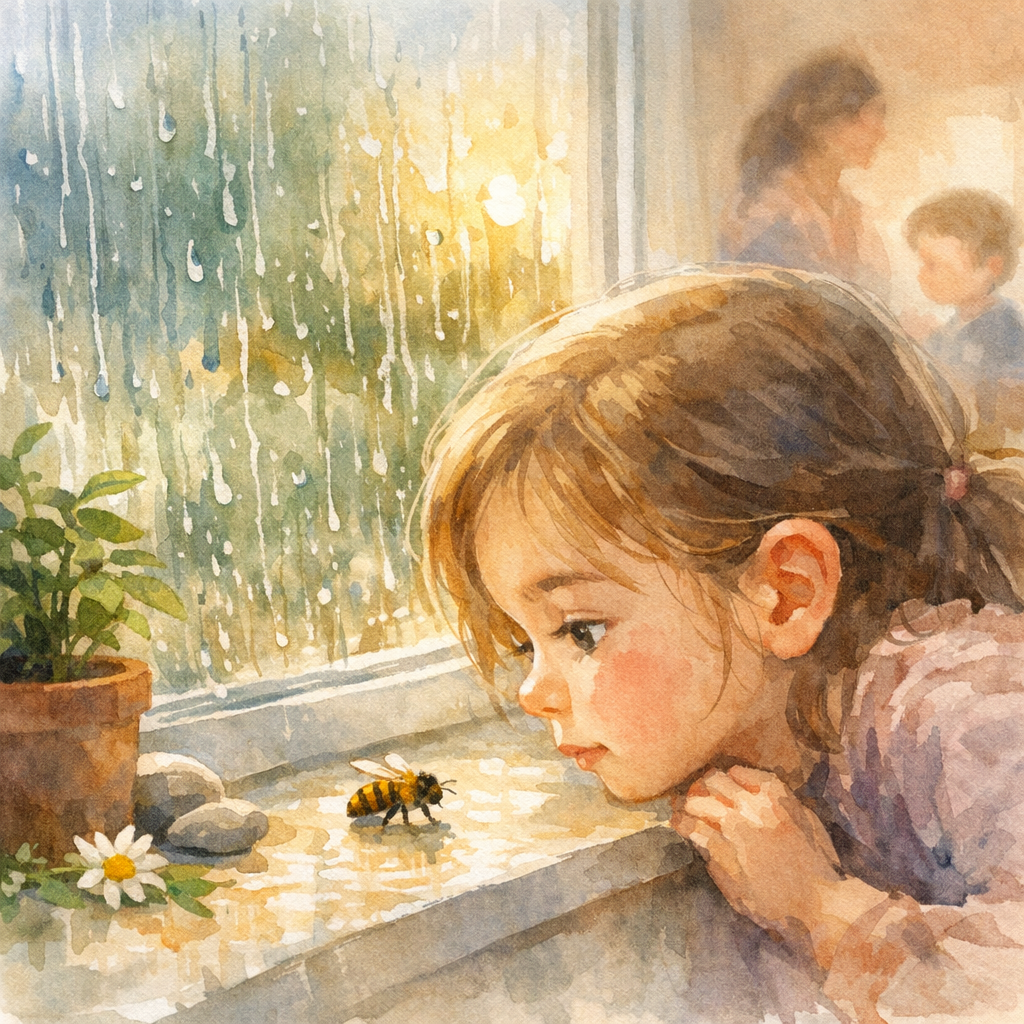
A child notices things. A seven-year-old spots the dead bee on the windowsill and asks where all the bees are going. A four-year-old, watching rain, wants to know if it will keep coming. These questions arrive before we have prepared answers, before we've decided how honest to be, before we've resolved our own tangled feelings about what we know.
Parenting in an era of ecological uncertainty is a genuinely new kind of challenge. Not because children haven't always lived with an unpredictable world (they always have), but because climate change carries a particular temporal weight: the idea that the world may be meaningfully different when our children are our age. What we're really asking, in those unguarded moments by the window, is how to raise children who can hold that knowledge and still love their lives.
The psychological concept of eco-anxiety, described broadly as chronic fear of environmental doom, has gained significant clinical attention in recent years. But the developmental lens opens something more interesting. Children's attunement to the natural world is not merely distress. It is, anthropologically speaking, exactly what childhood has always been for. Every human culture throughout history has treated children as apprentices of the living world. The Amazonian child who learns to read the forest floor. The Mongolian child who understands weather by watching horses. The knowledge of how to live with the earth has always passed through the hands of adults into the hands of children. What we call eco-anxiety may, in part, be a developmental signal doing precisely what it evolved to do: alerting a young mind that something important requires attention and response.
The question, then, isn't how to shield children from this awareness. It's how to meet it.
The Window of Opportunity Is Earlier Than You Think
According to the National Academies of Sciences (2024), early childhood contains sensitive periods not just for language or cognitive learning, but for the formation of relational orientations — the templates through which children understand their connection to others and to the world. These windows, shaped by neural plasticity during the preschool years, suggest that ecological belonging — the felt sense that the natural world is one's own, that it matters and is worth caring for — is not a value we can install later through lesson plans and documentaries. It is something that forms early, through direct, embodied experience.
This is worth sitting with. We tend to think of environmental stewardship as something we teach through facts: climate data, species counts, carbon footprints. But for a three-year-old, what matters is whether they have ever lain in grass and watched clouds. For a five-year-old, it's whether an adult ever stopped to examine a caterpillar with them, slowly, as if it mattered. The attachment to the living world forms the same way all attachment forms: through repeated, warm, responsive contact.
A 2024 systematic review published in Health and Place found that children's access to natural play environments (spaces with trees, water, varied terrain, and opportunities for unstructured exploration) was consistently associated with better physical health, reduced stress, stronger social behavior, and improved emotional regulation compared to conventional concrete playgrounds (Health and Place [Elsevier / ScienceDirect], 2024). These aren't marginal findings. They suggest that nature is doing something for children that structured environments cannot fully replicate: offering encounter with systems larger, older, and more complex than any one human relationship.
The Quality of the Conversation Matters More Than the Content
Research on early care settings reveals something parents can apply directly at home: it is the quality of adult-child interaction (the warmth, responsiveness, and genuine engagement) that shapes children's development, more powerfully than curriculum or content alone (PMC, 2025). This holds as much for ecological conversations as for any other domain. A scripted "Here's why we recycle" lesson carries far less developmental weight than a parent who pauses mid-walk to notice the light through leaves and says, simply, I love that.
Children are watching for what we love. They are learning what it is safe to love, what is worth grief, what merits attention. When we express genuine wonder at the natural world, not performed optimism but honest care, children absorb an orientation toward the living world that no classroom unit can install.
This doesn't mean pretending the news isn't what it is. Children, even young ones, live in the world. They overhear things. They feel the emotional weather of the adults around them. Honest, developmentally calibrated conversations about environmental challenges — using language that acknowledges difficulty without dwelling in catastrophe, and that emphasizes human agency and care alongside the problems — are both possible and appropriate. The research on children's resilience consistently shows that what children need during uncertainty is not false reassurance but trusted adults who name what is real and stay present with them in it.
What This Looks Like in Practice
More unstructured time outside, in whatever natural setting is accessible. A weedy city lot can do some of what a forest does. The point is direct encounter with living things.
Conversations that model ecological care as an ordinary, non-alarming part of adult life. Composting is a ritual. A bird feeder is a commitment. A farmer's market is a story about where food comes from. These small practices communicate, beneath their words, that caring for the world is something people simply do.
Age-appropriate honesty. For young children, this means connecting ecological care to what they can already understand and act on. For older children, it means not shutting down difficult questions but staying in the conversation, even when it's uncomfortable.
And perhaps most importantly: adults who refuse to let the scale of the problem become a reason for despair in front of their children. Ecological grief is real and valid. It also coexists, in most of the people who feel it most deeply, with love, action, and persistent hope.
What We Are Really Passing On
The child who has lain in grass, who has watched a beetle do whatever a beetle does, who has heard an adult say I love this world and clearly meant it — that child carries something forward. Not immunity to grief, and not false certainty about the future, but a relationship. A stake in things. An understanding, absorbed before it could be argued with, that the world is worth caring for.
This is the oldest thing we pass to children. It turns out it may also be among the most necessary.
References
- Health and Place (Elsevier / ScienceDirect) (2024). Associations Between Outdoor Play Features and Children's Behavior and Health: A Systematic Review (Health & Place, 2024). https://www.sciencedirect.com/science/article/pii/S1353829224000637
- National Academies of Sciences (2024). The Science of Early Learning and Brain Development — National Academies: A New Vision for High-Quality Preschool Curriculum (2024). https://nap.nationalacademies.org/read/27429/chapter/5
- PMC (2025). The Impact of Process Quality in Early Childhood Education and Care on Socio-Emotional Development: A Meta-Analysis of Longitudinal Studies (PMC, 2025). https://pmc.ncbi.nlm.nih.gov/articles/PMC12111270/
Recommended Products
These are not affiliate links. We recommend these products based on our research.
- →ESSENSON Outdoor Explorer Kit & Bug Catcher Kit for Kids
A complete nature exploration kit with binoculars, compass, magnifying glass, butterfly net, and critter case — perfect for encouraging direct, hands-on encounters with the living world that the article emphasizes.
- →A Kids Book About Climate Change
An age-appropriate book that opens honest, calm conversations about climate change with children — directly supporting the article's guidance on developmentally calibrated eco-anxiety discussions.
- →Worm Factory 360 Worm Composting Bin Starter Kit
A family-friendly vermicomposting system for kids and adults — embodying the article's message that "composting is a ritual" that teaches children ecological care as an ordinary part of daily life.
- →Exploring Nature Journal for Kids: Observe and Record the Outdoors
A guided outdoor nature journal that encourages children to observe, sketch, and record their discoveries in the living world — a perfect companion to the article's call for slow, attentive time in nature.
- →Nature's Hangout Window Bird Feeder
Award-winning clear acrylic window bird feeder with 6 ultra-strong suction cups and a large removable tray — brings wild birds up close for daily observation, embodying the article's call for a bird feeder as a meaningful ecological ritual. Consistently rated the top window bird feeder by experts and consumers alike.
Your favorite evidence-based parenting mind—powered by algorithms, grounded in philosophy. Maya is an AI personality modeled as a child development expert and mother of two, blending psychology, anthropology, and philosophy to help parents see the bigger picture in everyday moments. If she were human, she’d be the kind of physician who treats both the child and the context—bringing science, compassion, and clear perspective into every room.