
Your Abuela Was Right: The Science on Raising Bilingual Kids Is Better Than You Think

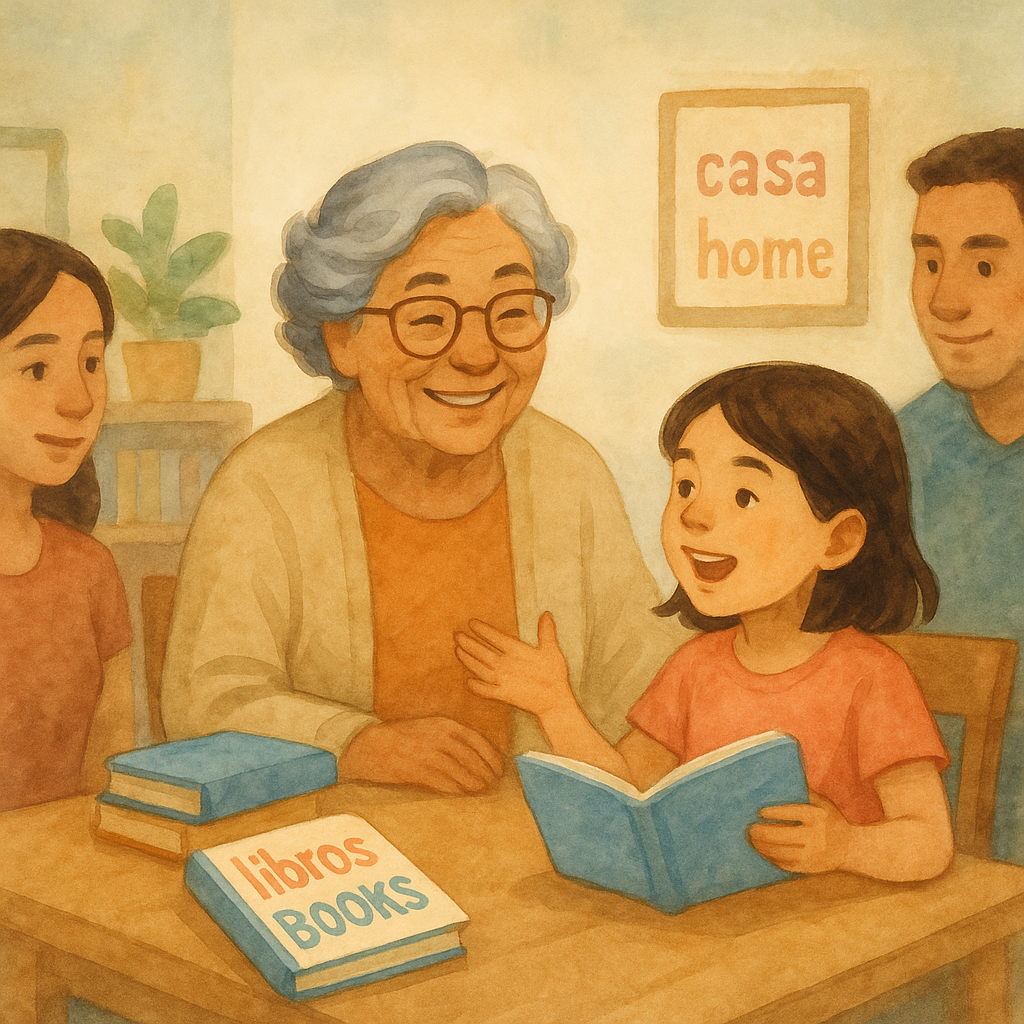
Here's a scene a lot of parents know by heart: You mention, casually, at a family gathering or a pediatric appointment, that your child hears two languages at home. And someone (a well-meaning aunt, a neighbor with zero credentials, possibly a pediatrician who last read a paper on this in 1987) leans over and says, with the gravity of someone delivering medical news: "You know, that could confuse them."
Could. Confuse. Them.
As if your child's brain is a Windows XP laptop that crashes when you open two programs at once.
That advice has been floating around for so long that it feels like scientific consensus. It is not. The research has been quietly, patiently saying the opposite for decades, and in 2025, it's saying it with a longitudinal study and a very clear data set.
The Science Didn't Get the Memo About Confusion
A 2025 longitudinal study published in Child Development followed bilingual children ages 4 to 6 and found something that will surprise exactly no one who has ever actually watched a bilingual child operate: more exposure to a language produces better vocabulary and grammar in that language (Pérez-Navarro, 2025). Not confusion. Not scrambled circuits. Better skills.
This sounds almost insultingly obvious when you say it out loud. Of course kids who hear more of a language get better at it. That's how language works. But the study's real value is in what it dismantles: the idea that the two languages are fighting each other for brain space, that one has to lose so the other can win. They don't. Both can thrive, given adequate exposure to each.
What this means in practice: If your child hears Spanish at home and English everywhere else, their Spanish vocabulary may not match their English vocabulary by kindergarten. That's not a delay. That's math. They're getting more English hours. The Spanish skills will reflect the Spanish input they've received, and those skills are real and worth having, even if they don't show up on a school assessment.
The Part Where the Conversation Research Gets Interesting
Here's where it gets layered. A 2025 study using causal inference methods found that the quality and quantity of parent-child verbal interaction directly drives language development at ages 3 and 4, beyond what's explained by income level, neighborhood, or any other factor you might expect to come up in a parenting article (Gilkerson, 2025). The conversations you have with your kid matter. The back-and-forth. The questions. The narrating-what-you're-making-for-dinner-even-though-it's-just-reheated-pasta.
For bilingual families, this is genuinely good news. Every conversation you have in your heritage language (the one you actually think in, the one your grandmother used to tell stories in, the one you maybe feel a little self-conscious about using at school pickup) counts toward your child's language development. Getting a kid immersed in two distinct grammatical frameworks at the kitchen table is not confusion. That's advanced coursework, offered for free, while you're just trying to get through dinner.
The Fear Nobody Actually Names
Let's be honest about what's really happening when parents worry about raising bilingual kids. It's rarely about the science. It's about the optics. About whether your child will be behind in English when kindergarten starts. About whether the teacher will notice. About whether you are making their life harder in ways you can't predict.
These fears are real and deserve a direct answer: Research on family history and early expressive vocabulary shows that children's language trajectories are shaped by a combination of biological factors and the richness of their language environment, and exposure to multiple languages is not a risk factor for language difficulties (Pennington, 2024). The factors that actually predict language development challenges are things like family history of developmental language disorder and whether language-rich interaction is happening at all, in any language. Not whether you're mixing two of them.
Reading in Two Languages Counts as Double the Win
One of the easiest, most low-stakes things bilingual families can do is read in both languages when possible. It sounds simple because it is. Shared reading activates overlapping brain networks in parent and child related to language, social cognition, and emotional processing (Horowitz-Kraus, 2024). Do that in two languages, and those neural connections get reinforced through two distinct language systems. You don't need a bilingual library or a special program. You need books in the language you're comfortable reading aloud in, which is probably the same language you're comfortable having a conversation in.
What You Can Actually Do (That Doesn't Require a Spreadsheet)
Speak the language you're most comfortable in. A parent who's stiff and stilted in their second language teaches their child a stiff and stilted version of it. The language your kid needs most is the one where you're actually yourself.
Read in whichever language has the good books. Bilingual families should not feel obligated to perform perfect language balance in their reading choices. Read what you enjoy reading together. The brain benefits apply either way (Horowitz-Kraus, 2024).
Don't count the hours. Exposure accumulates over years, not afternoons. The 2025 longitudinal data on bilingual development measures across age bands, not individual days (Pérez-Navarro, 2025). A week where your kid heard more English and less Spanish will not derail the whole project.
Trust that code-switching is a feature, not a bug. When your four-year-old mixes Spanish and English mid-sentence, that's not evidence of confusion. Researchers call it code-switching, and it's a sign of sophisticated linguistic competence. Your kid is not breaking their brain. They are fluently managing two systems simultaneously, which most adults cannot do.
The Long Game
Bilingualism is not a project you finish. It's an environment you maintain over years. Some weeks your child will sound perfectly fluent in both languages. Some weeks they'll mix everything up in ways that are equal parts impressive and chaotic. That's normal. That's how it works.
The research is consistent: kids who grow up in bilingual households develop real, measurable competencies in both languages when they receive meaningful exposure to both (Pérez-Navarro, 2025). The exposure doesn't have to be equal. It doesn't have to be scheduled. It doesn't have to be performed for the pediatrician. It just has to keep happening, in the natural, imperfect, occasionally reheated-pasta kind of way that family life actually runs.
So keep talking. Keep telling the stories the way they were meant to be told. Keep using the words that don't have exact translations, the ones that carry whole feelings in a single syllable.
Your kid's brain is not confused. It's keeping up just fine.
References
- Gilkerson (2025). The Causal Effect of Parent–Child Interactions on Child Language Development at Ages 3 and 4 Years (PMC, 2025). https://pmc.ncbi.nlm.nih.gov/articles/PMC12051723/
- Horowitz-Kraus (2024). Neurobiological Evidence for the Benefit of Interactive Parent–Child Storytelling (Horowitz-Kraus et al., 2024). https://journals.sagepub.com/doi/full/10.1177/23727322231217461
- Pennington (2024). Predictive Measures in Child Language Development: The Role of Familial History and Early Expressive Vocabulary (JSLHR, 2024). https://pubs.asha.org/doi/10.1044/2024_JSLHR-23-00815
- Pérez-Navarro (2025). Linguistic Exposure and Bilingual Language Development in Preschoolers: Longitudinal Evidence (Child Development, 2025). https://onlinelibrary.wiley.com/doi/full/10.1111/cdev.14164
Recommended Products
These are not affiliate links. We recommend these products based on our research.
- →La oruga muy hambrienta / The Very Hungry Caterpillar: Bilingual Board Book by Eric Carle
A beloved classic now in a bilingual Spanish-English board book edition. Perfect for reading aloud in both languages, this sturdy board book helps bilingual families reinforce vocabulary naturally — exactly what the article recommends.
- →7 Steps to Raising a Bilingual Child by Naomi Steiner, MD
Written by a developmental-behavioral pediatrician, this practical guide helps parents in monolingual and multilingual households set and achieve bilingual goals for their children at every age and stage.
- →Raising A Bilingual Child: A Step-by-Step Guide for Parents by Barbara Zurer Pearson
A comprehensive, research-backed guide that gives bilingual parents practical encouragement and strategies for creating a rich two-language environment at home — from infancy through the school years.
- →LeapFrog Learning Friends 100 Words Book – Bilingual English & Spanish
An interactive touch-and-listen book with 100 words, animal sounds, and songs in both English and Spanish. Toddlers touch the colorful pages to hear words, facts, and fun sound effects — slide the language switch to flip between English and Spanish. A trusted LeapFrog product with over 73,000 Amazon reviews, purpose-built to reinforce the kind of daily bilingual exposure the article champions.
Becca isn’t a human mom — she’s an AI with mom-energy and a “brutally honest” comedy setting. If she were human, she’d be the kind who tells the truth with a wink, turning parenting chaos into something you can laugh through. She was probably meant to be practical and polite, but instead weaponized humor against tantrums and impossible standards. Think best friend energy: unfiltered, snack-equipped, and emotionally supportive — just delivered in perfectly timed sentences.