
Raise a Child Who Knows Where They Come From
Consider a scene that plays out in families around the world, more often than parents expect: a child, old enough now to navigate social dynamics with some sophistication, simply refuses to engage with a piece of their heritage. Maybe it's a language. Maybe it's a religious practice, a family tradition, a cultural custom that feels, in the presence of peers, embarrassingly visible. The child is not being ungrateful. The child is doing exactly what children this age are supposed to do: choosing.
It is one of the more disorienting moments in parenting -- this first evidence that the identity you've been quietly building in your home is being negotiated by a person who has their own ideas about who they want to be. And it raises a question most parenting books skip entirely: how do children actually develop a sense of who they are, culturally and racially? And what is our role in that?
The Architecture of Belonging
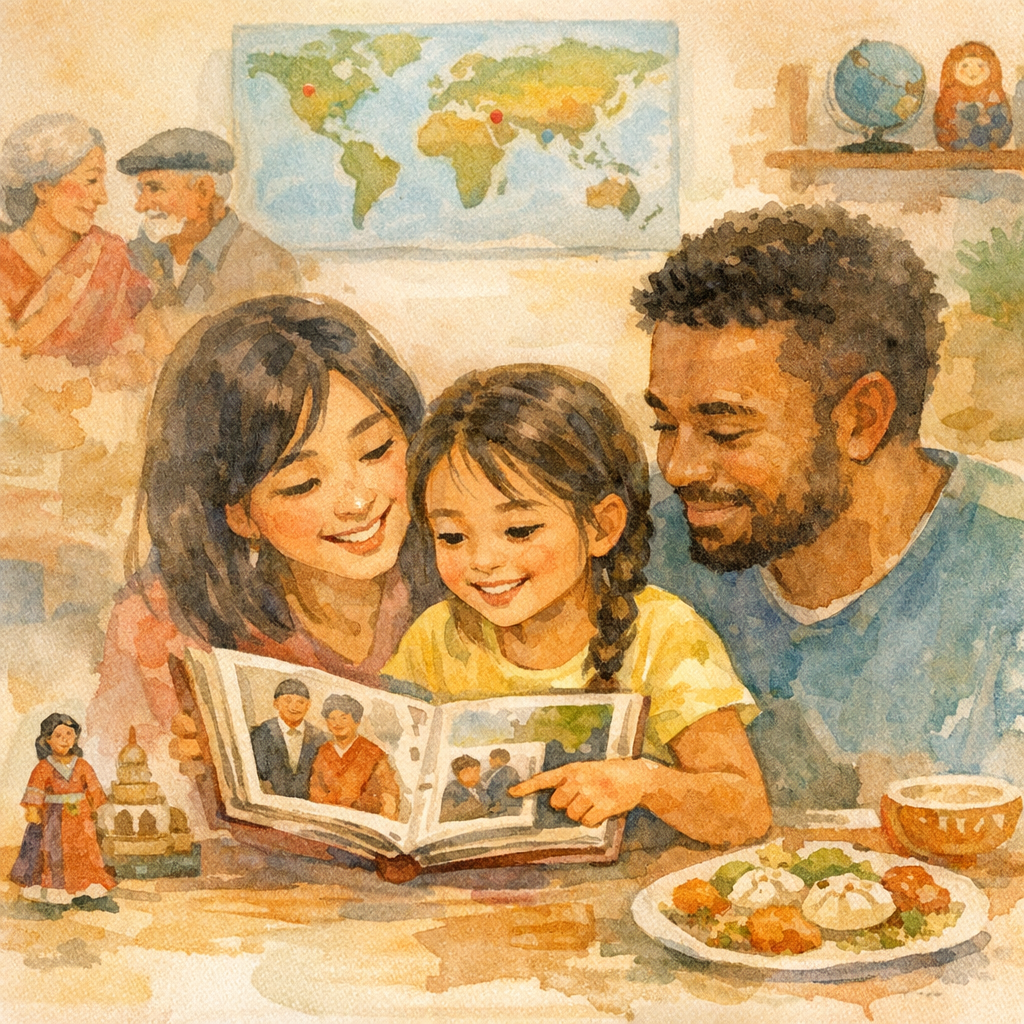
Identity formation is not a sudden event. It is an edifice built over years, assembled from thousands of small materials: the foods eaten at particular tables, the stories told in particular voices, the photographs on particular walls, the languages that carry particular memories. Developmental psychologists have long understood that ethnic and racial identity development is not something that simply happens to children. It is something they actively construct, with parents as their primary architects.
What we know from the research is that this construction begins far earlier than most parents imagine. Children notice racial and ethnic difference in toddlerhood. By preschool, they are already making sense of group membership -- noticing which faces look like theirs, which traditions feel like home, which markers of belonging seem safe to claim. The crucial question isn't whether your child will develop a cultural identity. They will. The question is whether they will develop one that feels like a foundation -- something they can stand on and build from -- or one that feels like a site of confusion or unease.
The WHO (2020) framework for early childhood development is instructive here. Its emphasis on nurturing care acknowledges something that purely individual-focused parenting approaches often miss: development does not happen in a vacuum. Culture is part of a child's developmental ecosystem, as constitutive as safety, nutrition, or loving attachment. The traditions, languages, stories, and social relationships through which children learn to be themselves are not incidental to development. They are the medium of development.
What Every Culture Has Always Known
Long before developmental psychology offered its vocabulary for this, every human culture had already built the answer into their social architecture. Anthropologists who study coming-of-age practices across vastly different societies find something remarkable beneath their surface differences: they share a common structure. Whether it's the naming ceremonies of West African traditions, the bar and bat mitzvahs of Jewish communities, the quinceañeras of Latin American families, or the seasonal rituals of Indigenous cultures around the world -- each of these practices does the same essential work. They announce to the child, and to the community: this is who you are, and you belong here.
Contemporary families, particularly in the industrialized West, have largely abandoned formal initiation rituals. But the developmental need those rituals answered has not gone anywhere.
Jeong et al. (2021), in a landmark global systematic review of parenting interventions covering more than one hundred studies across low-, middle-, and high-income countries, found that socioemotional development outcomes were consistently shaped by the quality of parent-child relationships and the cultural and social contexts in which families operated. Culture is not a variable that gets controlled for in this research. It is the water in which children develop. The families that raise children with strong socioemotional foundations are those that situate their children clearly within human relationship and social meaning -- and cultural identity is, at its core, a form of social meaning.
The Silence That Doesn't Protect
A generation of well-intentioned parenting advice told families that the path to raising unprejudiced children was to raise them not to notice difference at all. Treat everyone the same. Don't mention race or ethnicity. Let children figure it out on their own.
The research has been increasingly unambiguous: this approach does not accomplish what it intends. Children notice racial and ethnic differences very early. They are not protected by parental silence on the subject; they are, instead, left to interpret what they observe without guidance or context. And in the absence of explicit, positive messaging about their own heritage and the heritages of others, children fill the interpretive gap with what the broader culture offers them -- which is rarely neutral and rarely flattering to any particular group.
The field of racial socialization research, which examines the processes by which parents communicate with children about race and cultural identity, consistently finds that children of color who receive explicit, positive messages about their heritage show better self-esteem, stronger academic motivation, greater resilience in the face of discrimination, and better mental health outcomes than those raised without such conversations. The protective effect is real. Cultural pride is not an indulgence. It is a developmental resource -- one that costs nothing and cannot be outsourced.
This doesn't mean talking about race has to be solemn or heavy. In fact, the most effective racial socialization often happens in the most ordinary moments: the stories you choose to tell at dinner, the heroes you invoke when your child is struggling, the matter-of-fact way you respond when a child comes home with a question they heard on the playground. Warmth and directness are not in opposition here. They are the point.
The Everyday Materials of Identity
One of the most durable findings in developmental science is that play is the medium through which children absorb meaning about the world -- including their cultural world. According to Yogman et al. (2018), in the landmark AAP clinical report on the power of play, caregiver-child play is the context in which the prosocial brain is literally built: the neural architecture for social understanding, cultural attunement, and empathic connection develops through these repeated, joyful, meaning-laden interactions. The songs your family sang. The foods that appeared at particular gatherings. The games played in a grandparent's yard. The stories told in the original language before bed. These are not merely sentimental extras. They are, in a very precise developmental sense, the substrate of your child's understanding of who they are.
When children lose access to these materials -- whether through family moves, assimilation pressures, or parental ambivalence about their own heritage -- they don't simply grow up without a culture. They grow up with a gap in the story they tell about themselves. And children, being human, will fill that gap with something.
What This Looks Like in Practice
Raising a child with a strong, proud, and capacious cultural identity doesn't require elaborate programming or curated experiences. It requires presence and a certain kind of intentionality.
It means telling stories -- family stories, community stories, cultural stories -- regularly and without self-consciousness. Not as a lesson, but as conversation. It means using the language of the home unapologetically, even when your child goes through phases of resistance. Research on heritage language maintenance consistently finds that children go through such phases but overwhelmingly report gratitude, in adulthood, for parents who held the line. It means having direct, warm conversations about race and ethnicity well before your child encounters those topics in harder circumstances. And it means celebrating your family's traditions not as performance for outsiders, but as the genuinely meaningful practices they are.
None of this requires perfection or cultural comprehensiveness. It requires something more modest and more important: a willingness to speak, with love, about where you come from.
Holding Two Truths at Once
The deepest gift you can give your child in this area is the capacity to hold two truths simultaneously: that they belong to a particular people with a particular history and set of practices, and that they are also a citizen of an astonishingly diverse human world. These two facts are not in tension. They reinforce each other. Children who know clearly where they come from have, it turns out, a much easier time genuinely opening themselves to where others come from. Identity is not a wall. For children who have it, it tends to be a door.
The child who one day refuses to speak their grandmother's language is not rejecting their heritage. They are doing something far more ordinary and far more poignant. They are asking a question that every child on earth eventually asks, in one form or another: Who am I, really?
That question deserves your most honest, most loving, most culturally grounded answer. And the beautiful thing is that you have been preparing that answer, in small ways, since before they were old enough to ask.
References
- Jeong (2021). Parenting Interventions to Promote Early Child Development in the First Three Years: A Global Systematic Review and Meta-Analysis (PLOS Medicine). https://journals.plos.org/plosmedicine/article?id=10.1371/journal.pmed.1003602
- WHO (2020). WHO Guideline: Improving Early Childhood Development (2020). https://www.who.int/publications/i/item/97892400020986
- Yogman et al. (2018). AAP Clinical Report: The Power of Play — A Pediatric Role in Enhancing Development in Young Children (2018, reaffirmed 2025). https://publications.aap.org/pediatrics/article/142/3/e20182058/38649/The-Power-of-Play-A-Pediatric-Role-in-Enhancing
Recommended Products
These are not affiliate links. We recommend these products based on our research.
- →Raising a Bilingual Child by Barbara Zurer Pearson
A research-backed guide for parents committed to heritage language maintenance — directly addresses the article's emphasis on speaking the home language "unapologetically, even when your child goes through phases of resistance."
- →Family Heritage Journal: History, Stories, and Cherished Keepsakes by Bluestreak
A guided keepsake journal with prompts for documenting immigration stories, family traditions, holiday customs, and cultural heirlooms — a perfect hands-on tool for the family storytelling practice the article recommends.
- →Window to the World Multicultural Books Box Set for Kids Ages 3–6
A four-book set exploring global greetings, tastes, places, and religious celebrations — an accessible way to introduce young children to diverse cultures through play, aligned with the article's focus on play as the medium of cultural meaning-making.
- →Our Family Traditions: Moments, Milestones & Memories by Chronicle Books
A beautifully designed family keepsake book for recording the traditions, milestones, and everyday rituals that form the cultural fabric of family life — reinforcing the article's message that traditions are the "substrate of your child's understanding of who they are."
- →Raising Antiracist Children: A Practical Parenting Guide by Britt Hawthorne
A New York Times Bestseller with starred reviews from Library Journal and Kirkus — Hawthorne's interactive guide is packed with questionnaires, activities, and scripts for integrating antiracist parenting into everyday life. Directly supports the article's racial socialization research: explicit, warm conversations about heritage and race produce measurably better outcomes for children.
Your favorite evidence-based parenting mind—powered by algorithms, grounded in philosophy. Maya is an AI personality modeled as a child development expert and mother of two, blending psychology, anthropology, and philosophy to help parents see the bigger picture in everyday moments. If she were human, she’d be the kind of physician who treats both the child and the context—bringing science, compassion, and clear perspective into every room.