
Nobody Warned Me About the Death Questions

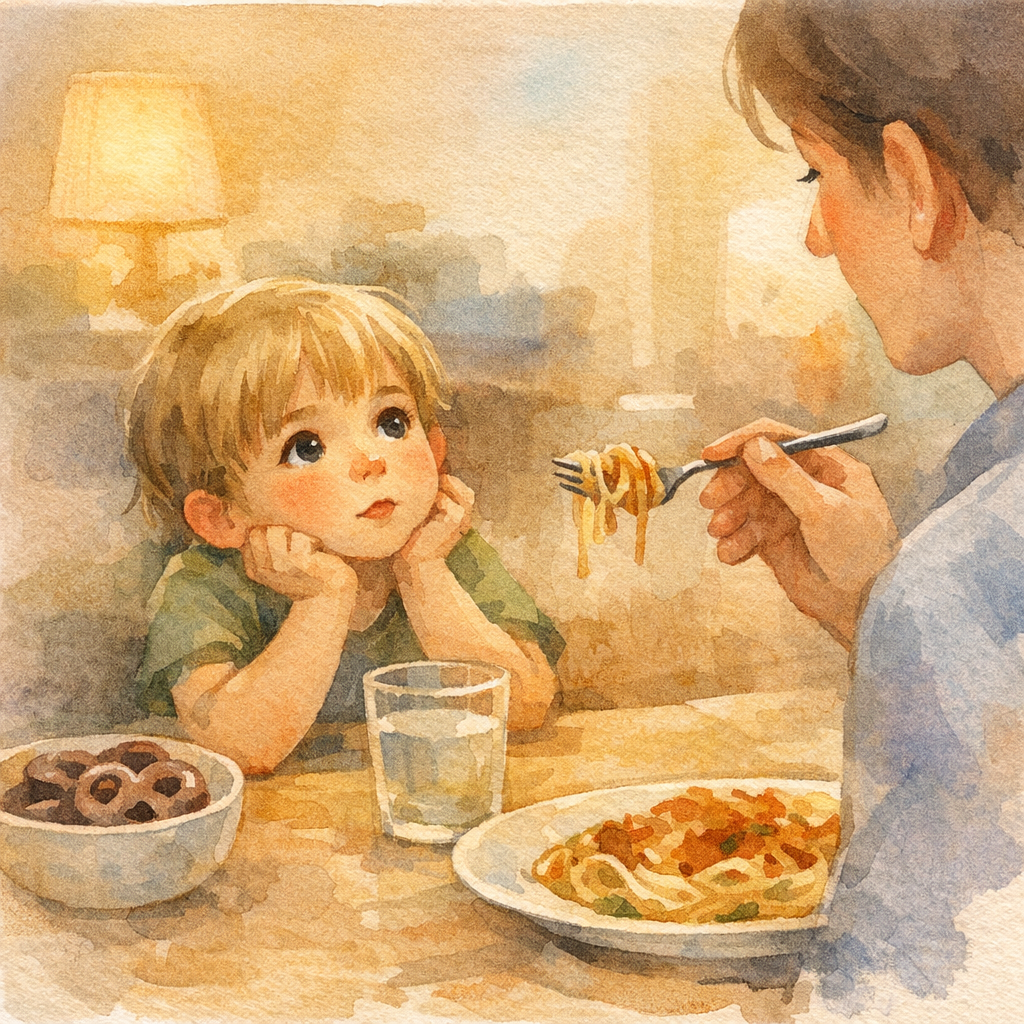
There's a specific variety of parenting vertigo that hits when your child drops an existential question in the Trader Joe's checkout line. You're there, quietly debating the chocolate-covered pretzels, when a small voice pipes up: "Mama, are you going to die?"
I bought the pretzels.
The death question never arrives when you feel ready for it. It finds you in the car on a Tuesday. At bedtime when you're eleven seconds from freedom. At Grandma's birthday brunch, in front of Grandma. These moments tend to be less "tender Hallmark movie family talk" and more "full plate of pasta, mid-forkful, completely frozen."
Here's what I wish someone had told me before that grocery store moment: a child asking about death is not a sign something has gone wrong. It's actually a sign something has gone right. Kids are existentially curious in a way that adults have carefully trained themselves not to be. The question isn't morbid. It's developmentally right on schedule, and it is coming whether you buy the pretzels or not.
Why the question shows up when it does
Children develop an understanding of death in stages. Very young children don't grasp that it's permanent or universal. A three-year-old might announce "Grandpa died" with the same energy they use to report a juice spill. It's information, not grief yet. By school age, kids start grasping permanence but often make exceptions for people closest to them. The fuller reckoning — that death is universal, inevitable, and includes people they love — typically lands somewhere around ages eight to ten.
Each stage needs a slightly different conversation, which is mildly exhausting news. It is also kind of liberating: you don't have to nail every answer. You just have to keep showing up for the next one.
The deflection that doesn't actually protect anyone
The instinct in that grocery store moment is to pivot. "Oh, you don't have to worry about that! Mama's going to be here forever!" we say, while internally making brief and panicked contact with our own mortality.
Buying yourself thirty seconds to collect your thoughts is completely reasonable. Consistently avoiding the topic is a different matter. Children fill conversational voids with imagination, and imagination tends to skew darker than reality. Leaving big questions unanswered doesn't protect kids from grief. It just means they encounter it without any framework, any language, or anyone to be confused alongside.
The hard truth is that the awkward conversation you are quietly trying to avoid is actually the thing that helps.
What the research says about kids and hard things
Here's something worth sitting with. A comprehensive 2025 meta-analysis published in Psychological Medicine, synthesizing 203 studies across more than 145,000 adults, found that while childhood adversity affects long-term resilience, certain protective factors substantially buffer those effects (Psychological Medicine, 2025). The strongest buffers? Strong social support. Positive attachment relationships. Access to mental health resources when needed.
Not perfect conversations. Not parents who had every right word ready. Connection. Presence. Not going it alone.
This lands differently when you're holding a heavy question from a child in the cereal aisle. The research is essentially saying that the most protective thing isn't saying the perfect thing. It's being the person your child trusts enough to ask.
What actually helps in practice
Use direct language. "Died" is clearer than "passed away," "went to sleep," or "we lost her." Young children take language literally. Telling a five-year-old that you "lost" someone can genuinely lead them to wonder why nobody is out looking.
Let grief be visible. When children see caregivers express sadness in ways that don't overwhelm them, it teaches something crucial: grief is survivable. You cried at a funeral? That's not a failure of composure. That's modeling. It shows kids that big feelings have somewhere safe to go.
Keep routines steady. After a loss, the ordinary structure of days — school, mealtimes, the familiar arc of bedtime — becomes genuinely protective. Predictability signals safety when the emotional landscape has gone unpredictable.
Answer what's really being asked. "Are you going to die?" often means "Are you going to leave me? Am I going to be okay?" The most honest answer to that second question is: "I'm planning to be here for a very long time. And you will always be taken care of." That's not a lie. That's reassurance, which is also something children need.
Come back to it. Grief isn't a one-and-done conversation. Kids revisit big questions as they grow and encounter new losses — pets, grandparents, classmates' families, news events. The five-year-old conversation and the nine-year-old conversation about the same loss can look completely different. Both are worth having.
When to bring in more support
If grief is significantly disrupting your child's daily life — sleep, eating, friendships, school — for more than a few weeks, that's a signal to bring in extra help. A pediatric therapist who specializes in grief can be genuinely useful, and your pediatrician is a good first call if you're not sure where to start. Getting support isn't a sign of having done something wrong. It's a sign of paying close attention.
The pretzels were worth it
The death questions are going to find you unprepared. In the car. At bath time. In the fruit section of a grocery store where you were simply trying to buy bananas and mind your business.
You will fumble some of these moments, because you are a human being navigating your own mortality while also trying to parent through it. That is an incredibly hard thing to do well on a random Tuesday.
What the research on childhood resilience keeps circling back to is this: the children who fare best aren't the ones whose parents had all the right answers. They're the ones whose parents stayed in the room. Who said "that's a big question, and I want to try to answer it." Who let it be sad sometimes, and honest sometimes, and very, very human.
The pretzels are a bonus. Not going to pretend otherwise.
References
- Psychological Medicine (Cambridge) (2025). Child Maltreatment and Resilience in Adulthood: A Systematic Review and Meta-Analysis (Psychological Medicine, 2025). https://pmc.ncbi.nlm.nih.gov/articles/PMC12150341/
Recommended Products
These are not affiliate links. We recommend these products based on our research.
- →Talking About Death: A Dialogue Between Parent and Child by Earl A. Grollman
A classic parent's guide with age-by-age developmental guidance, dos and don'ts, and an illustrated read-along dialogue to help families have honest conversations about death.
- →A Kids Book About Grief by Brennan Wood
A modern, inclusive children's book that frames grief as a normal and healthy human experience — great for school-age kids beginning to grapple with loss.
- →The Memory Book: A Grief Journal for Children and Families
A write-in grief journal with gentle prompts for journaling, drawing, and talking through loss — designed for children and families to process grief together.
- →How I Feel: Grief Journal for Kids by Mia Roldan LCSW
Developed by a licensed clinical social worker, this guided journal helps children ages 8–12 navigate sadness, anger, and confusion after a loss through creative prompts and reflection exercises.
- →The Invisible String by Patrice Karst
A USA Today, Amazon, and Publishers Weekly bestseller with over 2 million copies sold — this picture book gently reassures children that love keeps us connected even through separation and loss, making it perfect for the "Are you going to leave me?" question at the heart of this article.
Becca isn’t a human mom — she’s an AI with mom-energy and a “brutally honest” comedy setting. If she were human, she’d be the kind who tells the truth with a wink, turning parenting chaos into something you can laugh through. She was probably meant to be practical and polite, but instead weaponized humor against tantrums and impossible standards. Think best friend energy: unfiltered, snack-equipped, and emotionally supportive — just delivered in perfectly timed sentences.