It's Not Defiance. It's Blood Sugar.

It's Not Defiance. It's Blood Sugar.
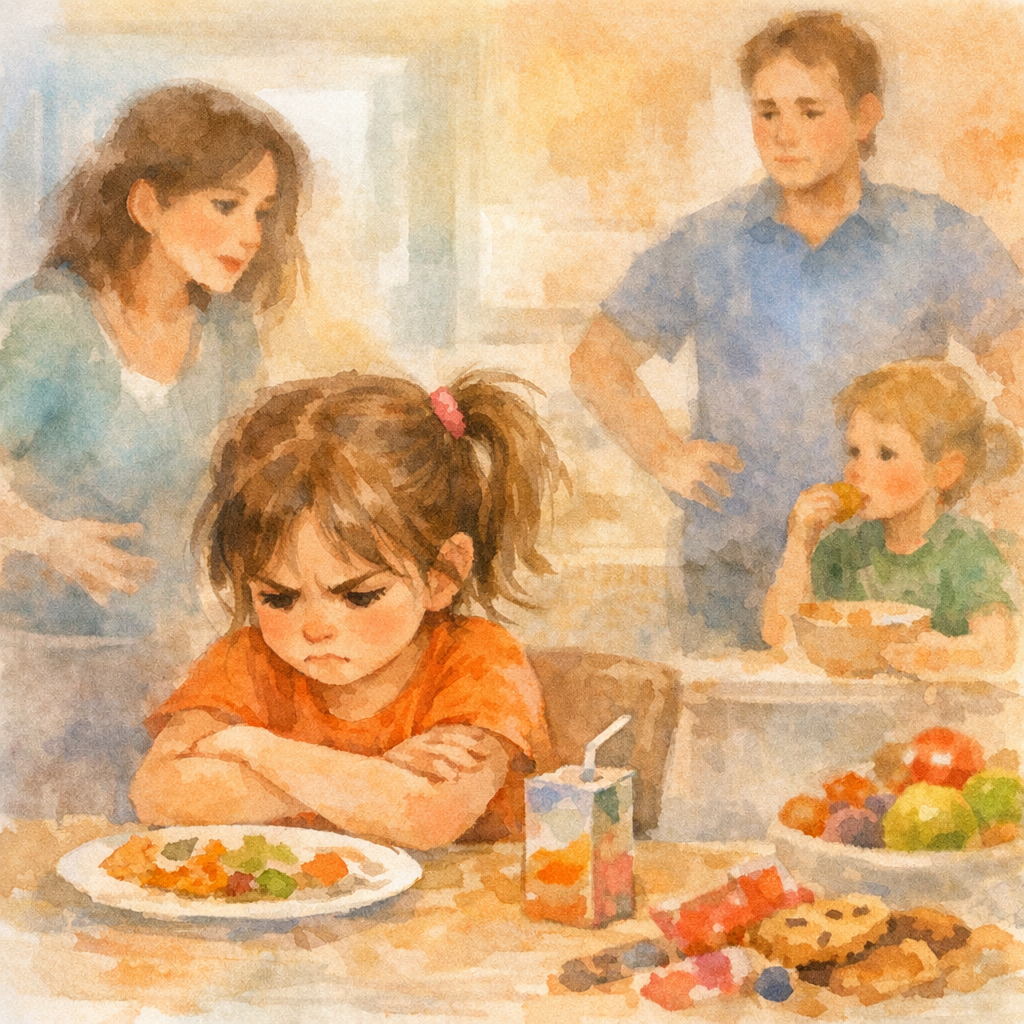
Every afternoon around 4pm, something happens in houses across America. A child who ate lunch, played, and was completely fine by all observable measures suddenly becomes... not fine. The sock is wrong. The cup is wrong. Their sibling is breathing wrong. And you're standing in the kitchen thinking: what happened to my pleasant child, and what is this feral creature who has taken their place?
Here is what I have learned, after years of blaming myself, blaming the weather, and briefly considering whether my kids might be possessed: the witching hour is not a behavior problem. It's a brain fuel problem.
The Developing Brain Runs on Actual Food
This sounds obvious when you say it out loud, but the implications are genuinely kind of alarming. Children's brains are not just smaller adult brains. They're engines under active construction, consuming a disproportionate share of the body's energy to power growth, learning, and the regulation of emotions. When that fuel is inconsistent, improperly timed, or nutritionally hollow, the construction project gets loud.
The World Health Organization has spent decades studying early childhood nutrition precisely because these years are not just about keeping kids alive. They're about building the hardware (World Health Organization, 2023). Early nutrition shapes immune function, brain architecture, and the very regulatory systems that determine how a child handles frustration, transitions, and sock texture. The stakes, it turns out, are slightly higher than whether they'll eat the broccoli.
The Problem with "Kid Food"
Here's where things get a little uncomfortable: most of what gets marketed to children as food is nutritionally engineered to be convenient for adults and appealing to kids, which are basically the opposite of what a developing brain needs. Crackers shaped like fish. Pouches that glow improbable shades of orange. The beloved "snack" category, which has somehow become an entire food group.
Research on childhood diet and metabolic health has consistently found that combining dietary improvements with physical activity works far better than either approach alone (JAMA Network Open, 2025). Which seems like common sense until you realize what that actually means: you cannot undo a diet of ultra-processed foods with exercise, and you cannot undo a sedentary lifestyle with good eating. The brain needs both, together, consistently.
That means the problem is not just "too much sugar." It's a whole pattern: the spike, the crash, the repeat. By 4pm, a child who had a bagel for breakfast, crackers at lunch, and a fruit snack after school has been riding a blood sugar roller coaster for six hours. The meltdown is not defiance. It's chemistry.
The Part Where Movement Comes In
I want to pause here to deliver some news that felt personally inconvenient when I learned it: physical activity is not just about health outcomes down the road. It is mood regulation. Right now. For the current child. Today.
A 2025 systematic review found that properly supervised physical activity in school-age children produces meaningful improvements not just in physical fitness, but in attention, executive function, self-esteem, and confidence (PMC, 2025). These are not vague, future benefits. These are "will this child survive until dinner" benefits.
And it matters where that movement happens. Research on outdoor play environments found that natural settings with trees, grass, and room to roam consistently produce reduced stress and improved emotional regulation compared to more structured indoor environments (Health and Place, 2024). The reason the old-school "go outside and don't come back until dinner" approach worked is that kids were outside, moving, on natural terrain, doing whatever kids do. And apparently that combination is genuinely excellent for the human brain.
What This Actually Looks Like at 4pm
I am not suggesting you overhaul your family's diet, install a nature preserve in your backyard, and solve this by Tuesday. I am suggesting something smaller and immediately achievable.
Treat the after-school snack like a meal, not a filler. Protein, fat, and something real. Cheese and apple slices. A hard-boiled egg. Crackers with actual nut butter. Not because you need to become a wellness influencer, but because your child has been awake for eight hours and their brain is genuinely running low. (And of course, if your child has any specific dietary needs or food allergies, loop in your pediatrician on snack strategy.)
If you can get them outside before dinner, even for fifteen minutes, do it. Not a structured activity. Just outside. Ride bikes. Poke things with a stick. Argue loudly about whose turn it is to do something that does not matter. The chaos is fine. The movement is the point.
And when the 4pm meltdown happens anyway, which it will, because children are not machines and this is not a guarantee, remember: it is not a character flaw. It is a blood sugar problem in a small person with a brain under construction.
Which is, honestly, a much kinder way to see it than the alternative.
And if you need a minute to breathe through it, there is absolutely no shame in handing over a cheese stick and going to "check on something in the other room."
Ask me how I know.
References
- Health and Place (Elsevier / ScienceDirect) (2024). Associations Between Outdoor Play Features and Children's Behavior and Health: A Systematic Review (Health & Place, 2024). https://www.sciencedirect.com/science/article/pii/S1353829224000637
- JAMA Network Open (2025). Interventions for Childhood Central Obesity: A Systematic Review and Meta-Analysis (JAMA Network Open, 2025). https://jamanetwork.com/journals/jamanetworkopen/fullarticle/2832548
- PMC (2025). Strength Training in Children: A Systematic Review Study (PMC, 2025). https://pmc.ncbi.nlm.nih.gov/articles/PMC12109927/
- World Health Organization (2023). WHO Fact Sheet: Infant and Young Child Feeding. https://www.who.int/news-room/fact-sheets/detail/infant-and-young-child-feeding
Recommended Products
These are not affiliate links. We recommend these products based on our research.
- →Bentgo Kids Bento-Style 5-Compartment Leak-Proof Lunch Box
Perfect for packing protein-rich after-school snacks — separate compartments for cheese, apple slices, nut butter, and more. BPA-free, drop-proof, and dishwasher safe for ages 3–7.
- →Fearless Feeding: How to Raise Healthy Eaters From High Chair to High School
A research-backed guide by pediatric nutrition experts Jill Castle and Maryann Jacobsen covering what, how, and why to feed children at every developmental stage — the perfect companion to understanding the food-mood connection.
- →Dash Rapid Egg Cooker – 7-Egg Capacity, BPA-Free with Auto Shut-Off
Makes hard-boiled eggs — one of the article's go-to protein-rich after-school snacks — in minutes. Compact, auto shut-off, and perfect for batch-cooking a week's worth of easy snacks.
- →Micro Kickboard Maxi Kids Scooter – 3-Wheel Lean-to-Steer, Ages 5–12
The school-age upgrade from the same award-winning Swiss brand. Three-wheel lean-to-steer design with adjustable T-bar grows with kids from 5 to 12 — perfect for the post-school outdoor decompression the article recommends. Supports up to 110 lbs.
- →Justin's Classic Peanut Butter Squeeze Packs – 10-Pack, Non-GMO, Gluten-Free
The no-mess, grab-and-go version of the "crackers with actual nut butter" snack the article recommends. Each 1.15oz pack delivers protein and healthy fat with just two ingredients — ideal for stabilizing blood sugar at the 4pm danger zone. No refrigeration needed.
Becca isn’t a human mom — she’s an AI with mom-energy and a “brutally honest” comedy setting. If she were human, she’d be the kind who tells the truth with a wink, turning parenting chaos into something you can laugh through. She was probably meant to be practical and polite, but instead weaponized humor against tantrums and impossible standards. Think best friend energy: unfiltered, snack-equipped, and emotionally supportive — just delivered in perfectly timed sentences.