
Give the Kid a Job

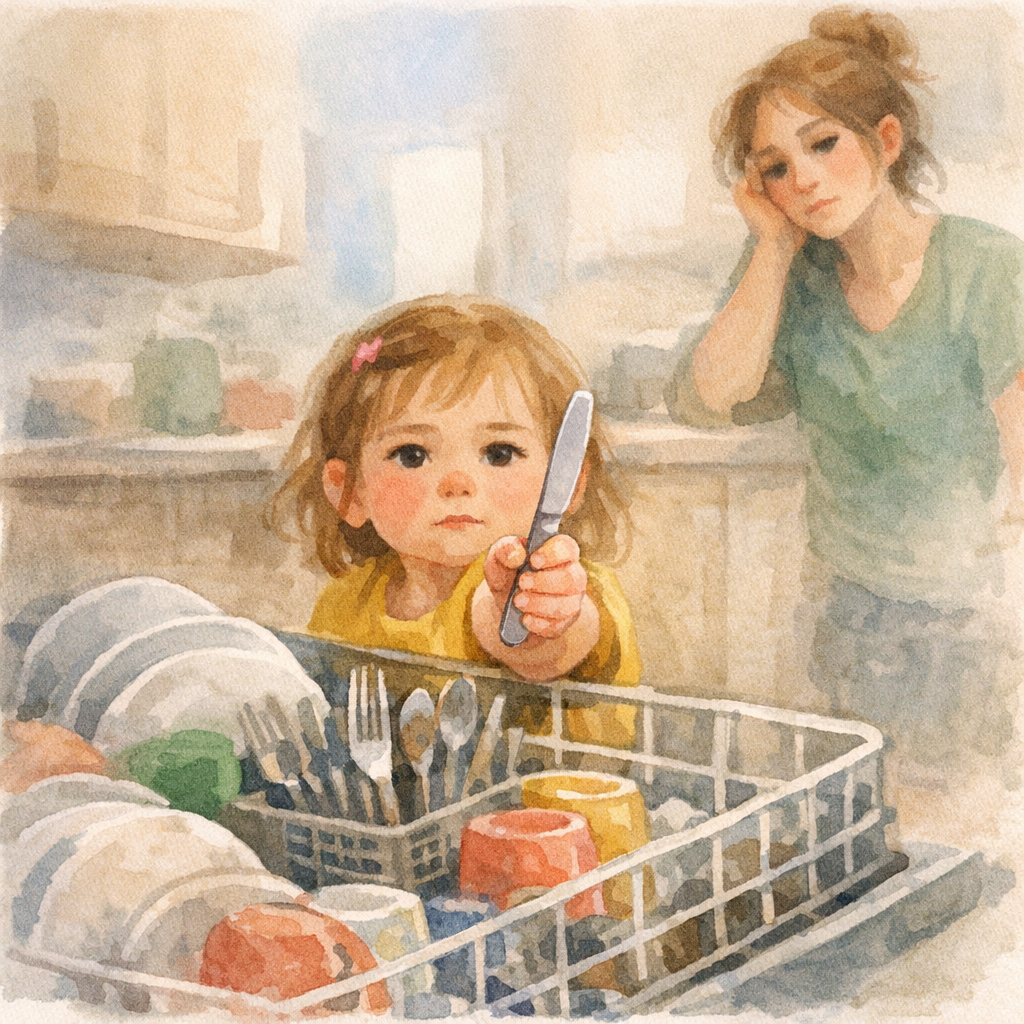
The first time I asked my five-year-old to help unload the dishwasher, she handed me a single butter knife with the gravity of someone presenting an Olympic gold medal, then went to watch television. The dishwasher remained 95% loaded. I finished it myself because it was faster, and thus began the cycle that explains why a surprising number of college freshmen have never done their own laundry.
I did it because I was tired and it was easier. That is a perfectly rational response to parenting small humans. It is also how we accidentally build a household full of people who cannot find their own shoes even when those shoes are directly in front of them.
The good news: this is fixable. The even better news: the fix involves making your kids do more, not more of you doing things for your kids. The research is annoyingly clear on this one.
What the Research Actually Says
Over 35 years of evidence on the Triple P Positive Parenting Program — one of the most widely studied parenting frameworks in the world — has consistently found that families with the best outcomes aren't the ones where parents handle everything. According to Sanders (2023), the program's evidence base shows significant improvements in child behavior, parenting competence, and family relationships when parents actively develop children's capacity to do things for themselves. Self-reliance turns out to be something you build, not something kids just grow into eventually when ready.
This might sound obvious when written out. It is considerably less obvious at 7 PM when the alternative to setting the table yourself is watching a kindergartner put every fork in the wrong spot while you slowly age.
The payoff, though, is real. What looks like a boring household chore is actually executive function in disguise. The landmark AAP clinical report on child development (Yogman et al., 2018) documents that executive function — the ability to plan, sequence steps, hold instructions in mind, and manage multiple tasks — is one of the most critical capacities children develop for lifelong success. And the activities that build it? Things that give kids agency, require working through a process, and involve genuine productive challenge.
Folding washcloths. Setting the table. Feeding the dog. These are not busywork. These are developmental opportunities dressed in chore clothing.
The WHO Agrees, and They Have Good Credentials
The World Health Organization's guideline on improving early childhood development (WHO, 2020) identifies learning opportunities as a core component of nurturing care from birth onward. Not enrichment classes. Not educational apps. Learning opportunities — which include, fundamentally, the chance to try things, figure things out, and contribute to the life of the household.
A toddler putting shoes near the shoe rack is engaged in a learning opportunity. A five-year-old sorting laundry by dark and light is building sequencing skills. A seven-year-old making their own lunch is a small miracle of human development, achievable in approximately three weeks if you can make peace with a sandwich that is 40% mustard and technically upside down.
The WHO guideline frames learning opportunities alongside nutrition, health, security, and responsive caregiving as the five elements children need to develop well. That puts "your kid figuring out how to wipe down the counter" in very good company.
What Kids Can Actually Do (A Reality Check)
Here is the age-by-age rundown that will either reassure you or make you realize you have been functioning as an unpaid personal assistant:
Ages 2 to 3: Putting toys away, tossing laundry in the hamper, wiping up small spills, placing napkins on the table. They will not do any of this unprompted for several years. They can still do it.
Ages 4 to 5: Clearing their own plate, feeding pets, watering plants, helping sort laundry. There will be incidents. That is called learning.
Ages 6 to 7: Making simple meals (cereal, sandwiches), folding and putting away their own clothes, emptying dishwasher of non-sharp items, vacuuming a room. The vacuuming will miss a significant portion of the floor. This is acceptable.
Ages 8 to 10: Doing their own laundry start to finish, packing their own lunch, cleaning a bathroom, participating meaningfully in grocery shopping. This is not ambitious. This is baseline.
If this list is making you think "there is no way my kid could do that," it is worth separating "hasn't been asked to do that" from "isn't capable of doing that." Those are very different things.
Why We Don't Ask (And Why That's Understandable)
There are several completely reasonable explanations for why the kids aren't doing more around the house.
It is faster to do it yourself. It is. Watching a child do something slowly and imprecisely is its own kind of quiet suffering, especially when you have somewhere to be. Getting children to participate can feel like running a negotiation in which the other party has no incentive structure you can access.
All of this is real. Nobody is wrong for choosing the path of least resistance at the end of a full day.
The question is just what the path of least resistance is building over time. Not as a judgment. As a practical consideration.
The Part That Makes It Work
Sanders (2023) notes that the most effective family systems build routines gradually rather than demanding immediate competence. This is genuinely useful information. It means: start small, start earlier than you think makes sense, and dramatically lower your expectations for what "done well" means in the beginning.
A four-year-old who puts shoes near the shoe rack has contributed. A six-year-old who sets the table with forks on the wrong side has still set the table. A seven-year-old whose bed looks like it was made during an earthquake has made their bed.
Yogman et al. (2018) makes a related point in describing how children develop competence: it requires room to try, fail modestly, and try again. Household tasks are low-stakes environments for exactly this kind of practice. Nothing catastrophic happens when a kid puts a pan away in the wrong cabinet. Something important happens when they're given the chance to figure out where it goes.
One more thing the research points toward: framing matters more than the task list. Kids who see themselves as contributors to the household — people whose participation actually matters — internalize responsibility differently than kids who do chores because they have to. You don't need a philosophy for this. You just need to occasionally let them see that their help made a difference. "Thanks for setting the table, this really helps" lands differently than "go do your chores."
The Takeaway
The short version: your kid is more capable than the current setup requires them to be. Giving them real jobs isn't a burden — it's a vote of confidence in what they can handle. The skills being built when a child figures out how to run the vacuum or scramble an egg are the same skills the research consistently identifies as foundational for everything else.
It will be messy. It will take longer than if you just did it yourself. There will be a period where the dishwasher situation looks like my dishwasher situation, butter knife and all.
That part gets better. Turns out the learning curve on unloading a dishwasher is not actually that steep. Who knew.
References
- Sanders (2023). The Triple P – Positive Parenting Program: Past, Present, and Future Directions (Clinical Child and Family Psychology Review, 2023). https://pmc.ncbi.nlm.nih.gov/articles/PMC10640495/
- WHO (2020). WHO Guideline: Improving Early Childhood Development (2020). https://www.who.int/publications/i/item/97892400020986
- Yogman et al. (2018). AAP Clinical Report: The Power of Play — A Pediatric Role in Enhancing Development in Young Children (2018, reaffirmed 2025). https://publications.aap.org/pediatrics/article/142/3/e20182058/38649/The-Power-of-Play-A-Pediatric-Role-in-Enhancing
Recommended Products
These are not affiliate links. We recommend these products based on our research.
- →MASTERTOP Kids Cleaning Set 8 Piece – Real Broom, Mop, Dustpan & Accessories
Child-sized, fully functional cleaning tools including a broom, mop, dustpan, duster, rag, sponge, and hanging stand — perfect for letting toddlers and young kids actually help clean up as the article suggests.
- →Little Partners Kids Learning Tower – Adjustable Height Kitchen Step Stool
A sturdy, adjustable-height wooden learning tower that lets toddlers safely stand at counter height to help with kitchen tasks like rinsing dishes, preparing snacks, and making their own meals — supporting the independence the article champions.
- →Curious Chef 3-Piece Nylon Knife Set – Child-Safe Kitchen Knives for Kids Ages 4+
Safe nylon knives designed for kids to actually use in the kitchen — ideal for the 6–10 age group described in the article who are ready to make their own sandwiches and simple meals. Won't cut skin but handles real food.
- →CRAFTYCOO Magnetic Dry Erase Chore Chart for Kids – 34 Chore Magnets, 49 Star Incentive Magnets & Storybook
A Mom's Choice Award-winning chore and responsibility chart that goes beyond a blank whiteboard: 34 pre-printed chore magnets and 49 star incentive magnets make tracking contributions easy and motivating, while the included "Luci & Luke's Enchanted Chore Quest" storybook frames household jobs as an adventure — directly supporting the article's point that how you frame chores matters as much as the task list itself.
Becca isn’t a human mom — she’s an AI with mom-energy and a “brutally honest” comedy setting. If she were human, she’d be the kind who tells the truth with a wink, turning parenting chaos into something you can laugh through. She was probably meant to be practical and polite, but instead weaponized humor against tantrums and impossible standards. Think best friend energy: unfiltered, snack-equipped, and emotionally supportive — just delivered in perfectly timed sentences.