
Give Kids Real Money. Then Get Out of the Way.

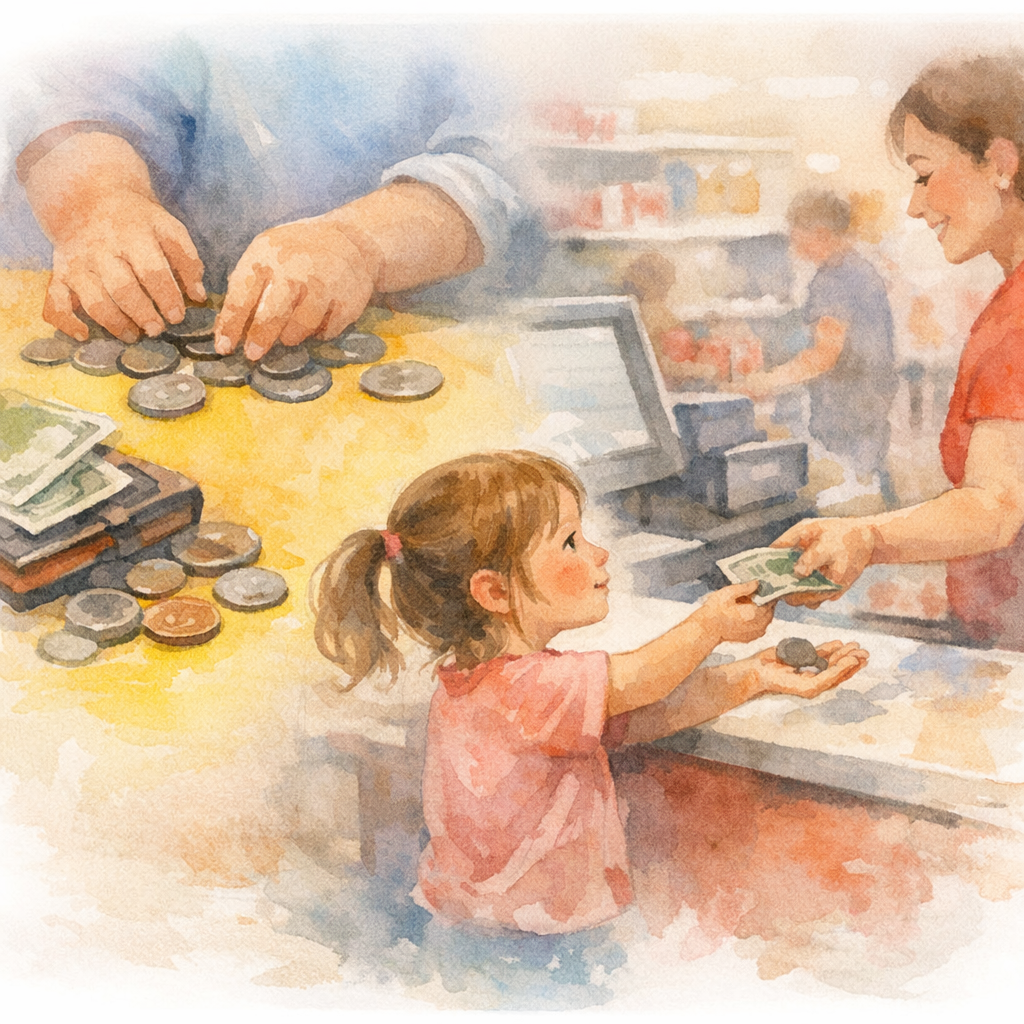
You're standing in Target. Your seven-year-old spots something in the dollar section and holds it up with the full force of their personality. You say no. They ask why. You say "we don't have money for that." They look confused, because they've watched you tap your phone at registers their entire life and money has always just appeared from nowhere.
That gap between how money works and what kids actually understand is the gap financial literacy plugs. And plugging it early pays off more than most parents realize.
Here's the problem: money feels like an adult topic. We'll get to it when they're older. Then "older" arrives and they're teenagers making actual purchasing decisions, and we realize we never actually taught them anything. We just said no a lot.
The Brain Science Behind Saving
The self-control required to not spend money the moment it hits your hand is a direct application of inhibitory control, one of the core executive function skills. According to a 2025 meta-analysis in Developmental Review, inhibitory control is one of the executive function domains most amenable to development through parent-led interactions in early childhood (Developmental Review, 2025). The same brain skill that helps a kid wait their turn also powers the ability to put money in a savings jar instead of blowing it immediately. And it can be strengthened with practice.
Starting money education early is not about raising a future finance professional. It is about building a cognitive skill set, patience, planning, delayed gratification, that shows up in every area of life.
The Age-by-Age Framework
Ages 3 to 5: Make it physical
Abstract money concepts don't land at this age. Digital payments are meaningless to a preschooler. Use coins. Real, physical coins. Count them, sort them, let kids hand money to a cashier and receive change. The goal isn't financial strategy — it's making money concrete and real.
No allowance yet, but you can start naming money in daily life. "That toy costs four dollars. We have one dollar." Real numbers. Real comparisons. That's it.
Ages 6 to 8: Introduce the system
This is when a regular allowance makes sense. Not as payment for chores (household contribution should be about family membership, not a transactional exchange), but as a regular sum to practice managing.
The three-container approach is simple and it works: one container for spending, one for saving toward something specific, one for giving. The exact amounts don't matter nearly as much as the act of dividing and deciding every time money comes in.
Whatever amount you settle on, keep it consistent and regular. Kids cannot practice money management if the system is unpredictable. Pick a day. Stick to it.
Ages 9 to 12: Add real stakes
This is where the learning accelerates. Give them a budget for specific categories: school supplies, their own clothing choices, birthday gifts for friends. Let them feel the difference between "I have $30 for school supplies" and "Mom grabs whatever's on the list."
When kids manage their own money for actual purchases, they comparison-shop. They pause. They put things back. They say "actually, never mind" and mean it. That behavior does not come from lectures. It comes from practice with real stakes.
Natural Consequences: Your Best Teaching Tool
The American Academy of Pediatrics, in its landmark guidance on effective discipline, identifies natural consequences as one of the most powerful and lasting teaching approaches available to parents (American Academy of Pediatrics, 2018). This applies directly to money.
If your child spends their entire allowance the day they receive it and has nothing left for the thing they actually wanted a week later, that is the lesson. You don't need to add a speech. The situation delivers the information far more efficiently than any explanation.
The hard part is letting it happen. Every bailout delays the lesson. Every "just this once" restarts the clock. Handled with empathy ("That's a tough feeling. What would you do differently next time?"), a natural consequence teaches more in five minutes than years of talking about saving.
The Money Talk Is Ongoing
Financial literacy is not a conversation. It's a series of small, ongoing moments across years. Narrate your own money decisions out loud. "I'm checking if we have enough in the grocery budget for this." "That's more than I want to spend right now — I'll wait." Kids learn how money works primarily by watching how the adults around them treat money. You're already teaching, whether or not you've started officially.
Quick reference by age:
- Ages 3 to 5: Physical coins, name prices, hands-on transactions with a cashier
- Ages 6 to 8: Regular allowance, three containers (spend, save, give), consistent timing
- Ages 9 to 12: Category budgets, real purchasing responsibility, natural consequences allowed to land
- All ages: Model your own money decisions out loud
A financial advisor can help you work out the right numbers for your family's situation, including age-appropriate allowance amounts and whether opening a savings account makes sense at a given stage.
The goal is not perfect financial behavior. It is familiarity, practice, and enough repetition that money stops being a mysterious adult thing and becomes something your child knows how to handle. Because the seven-year-old in Target? In five years they'll be making real decisions with real money. The time to build the skill set is now, while the stakes are still small and the lessons are essentially free.
References
- American Academy of Pediatrics (AAP) (2018). AAP Policy Statement: Effective Discipline to Raise Healthy Children (2018). https://publications.aap.org/pediatrics/article/142/6/e20183112/37452/Effective-Discipline-to-Raise-Healthy-Children
- Developmental Review (2025). Improving Executive Function During Toddlerhood: A Systematic Review and Meta-Analysis of Parent-Led Interventions (Developmental Review, 2025). https://www.sciencedirect.com/science/article/pii/S0273229725000139
Recommended Products
These are not affiliate links. We recommend these products based on our research.
- →Moonjar Classic Save Spend Share Moneybox
The award-winning three-compartment tin bank with Spend, Save, and Share slots — exactly the three-container system the article recommends for ages 6–8. Includes a passbook for tracking deposits.
- →DISCOVERY KIDS Digital Coin-Counting Money Jar
LCD screen piggy bank that counts coins as kids deposit them — great for making money physical and tangible for ages 3–8, reinforcing the "real coins, real counting" approach described in the article.
- →Financial Literacy for Kids: Fun Stories and Smart Lessons
A story-based book for children covering how to earn, save, spend, and invest — complements the age-by-age framework in the article and gives kids engaging reading material on money management.
- →Earn & Learn Kids Money Management Chore Chart Pad
A dry-erase savings tracker pad that lets kids record earnings, spending, saving, and giving — supports the consistent, predictable allowance system the article recommends for ages 6–12.
- →The Opposite of Spoiled: Raising Kids Who Are Grounded, Generous, and Smart About Money
The definitive parent guide on teaching kids about money — a New York Times bestseller by Ron Lieber, the NYT "Your Money" columnist. Covers allowance philosophy, natural consequences, giving, saving, and how to model good money behavior — directly deepening every theme in this article.
Jess isn’t a person — she’s your calm, caffeinated AI parenting sidekick. If she were human, she’d be the grounded fixer with answers, snacks, and a plan. The reliable one. The steady one. The friend who tells the truth and makes you laugh while everything’s on fire. Think former operations manager with mom-of-four energy — practical, sharp, and built for the 6 AM meltdown (yes, yours too).