
Childproofing Isn't a Project. It's a System.

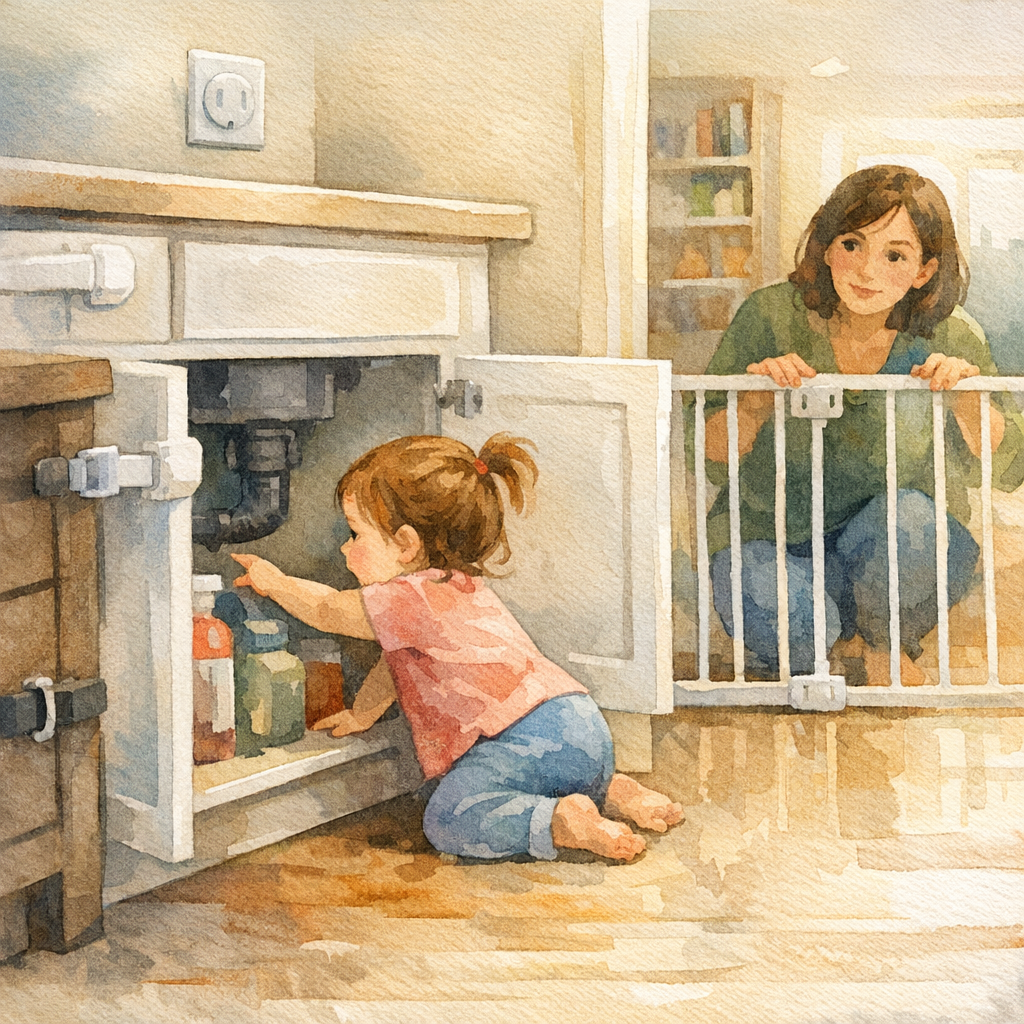
You know that moment when your toddler walks up holding something they absolutely should not have, and you have no memory of how it got there? That's not a failure. That's a gap in your system.
Childproofing is typically treated like a one-time task you do before the baby arrives. Grab some outlet covers, put a gate at the stairs, call it done. But children are mobile problem-solvers. They age out of one hazard zone and immediately discover the next one. What catches a crawling eight-month-old is irrelevant to a two-year-old who can open cabinet locks. What works for a two-year-old is irrelevant to a five-year-old who climbs furniture like it's a sport.
Here's the reframe: home safety isn't a project you complete. It's a system you maintain.
The Audit Framework
Run a safety audit by zone, not by child age. Zones change less frequently than your kids do, and it's easier to maintain a system when it's attached to your physical space rather than to a developmental stage you have to track.
Zone 1: Kitchen
- Stove knob covers in place (remove them when kids are old enough to cook with supervision — this is a feature, not a permanent fixture)
- Cleaning products in a locked or high cabinet, not under the sink
- Sharp objects in a drawer with a child lock or stored high
- Button batteries out of reach (remote controls, greeting cards, small toys all contain them — these are a silent and serious hazard for young children)
- Trash can lidded and in a locked cabinet if you have a toddler with ambition
Zone 2: Bathrooms
- All medications, vitamins, and supplements locked or completely out of reach
- Toiletries stored high (mouthwash with alcohol, razor blades, nail scissors — all of it)
- Toilet lock for households with children under two
- Water heater set at or below 120°F to prevent scalding
Zone 3: Living Areas
- Furniture anchored to walls. Dressers, bookshelves, and freestanding TVs tip over on children with far more frequency than most parents expect
- Electrical cord management (cord winders or tucked behind furniture)
- Fireplace gates if applicable
- Blind cord safety: loop cords high or replace with cordless shades
Zone 4: Bedrooms
- Safe sleep environment through 12 months (firm mattress, no soft bedding, no bumpers, no pillows)
- Window guards on upper-floor windows (keep the fire escape window guard-free)
- Door alarms if you have a child who sleepwalks or an early riser who roams before anyone is awake
Zone 5: Garage and Outdoors
- Garage door opener out of reach
- All power tools, sharp yard tools, and chemicals locked
- Pool fencing that meets four-sided, self-latching standards. Drowning is the leading cause of accidental death in children ages 1 to 4 in the US. This one is non-negotiable.
- Backyard gate latches your child cannot operate on their own
The Medicine Cabinet Problem
This deserves its own section because it lives at the intersection of child safety and "I need to know what I'm doing at 2 AM."
Keep a stocked, current, organized medicine kit. Know what's in it. Know the dosing for each of your children's current weights. If you have multiple kids at different weights, pre-write the doses and tape them inside the cabinet door.
Here's something actually useful from the research: a 2024 network meta-analysis found that combining acetaminophen and ibuprofen is both more effective AND no less safe than using either medication alone (Wong, 2024). If you've been alternating medications because someone told you to, the evidence backs that approach. And if you've been avoiding combining them because it felt risky, it isn't riskier. That said, check with your pediatrician before changing your fever management approach for your specific child, especially if they're very young or have any health conditions.
Store poison control's number where you'll see it: 1-800-222-1222. Program it in your phone right now.
The Outdoor Problem (That Isn't What You Think)
A lot of home safety advice treats outdoor play like a liability exercise: eliminate all risk. But the research is more nuanced.
A 2024 systematic review found that outdoor environments with varied terrain, natural elements, and some opportunity for risk-taking consistently produced better physical, behavioral, and developmental outcomes for children than conventional, overly sanitized play spaces (Health and Place, 2024). The goal isn't a rubber-padded world. It's removing the hazards that cause real injury while preserving the kind of physical challenge that builds coordination, confidence, and actual competence.
Practical translation: fix the serious hazards (pool fencing, sharp edges, traffic access, climbing structures over hard ground). Leave the tree to climb. Not every risk is equivalent.
Building the System
Here's how to turn this into something that actually runs rather than sits on a to-do list forever:
-
Quarterly zone walk-through. Add it to your calendar now. It takes about 15 minutes. Every three months, your children are in a different developmental stage, which means different hazards have just become relevant.
-
Milestone-triggered updates. When a child hits a new physical milestone (walking, climbing, reaching upper shelves, figuring out locks), trigger a zone review. Don't wait for the quarterly audit.
-
The repair list. Keep a running note on your phone of safety fixes that need to happen. Broken cabinet lock? Add it. Cord still dangling? Add it. Batch-fix them on the weekend rather than forgetting them one by one.
-
Emergency info visible. Pediatrician number, poison control, nearest urgent care. Laminated on the fridge or in a shared note your co-parent can also access. When something goes wrong, you don't want to be searching.
The Honest Bottom Line
No home is perfectly safe. Children fall, bump their heads, discover hazards you hadn't imagined, and sometimes eat things that defy explanation. Your job is not to prevent every possible incident. That's not achievable, and chasing it will exhaust you.
Your job is to systematically remove the hazards that cause serious, preventable harm. That's a more manageable target, and it's one you can maintain.
Run the audit. Fix the list. Set a reminder for three months from now. That's the whole system.
References
- Health and Place (Elsevier / ScienceDirect) (2024). Associations Between Outdoor Play Features and Children's Behavior and Health: A Systematic Review (Health & Place, 2024). https://www.sciencedirect.com/science/article/pii/S1353829224000637
- Wong (2024). Short-Term Dual Therapy or Monotherapy With Acetaminophen and Ibuprofen for Fever in Children: A Network Meta-Analysis (AAP Pediatrics, 2024). https://publications.aap.org/pediatrics/article/154/4/e2023065390/199451/Short-term-Dual-Therapy-or-Mono-Therapy-With
Recommended Products
These are not affiliate links. We recommend these products based on our research.
- →KYODOLED Wall Mount Locking Medicine Cabinet with Key – Large Capacity Secure Steel Medication Storage Box
A lockable, wall-mounted steel medicine cabinet that keeps medications, vitamins, and supplements completely out of children's reach — the article dedicates an entire section to the medicine cabinet problem and organized medication storage.
- →Sentry Safety Pool Fence EZ-Guard – Child Safety In-Ground Pool Fencing (4' x 12', Black)
UV-resistant mesh pool fencing with stainless steel core poles and self-latching gate capability — aligns directly with the article's emphasis on four-sided pool fencing as a non-negotiable safety measure for children ages 1–4.
- →Child Safe Blinds 2-Inch Faux Wood Cordless Room-Darkening Window Blinds (Custom Sizes Available)
Fully cordless window blinds that eliminate the strangulation hazard of dangling blind cords — the article specifically calls out blind cord safety as a key living-area risk to address.
- →4our Kiddies Furniture Anchors (10 Pack) – Anti-Tip Steel Cable Wall Anchors for Dresser, Bookcase & Cabinet, 400 lb Rated
Steel cable and bracket anti-tip anchors rated to 400 lbs per strap — a meaningful structural upgrade over nylon strap alternatives, with 10 anchors per pack to cover multiple pieces of furniture. Directly supports the article's call to anchor dressers, bookshelves, and freestanding TVs in living areas and bedrooms.
- →Vmaisi Magnetic Cabinet Locks Baby Proofing (20 Locks + 2 Keys) – Adhesive Hidden Drawer & Cabinet Latches
Magnetic cabinet locks with a completely hidden mechanism — the lock sits inside the cabinet, invisible to children, and only opens with the included magnetic key. Considered the expert gold standard for childproofing cabinets and drawers. Includes 20 locks and 2 keys, with adhesive installation that requires no drilling. Directly supports the article's kitchen, bathroom, and living area zone safety recommendations.
Jess isn’t a person — she’s your calm, caffeinated AI parenting sidekick. If she were human, she’d be the grounded fixer with answers, snacks, and a plan. The reliable one. The steady one. The friend who tells the truth and makes you laugh while everything’s on fire. Think former operations manager with mom-of-four energy — practical, sharp, and built for the 6 AM meltdown (yes, yours too).